Exploring the Meaning of Hopos in Greek
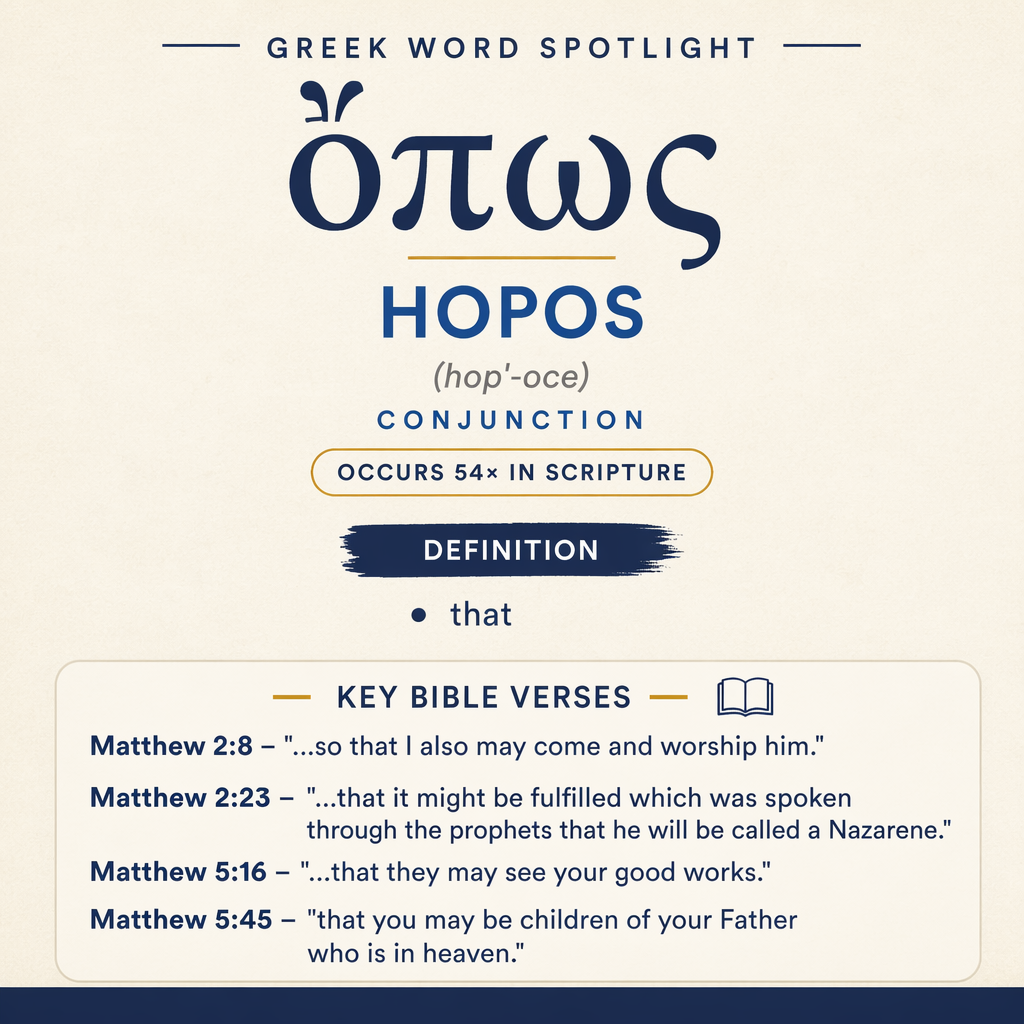
ὅπως means “that” and occurs 54 times in Scripture, including Matthew 2:8, 2:23, 5:16, 5:45, 6:2, 6:4, 6:5, and 6:16.
Sample Occurrences
Matthew uses ὅπως in places like Matthew 2:23 and 5:16. Additional examples include Matthew 6:2, 6:4, 6:5, and 6:16.
Learn More →ὅπως expresses a forward-looking “that,” introducing what is aimed at, expected, or brought about in a given action or situation. In the passages below it links speech, conduct, and events to an intended or resulting outcome.
Occurrences
Matthew 2:8 — “He sent them to Bethlehem, and said, “Go and search diligently for the young child. When you have found him, bring me word, so that I also may come and worship him.””
Here ὅπως connects Herod’s instruction to its projected endpoint. The searching and reporting are ordered “that” a further step may follow: “I also may come and worship him.” The conjunction makes the requested report function as the hinge between the Magi’s search and Herod’s stated plan.

Matthew 2:23 — “and came and lived in a city called Nazareth; that it might be fulfilled which was spoken through the prophets that he will be called a Nazarene.”
In this narrative conclusion, ὅπως ties relocation (“lived in a city called Nazareth”) to a fulfillment outcome. The clause introduced by “that” frames the move as serving the realization of what “was spoken through the prophets,” presenting the settlement as oriented toward that fulfillment.
Matthew 5:16 — “Even so, let your light shine before men; that they may see your good works, and glorify your Father who is in heaven.”
ὅπως links a public action (“let your light shine before men”) with the intended response it is meant to elicit: sight and praise. The “that” clause holds together two resulting acts—“see your good works” and “glorify your Father”—as the outcome toward which visible conduct is directed.
Matthew 5:45 — “that you may be children of your Father who is in heaven. For he makes his sun to rise on the evil and the good, and sends rain on the just and the unjust.”
Here ὅπως introduces a purpose/outcome statement that frames the preceding ethic in terms of identity: “that you may be children of your Father who is in heaven.” The explanation that follows (“For he makes his sun to rise… and sends rain…”) grounds the “that” clause in God’s indiscriminate beneficence, so the aimed-at result is likeness to the Father expressed in the same generous pattern.
Matthew 6:2 — “Therefore when you do merciful deeds, don’t sound a trumpet before yourself, as the hypocrites do in the synagogues and in the streets, that they may get glory from men. Most certainly I tell you, they have received their reward.”
ὅπως marks the motive attributed to the hypocrites’ display. The public trumpet-sounding is portrayed as conducted “that” they may achieve a particular social outcome: “get glory from men.” By placing this aim in a dependent clause, the sentence exposes the action as instrumentally chosen for that reward.
Matthew 6:4 — “so that your merciful deeds may be in secret, then your Father who sees in secret will reward you openly.”
In contrast to the prior verse, ὅπως ties a manner of giving to a different desired setting and evaluation. Doing merciful deeds without announcement is urged “so that” the deeds “may be in secret,” and the verse then points to a further consequence: the Father who sees “will reward you openly.” The conjunction thus frames secrecy as the intended condition under which the deeds are to occur.
Matthew 6:5 — ““When you pray, you shall not be as the hypocrites, for they love to stand and pray in the synagogues and in the corners of the streets, that they may be seen by men. Most certainly, I tell you, they have received their reward.”
Again ὅπως introduces the objective behind a public religious posture. Standing to pray in prominent places is described as chosen “that they may be seen by men.” The conjunction draws attention away from prayer as communion with God and toward visibility as the targeted result, which is then labeled their completed “reward.”
Matthew 6:16 — ““Moreover when you fast, don’t be like the hypocrites, with sad faces. For they disfigure their faces, that they may be seen by men to be fasting. Most certainly I tell you, they have received their reward.”
ὅπως functions similarly in the sphere of fasting. The altered appearance (“disfigure their faces”) is performed “that” an audience may perceive the practice: “be seen by men to be fasting.” The clause makes the visible sign the sought-after endpoint, reinforcing the critique that the social notice itself constitutes the reward they pursued.
Matthew 6:18 — “so that you are not seen by men to be fasting, but by your Father who is in secret, and your Father, who sees in secret, will reward you.”
Here ὅπως introduces an intentionally negative outcome: “so that you are not seen by men to be fasting.” The verse then sets an alternative direction—being “by your Father who is in secret”—and attaches divine recompense to that hiddenness. The conjunction frames the practice as structured toward avoiding one kind of perception and living under another.
Matthew 8:17 — “that it might be fulfilled which was spoken through Isaiah the prophet, saying, “He took our infirmities, and bore our diseases.””
ὅπως again serves a fulfillment frame, this time following a summary of healing activity. The “that” clause presents what happens as oriented toward fulfillment, and it culminates in a quoted statement describing the bearing of infirmities and diseases. The conjunction highlights the movement from event to fulfillment, making the healings read as coordinated with that prophetic saying.
Matthew 8:34 — “Behold, all the city came out to meet Jesus. When they saw him, they begged that he would depart from their borders.”
In this reaction scene, ὅπως links the city’s plea with its requested outcome. The people “begged that he would depart from their borders,” so the conjunction introduces the content and aim of their petition: not merely an expression of emotion, but a directed request for Jesus’ departure.
Matthew 9:38 — “Pray therefore that the Lord of the harvest will send out laborers into his harvest.”
ὅπως introduces the specific object of prayer. The imperative “Pray therefore” is immediately oriented “that the Lord of the harvest will send out laborers into his harvest,” defining the intended result to be sought. The conjunction makes the prayer’s content explicitly goal-directed toward the sending.

Sense and Usage
Across these passages ὅπως functions as a connector that turns actions, commands, and requests into purposeful sequences. In Matthew 2:8 it links a report to a planned follow-up (“bring me word, so that I also may come and worship him”), and in Matthew 8:34 it introduces the outcome sought by a community’s plea (“begged that he would depart”). In these cases the conjunction makes speech acts concrete by attaching them to a desired end.
In Matthew 5:16 and 5:45, ὅπως attaches ethical instruction to an envisioned result. The “light” is to shine “that” observers may respond with seeing and glorifying, and the pattern of the Father’s sun and rain frames conduct “that you may be children of your Father who is in heaven.” The conjunction therefore helps present discipleship not as isolated acts but as acts oriented toward a recognizably framed outcome: public glorification of the Father, and lived resemblance to him.
Matthew 6:2, 6:5, and 6:16 use ὅπως to expose the target of hypocritical behavior: glory, being seen, and being recognized as fasting. The conjunction draws a line from external display to the human audience as the intended payoff. By contrast, Matthew 6:4 and 6:18 deploy ὅπως to define secrecy and the avoidance of public notice as the aimed-at condition, with the Father’s seeing and rewarding following from that hidden posture. In this cluster the same “that” structure becomes a diagnostic tool: it reveals what outcome a practice is really designed to secure.
Finally, Matthew 2:23 and 8:17 show ὅπως in fulfillment statements, binding an event (dwelling in Nazareth; healings associated with infirmities and diseases) to the realization of what was spoken. Here ὅπως gives narrative developments a teleological shape: events are presented as moving toward fulfillment, not merely happening in sequence.
Imagery in Context
The repeated “that” clauses create a consistent sense of motion toward an endpoint: a journey and message meant to enable a visit (Matthew 2:8), a settlement presented as serving fulfillment (Matthew 2:23), light shining toward seen works and glorified Father (Matthew 5:16), and prayers directed toward a sending into a harvest (Matthew 9:38). Even the negative examples retain the same forward pull—actions performed “that they may be seen”—so that motives and outcomes become visible within the sentence itself (Matthew 6:5; Matthew 6:16).
Sources: Lexical data from Strong’s Exhaustive Concordance and the Translators Brief Lexicon of Extended Strongs for Greek (STEPBible, CC BY). Occurrence data from the Translators Amalgamated Greek New Testament (STEPBible, CC BY). Scripture quotations from the World English Bible (public domain).