
Exploring the Meaning of Homoiosis in Greek
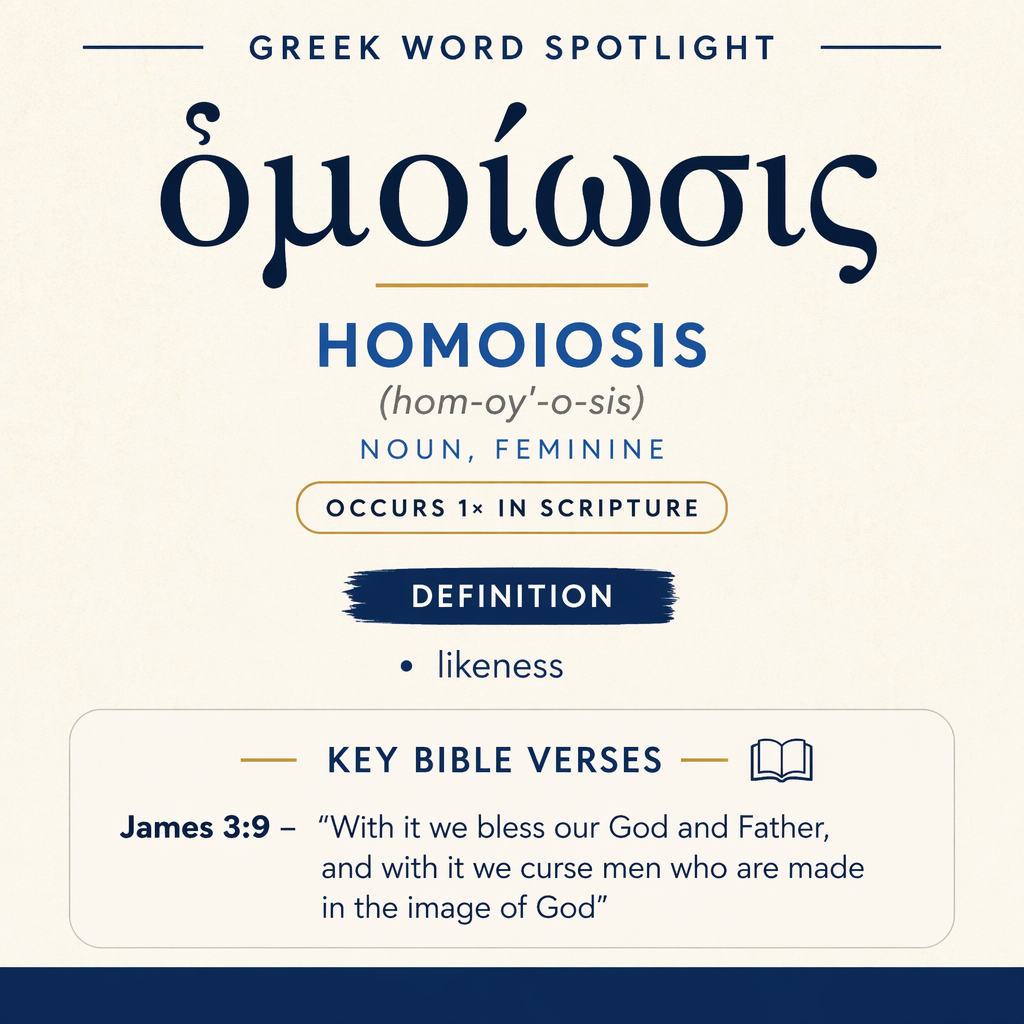
ὁμοίωσις (Homoiosis) means “likeness” and appears once in Scripture, in James 3:9.
Scripture Occurrence
This word occurs 1 time in Scripture. Its single occurrence is in James 3:9.
Learn More →James 3:9 Context
In James 3:9, it relates to men made in the image of God, whom the tongue can bless or curse.
Learn More →ὁμοίωσις means “likeness” and appears once in the New Testament, in James 3:9. In that setting it belongs to James’s moral diagnosis of the tongue’s contradictory speech toward God and toward human beings.
Root and Related Words
homoioō (ὁμοιόω), “to liken” (Strong’s G3666), stands behind ὁμοίωσις as its related verbal form. The noun expresses the resulting state or quality that corresponds to that verbal action.

Occurrences
“With it we bless our God and Father, and with it we curse men who are made in the image of God.” (James 3:9)
In James 3:9, ὁμοίωσις (“likeness”) supplies the grounding for why cursing people is so morally incongruent with blessing “our God and Father.” James places two uses of the tongue side by side—“we bless” and “we curse”—and then identifies the object of the cursing as “men who are made in the image of God.” The word “likeness” functions here as a decisive link between God and the people being cursed: the persons targeted by harmful speech bear a likeness connected with God, so speech directed at them cannot be treated as ethically detached from speech directed toward God.

Within the single sentence, the logic moves from actions (blessing, cursing) to identity (“our God and Father,” “men”) and then to a defining description of humanity (“made in the image of God”). ὁμοίωσις, translated here with the thought of “image,” marks that description as more than a social label: it is a creational marker that reaches beyond individual worth to a relational reference point—God Himself. James’s argument does not merely condemn cursing as a general vice; it exposes a contradiction: the same instrument (“With it…with it”) is used to address God with reverence and then to address humans with contempt, even though those humans stand in a likeness that points back to God.
The placement of the likeness-language at the end of the verse gives it rhetorical weight. After naming the two opposing speech-acts, James adds the reason the second act is especially out of step: the people cursed are characterized by their being “made” in relation to God. This makes ὁμοίωσις part of an ethical syllogism embedded in the sentence: if the tongue blesses God, it ought not to curse those whose existence is marked by likeness to God. The term therefore contributes to the verse not as a decorative theological aside, but as the premise that makes the contradiction stark and personal.
Sense and Usage
The sense “likeness” in James 3:9 is concrete and relational rather than abstract or purely metaphorical. It signals resemblance in a way that matters for conduct: the moral issue James presses depends on the reality that human beings are “made” with reference to God, so their identity carries a likeness that must be respected in how they are spoken to and about. In this context, “likeness” is not used to measure degrees of similarity or to compare two unrelated things; it functions as a categorical descriptor of what humans are in relation to God.
Because ὁμοίωσις appears in a context of speech ethics, its force is felt in how words travel along lines of relationship. James does not treat blessing and cursing as merely opposite kinds of sounds; he treats them as actions aimed at personal objects: “our God and Father” on the one hand, and “men” on the other. “Likeness” therefore helps define the kind of object a human being is in this argument—one whose connection to God is sufficiently close that to curse the person is a kind of affront to the One whose likeness the person bears. The term builds a bridge between vertical speech (toward God) and horizontal speech (toward people) by showing that the horizontal target is not isolated from the vertical reference.
In James’s phrasing, likeness is tied to being “made,” which keeps the word anchored in origin and status rather than in achievement or appearance. The verse does not present likeness as something acquired by moral improvement or lost by moral failure; rather, it is bound to what humans are as humans. That anchoring makes James’s critique sharper: the tongue’s inconsistency cannot be excused by redefining the cursed as exceptions; the very category “men” is already described as made in relation to God’s image. Thus ὁμοίωσις carries ethical implications precisely because it is presented as a given reality about human beings.
As a noun, ὁμοίωσις also fits the verse’s emphasis on stable identity. James contrasts fluctuating speech acts—blessing and cursing—against something fixed about their recipients. God’s fatherhood (“our God and Father”) and humanity’s being made in God’s image stand as stable realities, while the tongue toggles between honoring and harming. In that contrast, “likeness” functions as a non-negotiable point of reference: speech is judged not only by tone or intent but by whether it aligns with the reality that humans bear a likeness connected to God.
Imagery
James 3:9 sets “likeness” in the vivid, everyday arena of spoken words. The imagery is simple but searching: a single mouth and tongue can produce both blessing and cursing, directed toward different recipients, yet the recipients are not as disconnected as the speaker may act as though they are. By placing human beings under the description “made in the image of God,” ὁμοίωσις gives the verse a mirror-like quality: how one speaks to people reflects one’s posture toward God, because the people addressed stand in a likeness that points back to Him.
Sources: Lexical data from Strong’s Exhaustive Concordance and the Translators Brief Lexicon of Extended Strongs for Greek (STEPBible, CC BY). Occurrence data from the Translators Amalgamated Greek New Testament (STEPBible, CC BY). Scripture quotations from the World English Bible (public domain).




