
Exploring the Meaning of Homoios in Greek
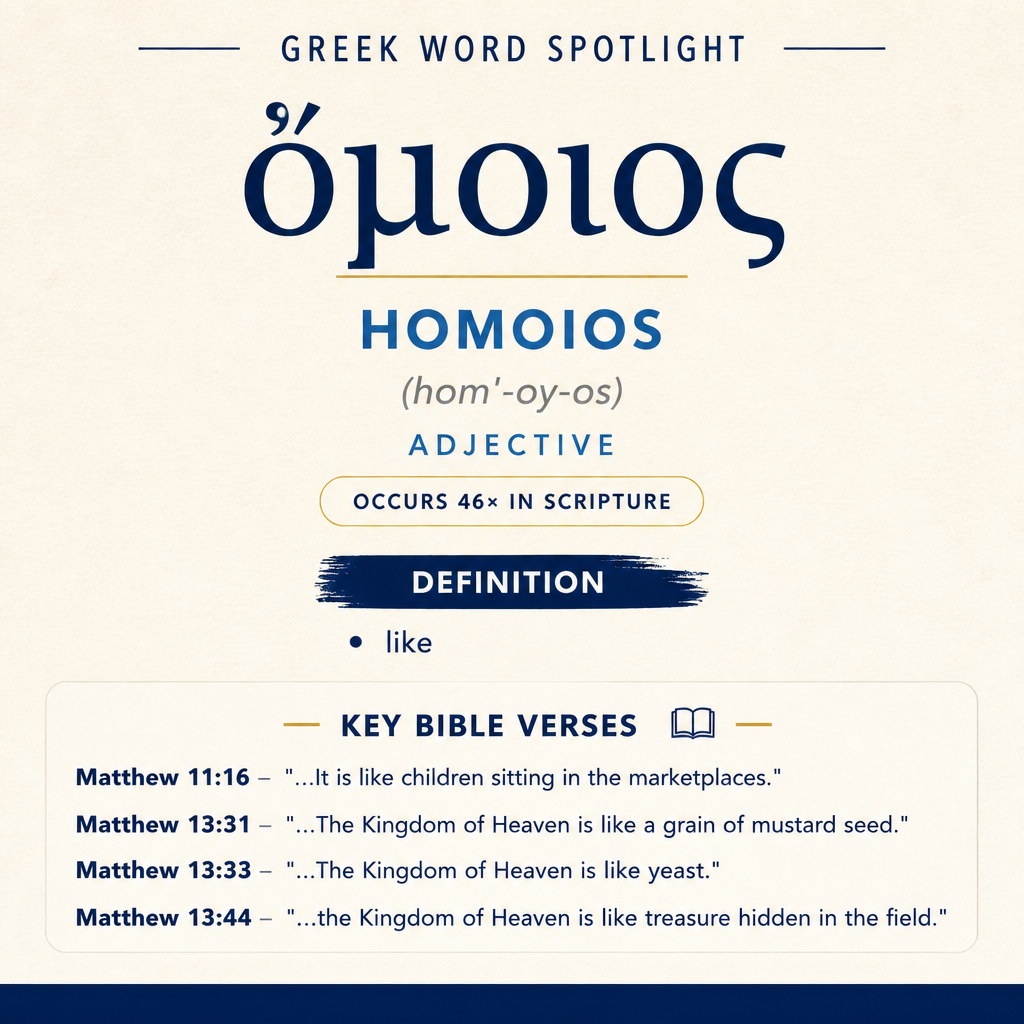
ὅμοιος (Homoios) means “like” and occurs 46 times in Scripture, including Matthew 11:16 and multiple Kingdom of Heaven parables in Matthew 13.
Matthew Examples
In Matthew 11:16, a generation is compared as “like children sitting in the marketplaces.” In Matthew 13 and Matthew 20:1, it introduces parables beginning, “The Kingdom of Heaven is like…”.
Learn More →Parable Framing
Matthew frequently uses ὅμοιος to open illustrations: “The Kingdom of Heaven is like…” Examples include the mustard seed, yeast, treasure, pearls, and a dragnet.
Learn More →ὅμοιος conveys the idea of resemblance (“like”) and appears in sayings and parables where one thing is compared to another so that the listener can grasp a point through a familiar picture. In the passages quoted below, it functions as the hinge that links a present situation (“this generation,” “the Kingdom of Heaven,” a person who hears and does) to a concrete analogy (children in a marketplace, seed, yeast, treasure, and more).
Root and Related Words
Related is the adverb ὁμοῦ (homou), “together” (Strong’s G3674).

Occurrences
“But to what shall I compare this generation? It is like children sitting in the marketplaces, who call to their companions” (Matthew 11:16)
Here ὅμοιος introduces a comparison that frames “this generation” by placing it alongside a recognizable scene: children seated in public space, calling out to others. The adjective supplies the resemblance that makes the comparison work; the generation is presented as matching the character of that marketplace scene, so the listener is invited to interpret the generation through the behavior implied by “children… who call to their companions.”
He set another parable before them, saying, “The Kingdom of Heaven is like a grain of mustard seed, which a man took, and sowed in his field;” (Matthew 13:31)
In this parable ὅμοιος links “The Kingdom of Heaven” to “a grain of mustard seed.” The comparison is not mere decoration: it selects a small, ordinary object and places it beside the Kingdom as a lens for understanding it. The added details—“which a man took, and sowed in his field”—anchor the resemblance in a simple agricultural action, letting the hearer picture the Kingdom in terms of something planted and placed intentionally.
He spoke another parable to them. “The Kingdom of Heaven is like yeast, which a woman took, and hid in three measures of meal, until it was all leavened.” (Matthew 13:33)
Again ὅμοιος joins the Kingdom to a domestic image: “yeast,” handled by “a woman” and “hid in three measures of meal.” The word “like” makes the household process the interpretive frame for the Kingdom. Because the yeast is “hid” and the meal becomes “all leavened,” the resemblance draws attention to an effect that spreads through what it is placed in, portrayed as thorough (“all leavened”) and connected to an initial, specific action (“took, and hid”).
“Again, the Kingdom of Heaven is like treasure hidden in the field, which a man found, and hid. In his joy, he goes and sells all that he has, and buys that field.” (Matthew 13:44)
Here ὅμοιος aligns the Kingdom with “treasure hidden in the field.” The resemblance is then filled out by the man’s sequence of actions: he “found, and hid,” then “in his joy” sells “all that he has” to buy the field. The word “like” positions that story as the chosen parallel to the Kingdom, so that the hearer understands the Kingdom through discovery, concealment, joy, and decisive exchange.
“Again, the Kingdom of Heaven is like a man who is a merchant seeking fine pearls,” (Matthew 13:45)
In this compact comparison, ὅμοιος connects the Kingdom with “a man… a merchant seeking fine pearls.” The resemblance is carried by the merchant’s identity and activity—he is defined as one who seeks. The adjective “like” places the Kingdom alongside the merchant’s purposeful searching, letting that pursuit supply the shape of the parable’s point even before any further detail is given.
“Again, the Kingdom of Heaven is like a dragnet, that was cast into the sea, and gathered some fish of every kind,” (Matthew 13:47)
Here ὅμοιος brings the Kingdom into comparison with “a dragnet” cast into the sea. The net’s action is emphasized: it “gathered some fish of every kind.” The word “like” directs the listener to think of the Kingdom in terms of a gathering instrument whose reach results in an inclusive catch across variety (“every kind”), with the imagery grounded in the concrete motion of casting into water.
He said to them, “Therefore every scribe who has been made a disciple in the Kingdom of Heaven is like a man who is a householder, who brings out of his treasure new and old things.” (Matthew 13:52)
In this saying ὅμοιος does not compare the Kingdom itself, but “every scribe who has been made a disciple in the Kingdom of Heaven.” The resemblance is to “a man who is a householder,” characterized by drawing from stored wealth: “brings out of his treasure new and old things.” The adjective establishes that the disciple-scribe corresponds to this householder in function—someone whose resources are ample enough to produce both “new and old.”
“For the Kingdom of Heaven is like a man who was the master of a household, who went out early in the morning to hire laborers for his vineyard.” (Matthew 20:1)
Here ὅμοιος introduces a narrative comparison in which the Kingdom resembles “a man… the master of a household.” The specific action described—going out “early in the morning” to “hire laborers for his vineyard”—provides the immediate content of the resemblance. “Like” signals that this household master’s initiative and authority in arranging labor are the intended parallel by which the Kingdom is to be understood in this parable’s setting.
A second likewise is this, ‘You shall love your neighbor as yourself.’ (Matthew 22:39)
In this context ὅμοιος appears as “likewise,” introducing a second command alongside a first, presented as comparable in standing. The word marks the relationship between the commands: the second is put forward as corresponding to the first in its kind or rank, and the quoted content (“You shall love your neighbor as yourself.”) is presented under that banner of resemblance.
The second is like this, ‘You shall love your neighbor as yourself.’ There is no other commandment greater than these.” (Mark 12:31)
Here ὅμοιος explicitly says, “The second is like this,” again setting a second command in relation to a first by means of resemblance. The comparison works at the level of commandment weight and placement: the second is presented as matching the first closely enough to be paired with it, and the conclusion (“There is no other commandment greater than these.”) reinforces the shared greatness that the word “like” helps to express.
Everyone who comes to me, and hears my words, and does them, I will show you who he is like.” (Luke 6:47)
In this saying ὅμοιος sets up an interpretive disclosure: the speaker will show “who he is like” for the person who “comes,” “hears,” and “does.” The adjective functions as the bridge from behavior to analogy; it promises that the obedient person’s life can be understood by comparison to a particular image, preparing the hearer for a concrete illustration of what such hearing-and-doing resembles.
He is like a man building a house, who dug and went deep, and laid a foundation on the rock. When a flood arose, the stream broke against that house, and could not shake it, because it was founded on the rock. (Luke 6:48)
Here ὅμοιος supplies the explicit comparison promised in the previous verse: “He is like a man building a house.” The resemblance is defined by actions and outcomes: the builder “dug and went deep,” “laid a foundation on the rock,” and when external pressure comes (“a flood arose,” “the stream broke against that house”), the house remains stable (“could not shake it”) for a stated reason (“because it was founded on the rock”). The word “like” directs the listener to read the stability of the well-founded house as the matching picture for the person described.
Sense and Usage
Across these passages, ὅμοιος works as a comparing word that attaches an explanation to something otherwise abstract or contested. In Matthew 13 and Matthew 20 it repeatedly fastens “The Kingdom of Heaven” to concrete scenes: sowing seed, mixing yeast into meal, discovering treasure, seeking pearls, casting a net, and managing a household’s affairs. By doing so, it lets the Kingdom be spoken of through ordinary activities and objects, each comparison selecting a particular angle—planting, permeation, discovery and purchase, purposeful seeking, wide gathering, and household authority.
In Matthew 11:16 the same comparing function is turned toward moral and social diagnosis: “this generation” is set beside “children sitting in the marketplaces.” The point is carried by the chosen likeness: the generation is interpreted through that everyday public image. In Matthew 22:39 and Mark 12:31, ὅμοιος shifts from pictorial parable to evaluative pairing; it places a second command in close correspondence with a first, treating the second as comparable in significance and therefore properly joined with it.
In Luke 6:47–48 ὅμοιος connects conduct to consequence through a vivid construction scene. The listener is not left with a bare statement about hearing and doing; instead, the word “like” introduces a model that can be pictured and tested under strain: deep digging, a rock foundation, and a flood that fails to shake the house. The comparison turns an ethical description into an intelligible, embodied scenario whose internal logic is spelled out within the image itself.
Imagery
The passages cluster around two dominant kinds of imagery joined by ὅμοιος: everyday work (sowing, baking, trading, fishing, hiring, building) and the ordering of what matters most (the pairing of commandments). In both cases, “like” is the pivot that moves from statement to understanding—either by placing a listener inside a scene that can be pictured, or by setting one command beside another so their shared weight is heard together.
Sources: Lexical data from Strong’s Exhaustive Concordance and the Translators Brief Lexicon of Extended Strongs for Greek (STEPBible, CC BY). Occurrence data from the Translators Amalgamated Greek New Testament (STEPBible, CC BY). Scripture quotations from the World English Bible (public domain).




