
Exploring the Meaning of Homoioma in Greek
ὁμοίωμα means “likeness” and appears six times in Scripture: Romans 1:23; 5:14; 6:5; 8:3; Philippians 2:7; Revelation 9:7.
Core Meaning
ὁμοίωμα means “likeness.” It is used to describe resemblance or similarity in the cited passages.
Learn More →Romans Usage
Romans uses ὁμοίωμα for the likeness of an image (1:23), Adam’s disobedience (5:14), Christ’s death (6:5), and sinful flesh (8:3).
Learn More →Other Occurrences
Philippians 2:7 speaks of being made in the likeness of men. Revelation 9:7 describes the shapes of locusts as like horses prepared for war.
Learn More →ὁμοίωμα speaks of “likeness,” a term used for resemblance and representation in a range of scenes from Romans, Philippians, and Revelation. In these passages it can describe what is exchanged in idolatry, how solidarity with Christ is expressed, how the Son is sent, how the Son is made, and what visionary creatures resemble.

Occurrences
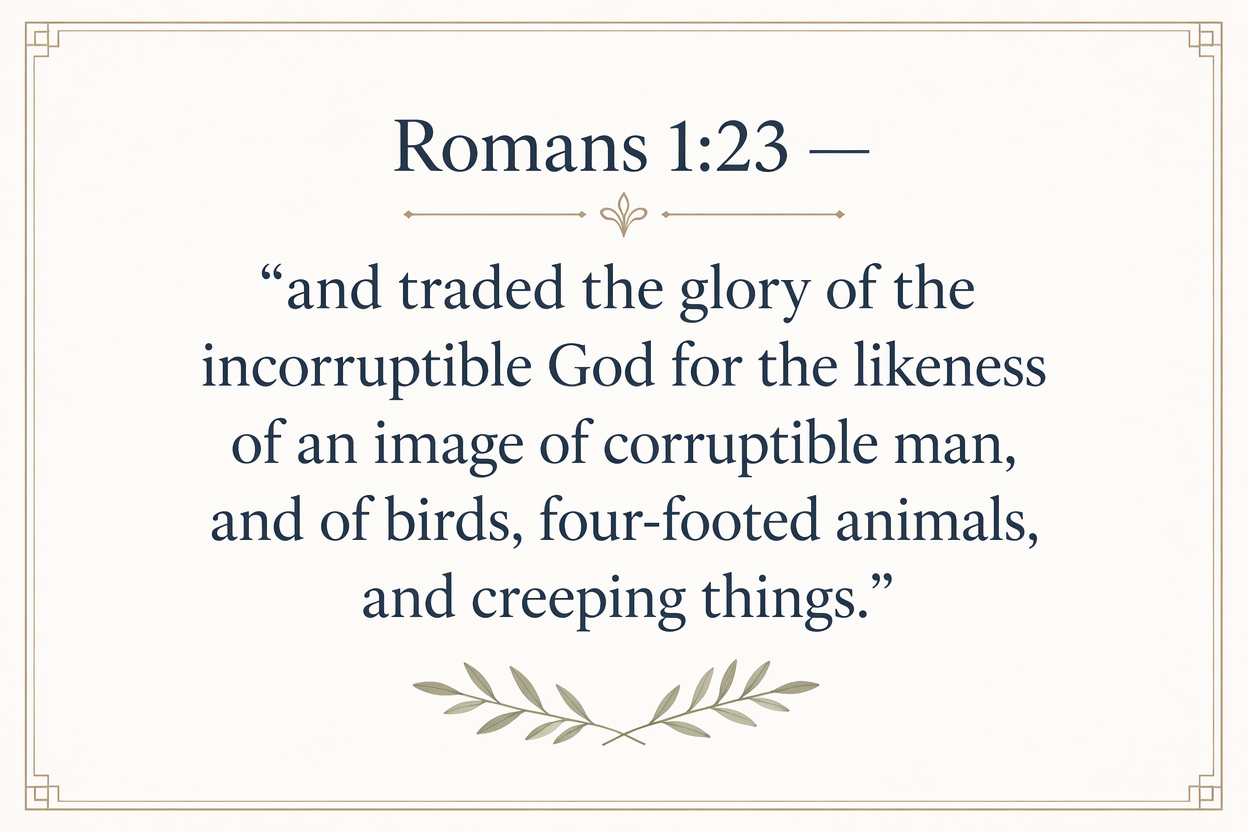
Romans 1:23 — “and traded the glory of the incorruptible God for the likeness of an image of corruptible man, and of birds, four-footed animals, and creeping things.”
Here ὁμοίωμα marks the representative character of what replaces God’s glory: a “likeness of an image” shaped after corruptible, created life (“man… birds… four-footed animals… creeping things”). The word helps frame the exchange as movement from divine glory to a resemblance tied to the creaturely realm. Within the sentence, “likeness” belongs to what is crafted and categorized—human and animal forms—so the focus is not on the creatures themselves but on their representational resemblance as displayed in an image.
Romans 5:14 — “Nevertheless death reigned from Adam until Moses, even over those whose sins weren’t like Adam’s disobedience, who is a foreshadowing of him who was to come.”
In this statement about death’s reign, “like” sets up a comparison between later sins and “Adam’s disobedience.” The contribution of ὁμοίωμα is comparative: it identifies a resemblance that is denied (“weren’t like”), sharpening the argument that death held sway even where sin did not match Adam’s act in that particular way. The verse then speaks of Adam as “a foreshadowing,” and the comparison word prepares for that typological framing by distinguishing what is and is not analogous.
Romans 6:5 — “For if we have become united with him in the likeness of his death, we will also be part of his resurrection;”
Here “likeness” qualifies the union described: believers are “united with him” in relation to “his death” through a likeness. The term signals that the union is expressed by resemblance with respect to the death, and the sentence links that likeness to an expectation of participation in resurrection. In this context, ὁμοίωμα functions as the bridge between two realities named in the verse—death and resurrection—locating the first as a pattern of resemblance that undergirds the promised sharing in the second.
Romans 8:3 — “For what the law couldn’t do, in that it was weak through the flesh, God did, sending his own Son in the likeness of sinful flesh and for sin, he condemned sin in the flesh;”
In this tightly argued line, “likeness” specifies the manner of the Son’s sending: “in the likeness of sinful flesh.” The word enables Paul to speak of a real connection to “flesh” while characterizing it by resemblance with “sinful” flesh. The verse keeps the focus on God’s action—sending the Son and condemning sin—while ὁμοίωμα sets the Son’s mission within the sphere where the law was “weak through the flesh.” The final clause (“he condemned sin in the flesh”) echoes the earlier “flesh,” so “likeness” carries weight in describing how the Son’s sending relates to the arena where sin is condemned.
Philippians 2:7 — “but emptied himself, taking the form of a servant, being made in the likeness of men.”
In this description of self-emptying, “likeness” is paired with concrete role-language: “taking the form of a servant” and “being made in the likeness of men.” ὁμοίωμα supports the depiction of genuine human resemblance as part of the movement into servanthood. The word marks the relation between the one who “emptied himself” and “men”: he is made in their likeness, so the humiliation described is not merely positional (“form of a servant”) but also involves appearing in the same kind of humanity as those he serves.
Revelation 9:7 — “The shapes of the locusts were like horses prepared for war. On their heads were something like golden crowns, and their faces were like people’s faces.”
In this apocalyptic vision, “like” repeatedly indicates resemblance: locusts compared to “horses prepared for war,” headgear compared to “golden crowns,” and faces compared to “people’s faces.” ὁμοίωμα contributes the language of likeness that allows the seer to describe extraordinary beings using familiar forms without equating them. The effect is cumulative: each comparison adds a facet to the “shapes,” building a composite picture by resemblance—war-horse readiness, crownlike headpieces, and humanlike faces—while preserving their identity as locusts.

Sense and Usage
Across these passages, ὁμοίωμα serves as a flexible word for resemblance that can operate in at least three observable ways.
First, it can mark representational resemblance in the realm of images and crafted forms. Romans 1:23 places “likeness” within the language of exchange and depiction: “the likeness of an image” aligns the term with resemblance that is deliberately made and then revered. The likeness is not an abstract similarity but a representational form tied to created categories (human and animal kinds), and it is the object for which divine glory is traded.
Second, it can express comparison that clarifies an argument by identifying similarity or denying it. Romans 5:14 uses the word to say later sins “weren’t like Adam’s disobedience,” which is a comparison that distinguishes kinds of sin while still maintaining the larger claim that death reigned broadly. Revelation 9:7 multiplies comparisons to render a visionary description intelligible; likeness becomes a descriptive tool that attaches known shapes to unknown ones, giving the reader points of reference (“horses… crowns… people’s faces”). In both cases, ὁμοίωμα functions as a relational marker: it sets one thing alongside another so the resemblance (or lack of it) can be grasped.
Third, it can locate a person’s participation or placement within a condition by means of resemblance. Romans 6:5 connects “likeness” to union: becoming “united with him in the likeness of his death” places resemblance at the heart of shared experience, and that shared pattern opens onto the stated hope of resurrection participation. Romans 8:3 and Philippians 2:7 likewise use likeness-language to speak about the Son’s relation to humanity and the sphere of “flesh.” In Romans, the likeness is specifically tied to “sinful flesh,” and the verse immediately frames God’s purpose: condemning sin “in the flesh.” In Philippians, likeness is tied to “men” and set within the portrayal of self-emptying and servanthood. In these texts, ὁμοίωμα is not a detached comparison; it is embedded in statements about sending, making, and uniting—actions that place someone within a recognizable human or fleshly sphere by resemblance.
Taken together, the occurrences show that “likeness” can carry the weight of representation (an image that resembles), argument (a comparison that sharpens a claim), and participation (a shared pattern that joins persons to an event or condition). The word’s force is determined by its immediate companions: “image” and creaturely forms in Romans 1; “sins” and “disobedience” in Romans 5; “united,” “death,” and “resurrection” in Romans 6; “sinful flesh,” “for sin,” and “condemned” in Romans 8; “emptied,” “form of a servant,” and “men” in Philippians 2; and the stacked similes of Revelation 9.
Imagery
The imagery attached to ὁμοίωμα is strikingly concrete in these verses. Romans 1:23 pictures likeness as something fashioned after visible life, a representational substitute that draws attention away from the incorruptible God toward corruptible forms. Revelation 9:7 uses likeness to sketch terrifying, hybridized shapes by reference to familiar objects of power and status—war-horses and crowns—and even the unsettling nearness of “people’s faces.” Between these, Romans 6:5, Romans 8:3, and Philippians 2:7 show likeness working in statements about identification: resemblance becomes the language by which union, sending, and making are described, and so the term can carry both the heaviness of idolatrous substitution and the intimacy of shared condition and experience, depending on the scene.
Sources: Lexical data from Strong’s Exhaustive Concordance and the Translators Brief Lexicon of Extended Strongs for Greek (STEPBible, CC BY). Occurrence data from the Translators Amalgamated Greek New Testament (STEPBible, CC BY). Scripture quotations from the World English Bible (public domain).




