Exploring the Meaning of Homilos in Greek
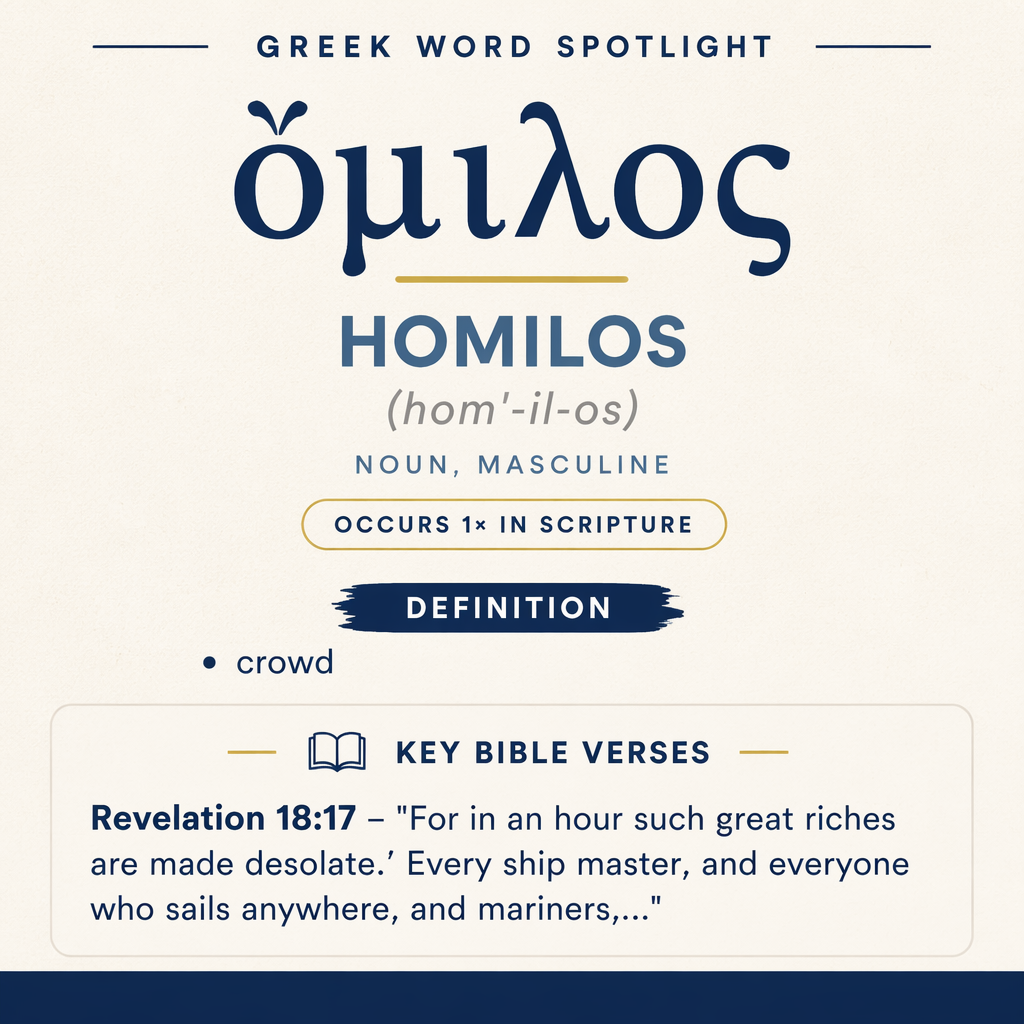
ὅμιλος means “crowd” and appears once in Scripture in Revelation 18:17.
Scripture Occurrence
It occurs 1 time in Scripture. The occurrence is in Revelation 18:17.
Learn More →Verse Context
In Revelation 18:17, it appears in a list including “Every ship master… and mariners.”
Learn More →ὅμιλος means “crowd” and is attested in the New Testament in a single passage describing the sudden desolation of vast maritime wealth. In its one appearance, it gathers varied sea-workers into one collective presence at the moment of catastrophe.
Root and Related Words
ὅμιλος is linked with two related words: αἱρέω (haireomai), “to choose” (Strong’s G138), and ὁμοῦ (homou), “together” (Strong’s G3674).

Occurrences
“For in an hour such great riches are made desolate.’ Every ship master, and everyone who sails anywhere, and mariners, and as many as gain their living by sea, stood far away,” (Revelation 18:17)
In Revelation 18:17, ὅμιλος functions to compress a long list of distinct maritime roles into a single social reality: a crowd bound together by shared livelihood and shared loss. The verse moves through successive groups—“Every ship master,” then “everyone who sails anywhere,” then “mariners,” and finally “as many as gain their living by sea.” The piling up of categories highlights breadth: leadership on ships, ordinary sailors, professional seamen, and all whose income depends on the sea. ὅμιλος gathers this breadth into a unified mass, presenting them not as isolated individuals reacting privately but as a collective body responding in the same moment.
The clause “stood far away” gives the crowd a posture and a distance. The crowd is present, yet not near; unified, yet held back. Within the scene, the crowd’s separation from the desolated riches communicates both involvement and detachment: they are clearly stakeholders (“gain their living by sea”), but their stance is one of removed observation. The effect is to make their shared reaction part of the portrait of sudden ruin: the desolation is so complete and so swift—“in an hour”—that a crowd of those most connected to the commerce is reduced to standing at a distance.
Because the verse identifies the crowd by occupation, ὅμιλος here carries a strongly situational nuance: it is not a random assembly but an economically defined gathering. The “great riches” in view are framed in maritime terms; the crowd is composed of those whose work and income are tied to the seaborne flow of wealth. In that setting, the word helps the reader envision the shoreline or vantage point from which many sea-workers, now abruptly dispossessed, stand together and watch the outcome.
Sense and Usage
The sense “crowd” in this passage is not merely a headcount; it is a way of portraying collective presence and collective reaction. Revelation 18:17 does not describe a single witness or a small delegation but a mass formed from multiple strata of sea-related labor. The verse’s structure—an opening declaration of sudden desolation, followed by a list of maritime groups—sets the crowd within an economy that has collapsed. The crowd is therefore a narrative device that makes the impact public and visible: the loss is not confined to a private treasury but ripples outward until it is embodied in a gathered multitude.
In this scene, the crowd is also marked by shared location and shared posture. The listed groups are not scattered across different settings; they are presented as together in one place, doing one thing: they “stood far away.” A crowd can be near or pressing in, but here its defining feature is distance. That distance frames the crowd as observers rather than interveners. Their unity lies in mutual witness to the devastation and in the common bond of having “gain[ed] their living by sea.” The word thus fits a portrayal where many people, connected by the same commercial system, react in parallel when that system’s wealth becomes “desolate” within an hour.
The occupational identifiers also shape how the crowd is imagined. “Every ship master” suggests authority and responsibility; “everyone who sails anywhere” widens the net to include travelers or seafarers broadly; “mariners” evokes professional sea-work; and the final phrase, “as many as gain their living by sea,” gathers in all remaining dependents of maritime trade. The crowd, then, is expansive and inclusive with respect to sea commerce. ὅμιλος helps bind this inclusiveness into a single scene rather than leaving it as a loose catalog.
The immediacy of the time marker—“in an hour”—adds another dimension to the crowd’s function. Suddenness tends to fragment people into scattered reactions, yet the verse’s picture is the opposite: a united mass at a shared distance. The crowd’s presence reinforces the scale of what has happened: something capable of drawing together ship masters, sailors, and all sea-dependent workers at once is not a minor setback but a sweeping desolation of “such great riches.” The crowd, therefore, helps the text communicate magnitude by showing how many kinds of people are simultaneously implicated and simultaneously present.
Imagery
Revelation 18:17 frames ὅμιλος with maritime imagery and the language of economic collapse. The crowd is made visible against the backdrop of ships, sailors, and seaborne livelihood, and its defining action is to stand at a remove while “such great riches are made desolate.” The word lends weight to the scene by giving the desolation a gathered human witness: a collective of sea-workers, held together by their trade, looking on from far away.
Sources: Lexical data from Strong’s Exhaustive Concordance and the Translators Brief Lexicon of Extended Strongs for Greek (STEPBible, CC BY). Occurrence data from the Translators Amalgamated Greek New Testament (STEPBible, CC BY). Scripture quotations from the World English Bible (public domain).