
Exploring the Meaning of Hodos in Greek
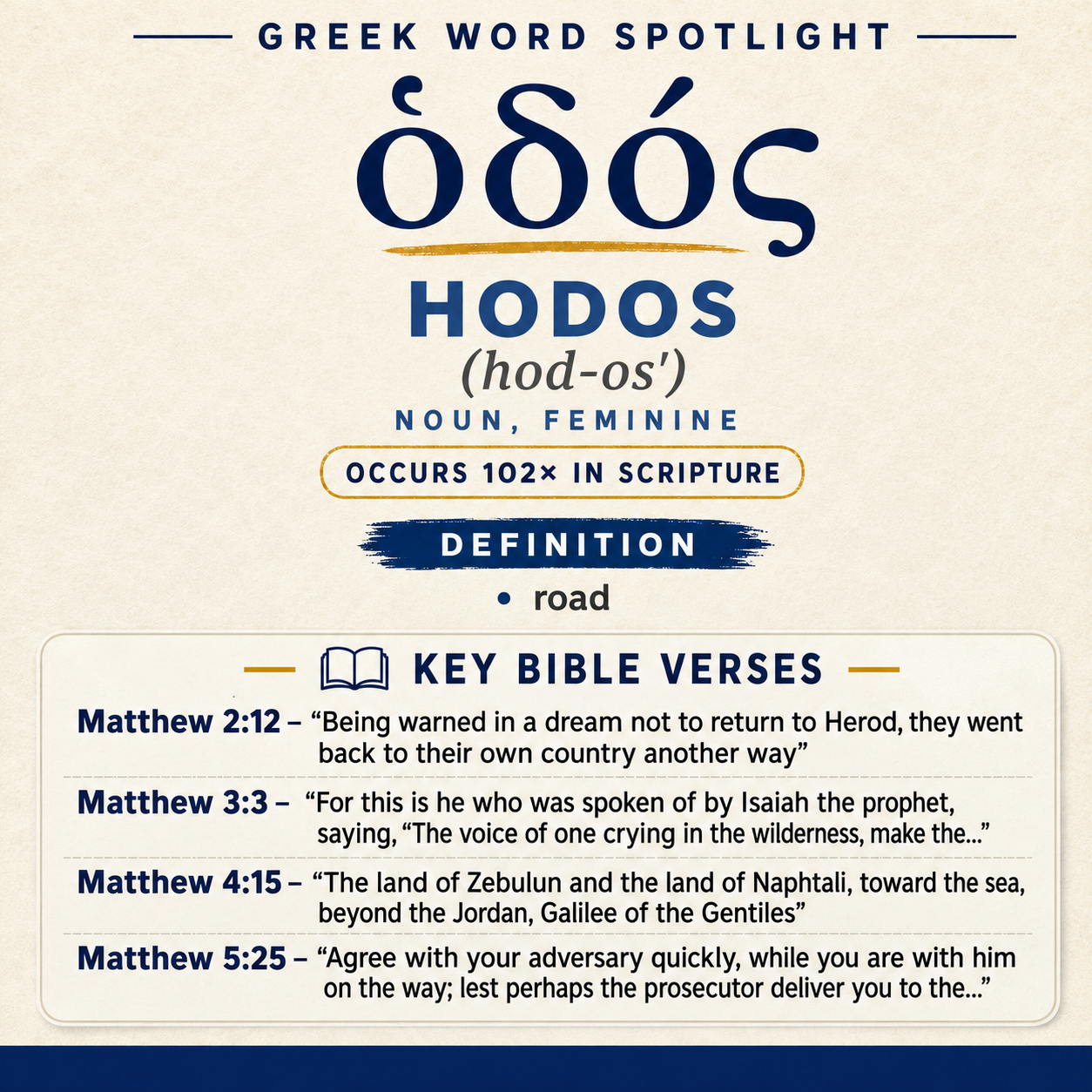
ὁδός (Hodos) means “road” and appears 102 times in Scripture, including Matthew 2:12; 3:3; 5:25; and 7:13–14.
Core Meaning
ὁδός means “road.” In Matthew 2:12 it describes traveling “another way.”
Learn More →Matthew Highlights
In Matthew 3:3 it occurs in the phrase “make the way.” In Matthew 7:13–14 it contrasts a broad way leading to destruction with a restricted way leading to life.
Learn More →Usage Snapshot
ὁδός occurs 102 times in Scripture. The provided occurrences include Matthew 2:12; 3:3; 5:25; 7:13–14; and 10:5.
Learn More →ὁδός names a “road,” and in these passages it repeatedly anchors the reader in movement: travel routes, directions taken, and the course along which people and events proceed. The word also becomes a concrete image for a directed route that can be prepared, narrowed, blocked, or skirted.
Occurrences
Matthew 2:12: “Being warned in a dream not to return to Herod, they went back to their own country another way.”
Here ὁδός identifies an alternative road taken to complete a journey safely. The scene turns on a change of route: the travelers still return to their own country, but by a different road than the one that would lead back to Herod.
Matthew 3:3: “For this is he who was spoken of by Isaiah the prophet, saying, “The voice of one crying in the wilderness, make the way of the Lord ready! Make his paths straight!””
In the wilderness setting, ὁδός is the road that is to be made ready. The language of preparation and straightness treats the road as something that can be cleared and aligned, so that a coming approach is unhindered and direct.
Matthew 4:15: ““The land of Zebulun and the land of Naphtali, toward the sea, beyond the Jordan, Galilee of the Gentiles,”
This citation frames a region by directional markers (“toward the sea, beyond the Jordan”). Within that kind of geographic orientation, ὁδός contributes the idea of a road as a line of approach into and through named places—an element that makes the quoted geography feel like a traversed landscape rather than a static map.
Matthew 5:25: “Agree with your adversary quickly, while you are with him on the way; lest perhaps the prosecutor deliver you to the judge, and the judge deliver you to the officer, and you be cast into prison.”
ὁδός is the road shared by two parties who are headed toward an official reckoning. The road functions as a limited window of time and space (“while you are with him on the way”), before the sequence of delivery to judge and officer becomes irreversible.
Matthew 7:13: ““Enter in by the narrow gate; for wide is the gate and broad is the way that leads to destruction, and many are those who enter in by it.”
The word presents a road characterized by breadth and by its direction (“leads to destruction”). The picture begins at a gate and continues onto a road, so that choosing an entrance commits a traveler to a particular road with a particular end.
Matthew 7:14: “How narrow is the gate, and restricted is the way that leads to life! Few are those who find it.”
In contrast to the prior saying, ὁδός is a restricted road, paired again with a gate and defined by where it leads (“to life”). The emphasis falls on difficulty of access (“restricted”) and on discovery (“Few are those who find it”), as if the road is present but not easily located or entered.
Matthew 8:28: “When he came to the other side, into the country of the Gergesenes, two people possessed by demons met him there, coming out of the tombs, exceedingly fierce, so that nobody could pass that way.”
ὁδός is a passable route that becomes effectively closed. The fierce confrontation at the tombs turns the road into a boundary people avoid (“nobody could pass that way”), showing the road’s ordinary purpose—public movement—frustrated by fear and danger.
Matthew 10:5: “Jesus sent these twelve out, and commanded them, saying, “Don’t go among the Gentiles, and don’t enter into any city of the Samaritans.”
The command regulates travel and entry. In a context of being “sent… out,” ὁδός supplies the idea of a road or route that can be taken or not taken; the prohibition shapes where their outward movement is permitted to go.
Matthew 10:10: “Take no bag for your journey, neither two coats, nor sandals, nor staff: for the laborer is worthy of his food.”
Here the road is implicit in “your journey,” and ὁδός makes that journey concrete as travel that ordinarily requires supplies. The instruction assumes the realities of the road—distance, need, and preparation—yet directs the travelers to go unencumbered, with provision coming through their work.
Matthew 11:10: “For this is he, of whom it is written, ‘Behold, I send my messenger before your face, who will prepare your way before you.’”
ὁδός again appears as a road that can be prepared in advance, but now explicitly “before you.” The messenger’s role is pictured as going ahead on the road to ready it, so that the one who follows encounters a prepared route rather than an obstructed one.
Matthew 13:4: “As he sowed, some seeds fell by the roadside, and the birds came and devoured them.”
In this agricultural scene, ὁδός is the roadside margin where seed is wasted rather than planted. The road’s edge is exposed and vulnerable: the seed lies where birds can easily find and consume it.
Matthew 13:19: “When anyone hears the word of the Kingdom, and doesn’t understand it, the evil one comes, and snatches away that which has been sown in his heart. This is what was sown by the roadside.”
The explanation returns to the roadside as a definable location within the story-world of sowing. ὁδός marks the place where the seed is quickly removed; the roadside image supports the description of something snatched away before it can take hold.
Sense and Usage
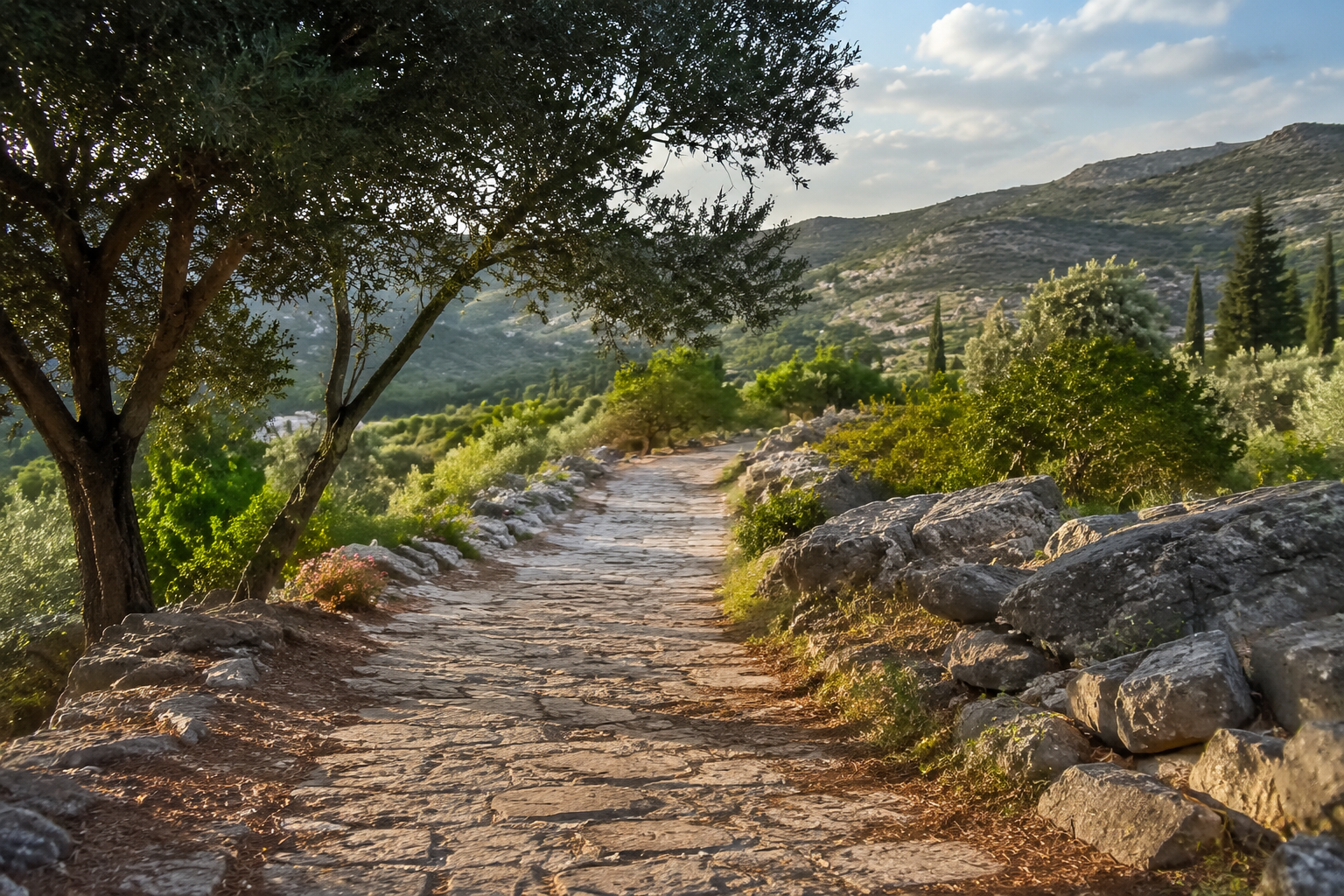
Across these passages, “road” consistently carries the basic idea of a route along which someone goes, but the contexts highlight different features of what a road is and does. In narrative travel (Matthew 2:12), a road is a chosen line of return; changing the road changes exposure to danger. In sayings about readiness (Matthew 3:3; 11:10), the road is something that can be made ready and straightened, emphasizing access and unobstructed approach. This use depends on the tangible properties of roads—clearing, leveling, directing—so that preparation is pictured as work done to the road itself.
Other contexts emphasize the road as a corridor of encounter and consequence. In Matthew 5:25 the road is shared space before a judicial handoff; what happens “on the way” matters because the road leads toward an authority structure that can end in imprisonment. In Matthew 8:28 the road is a public thoroughfare that is made impassable; the road’s normal openness is reversed when nobody can pass. In Matthew 10:5 and 10:10, the road is the practical reality behind being “sent… out” and undertaking a “journey”: it involves destinations, boundaries, and the ordinary question of what to carry. Commands about where to go and what not to take are intelligible because a road ordinarily demands planning, and because routes determine which towns and peoples are encountered.
The sayings in Matthew 7:13–14 treat roads with particularly vivid spatial adjectives: “broad” and “restricted.” The road is linked to a gate, forming a coherent travel image in which an entrance leads onto a route. The road’s character and its destination are bound together: the broad road “leads to destruction,” and the restricted road “leads to life.” In these two lines, the road is not merely a strip of ground; it is a directed course with an end, and the traveler’s choice of entry sets the course.
Finally, the parable of the sower uses the road’s edge (“by the roadside”) to portray a place where seed does not remain. The roadside is not depicted as cultivated soil but as an exposed margin; in Matthew 13:4 the birds devour the seed, and in 13:19 the roadside becomes the interpretive label for what is quickly taken away. The road here is not for the sower’s movement but a boundary in the field—an area shaped by traffic and openness rather than planting and growth.
Imagery
These scenes repeatedly attach ὁδός to motion and direction: returning by “another way” (Matthew 2:12), preparing a way in the wilderness (Matthew 3:3), and traveling on a journey with minimal supplies (Matthew 10:10). The word’s imagery also makes a road feel morally and practically weighty: it can be the last place to reconcile before reaching a judge (Matthew 5:25), it can be blocked so that “nobody could pass” (Matthew 8:28), and it can be described as broad or restricted with a stated end (Matthew 7:13–14). Even at the field’s edge, the roadside functions as a telling location—open to immediate loss (Matthew 13:4, 13:19).
Sources: Lexical data from Strong’s Exhaustive Concordance and the Translators Brief Lexicon of Extended Strongs for Greek (STEPBible, CC BY). Occurrence data from the Translators Amalgamated Greek New Testament (STEPBible, CC BY). Scripture quotations from the World English Bible (public domain).




