Exploring the Meaning of Hode in Greek
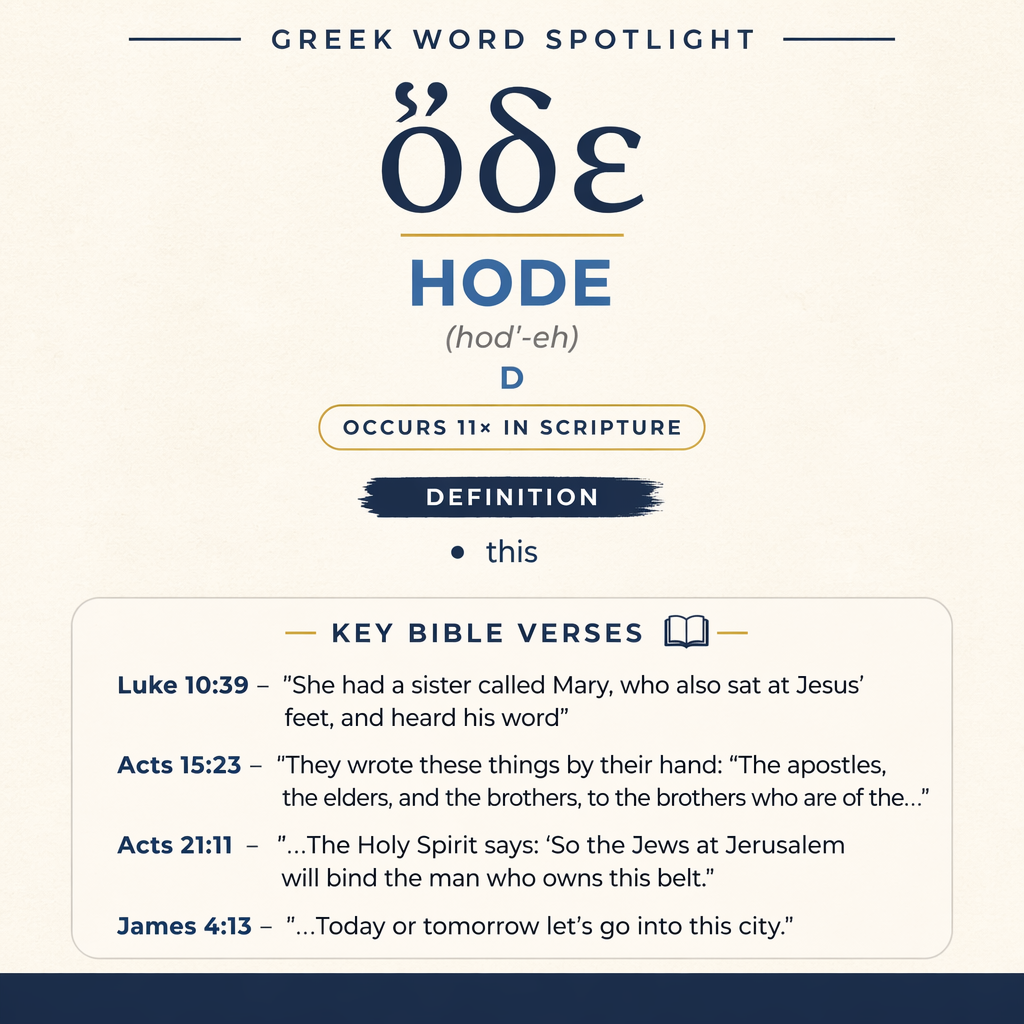
ὅδε means “this” and occurs 11 times in Scripture, including Luke, Acts, James, and Revelation.
Scripture Occurrences
ὅδε occurs 11 times in Scripture. Listed references include Luke 10:39; Acts 15:23; Acts 21:11; and James 4:13.
Learn More →Revelation Usage
ὅδε appears in Revelation 2:1, 2:8, 2:12, and 2:18. In these verses, it occurs within messages addressed to assemblies.
Learn More →ὅδε expresses near, immediate reference (“this”) and appears in narrative scenes, reported speech, and formal written messages. In the cited passages it points to a person, object, place, or set of words as presently in view for speaker and hearer.
Root and Related Words
ὅδε is derived (per Strong’s) from the particle δέ (de, δέ), “then,” and the article/pronoun ὁ (ho, ὁ), “the/this/who.”

Occurrences
Luke 10:39 — “She had a sister called Mary, who also sat at Jesus’ feet, and heard his word.”
Within this domestic setting, ὅδε functions as a marker of immediacy in the scene: Mary is not described in general terms, but as the one “here,” placed at Jesus’ feet and attentive to “his word.” The demonstrative force tightens the focus onto the concrete posture and moment of listening as the defining feature of the description.
Acts 15:23 — “They wrote these things by their hand: “The apostles, the elders, and the brothers, to the brothers who are of the Gentiles in Antioch, Syria, and Cilicia: greetings.”
Here ὅδε serves the idiom of written communication: it anchors the content as “these things” being committed to writing. The effect is to present the letter as a specific, bounded message—what follows is not merely a general sentiment but the particular matter being sent “by their hand” to named recipients.
Acts 21:11 — “Coming to us and taking Paul’s belt, he bound his own feet and hands, and said, “The Holy Spirit says: ‘So the Jews at Jerusalem will bind the man who owns this belt, and will deliver him into the hands of the Gentiles.’ ”
In this acted prophecy, ὅδε points to an object physically present: “this belt.” The demonstrative gives the statement a concrete, evidential quality, linking the symbolic action (binding feet and hands) to a tangible item associated with “the man who owns” it. “This” creates a direct connection between object and owner without naming him in the prophecy itself.
James 4:13 — “Come now, you who say, “Today or tomorrow let’s go into this city, and spend a year there, trade, and make a profit.”
In the quotation of presumptive planning, ὅδε identifies the destination as “this city,” as though it were already selected and fixed in the speakers’ minds. The demonstrative makes the plan sound settled and specific: not a vague intention to travel, but movement toward a particular place that is treated as immediately definable within the speakers’ outlook.
Revelation 2:1 — “To the angel of the assembly in Ephesus write: “He who holds the seven stars in his right hand, he who walks among the seven golden lamp stands says these things:”
In the opening of the message to Ephesus, ὅδε frames the communication as a definite set of utterances: “says these things.” The phrasing draws attention to the words as an authoritative package delivered to a specific recipient (“the angel of the assembly”), with the speaker identified by his actions (“holds,” “walks among”).
Revelation 2:8 — “To the angel of the assembly in Smyrna write: “The first and the last, who was dead, and has come to life says these things:”
Again ὅδε signals that what follows is the particular content spoken by the one described. “These things” functions like an introducer: the identity and credentials of the speaker are stated, and then the demonstrative points forward to the concrete message that is about to be given to Smyrna.
Revelation 2:12 — “To the angel of the assembly in Pergamum write: “He who has the sharp two-edged sword says these things:”
Here ὅδε similarly ties the message to the speaker’s characterized authority (“has the sharp two-edged sword”). The demonstrative does not add new subject matter by itself; it marks the ensuing words as the defined, immediate utterance of the one speaking, setting them off as the particular pronouncement addressed to Pergamum.
Revelation 2:18 — “To the angel of the assembly in Thyatira write: “The Son of God, who has his eyes like a flame of fire, and his feet are like burnished brass, says these things:”
In the Thyatira message, ὅδε again frames the discourse as a specific statement being issued. The speaker description is vivid and concrete (“eyes like a flame of fire,” “feet… like burnished brass”), and “these things” signals that the words that follow are the immediate expression of that speaker’s assessment and instruction, not a general report.
Revelation 3:1 — “And to the angel of the assembly in Sardis write: “He who has the seven Spirits of God, and the seven stars says these things: “I know your works, that you have a reputation of being alive, but you are dead.”
Here the demonstrative directly introduces an evaluation: “says these things: ‘I know your works…’” ὅδε functions as the hinge between the speaker’s identity and the concrete content of his address, presenting the verdict on Sardis (“you are dead”) as part of the defined message being delivered.
Revelation 3:7 — “To the angel of the assembly in Philadelphia write: “He who is holy, he who is true, he who has the key of David, he who opens and no one can shut, and who shuts and no one opens, says these things:”
In Philadelphia, ὅδε continues the same epistolary pattern. After a piling up of identifying clauses (“holy,” “true,” “has the key,” “opens… shuts”), “says these things” marks the forthcoming words as the immediate, determinate pronouncement of this speaker to this assembly.
Revelation 3:14 — “To the angel of the assembly in Laodicea write: “The Amen, the Faithful and True Witness, the Beginning of God’s creation, says these things:”
In Laodicea, ὅδε again introduces the set message to be written. The titles (“The Amen,” “the Faithful and True Witness,” “the Beginning of God’s creation”) are followed by “says these things,” which packages the impending address as the specific utterance that corresponds to that authoritative identity.
Sense and Usage
Across these passages, ὅδε serves as a near demonstrative that makes reference concrete and present. In Acts 21:11, the force is physical and immediate: “this belt” is an object to which the speaker can point, and the demonstrative binds meaning to the visible prop in the enacted scene. In James 4:13, the reference is spatial but still definite: “this city” sounds like a chosen, identifiable destination, making the plan feel precise and settled in the mouths of those speaking.
In Acts 15:23 and throughout Revelation 2–3, ὅδε operates in a textual and rhetorical way, pointing to words as a discrete unit: “these things.” The demonstrative gives shape to the communication, marking it as a particular message being transmitted rather than a vague generality. Especially in Revelation, the repeated “says these things” functions like an official framing device: after the speaker is identified, the demonstrative points to the immediate content that carries his authority to a named community.
Even where the setting is narrative (Luke 10:39), ὅδε has the same essential effect: it narrows attention to what is immediately before the reader—Mary’s specific posture and act of hearing. The word’s contribution is to make reference pointed, situational, and concrete, whether the “this” is an object in hand, a city in a plan, or a set of words being delivered as a defined message.
Imagery
The passages pair ὅδε with scenes that can be seen and located: a woman seated at Jesus’ feet (Luke 10:39), a belt taken and used to bind hands and feet (Acts 21:11), a destination city imagined as the next step in a commercial plan (James 4:13), and letters dictated to named assemblies (Revelation 2:1–3:14). In each case “this” draws what is referenced into the foreground as the immediate matter at hand—something pointed to, written down, or set directly before the hearer.
Sources: Lexical data from Strong’s Exhaustive Concordance and the Translators Brief Lexicon of Extended Strongs for Greek (STEPBible, CC BY). Occurrence data from the Translators Amalgamated Greek New Testament (STEPBible, CC BY). Scripture quotations from the World English Bible (public domain).