
Exploring the Meaning of Gamos in Greek
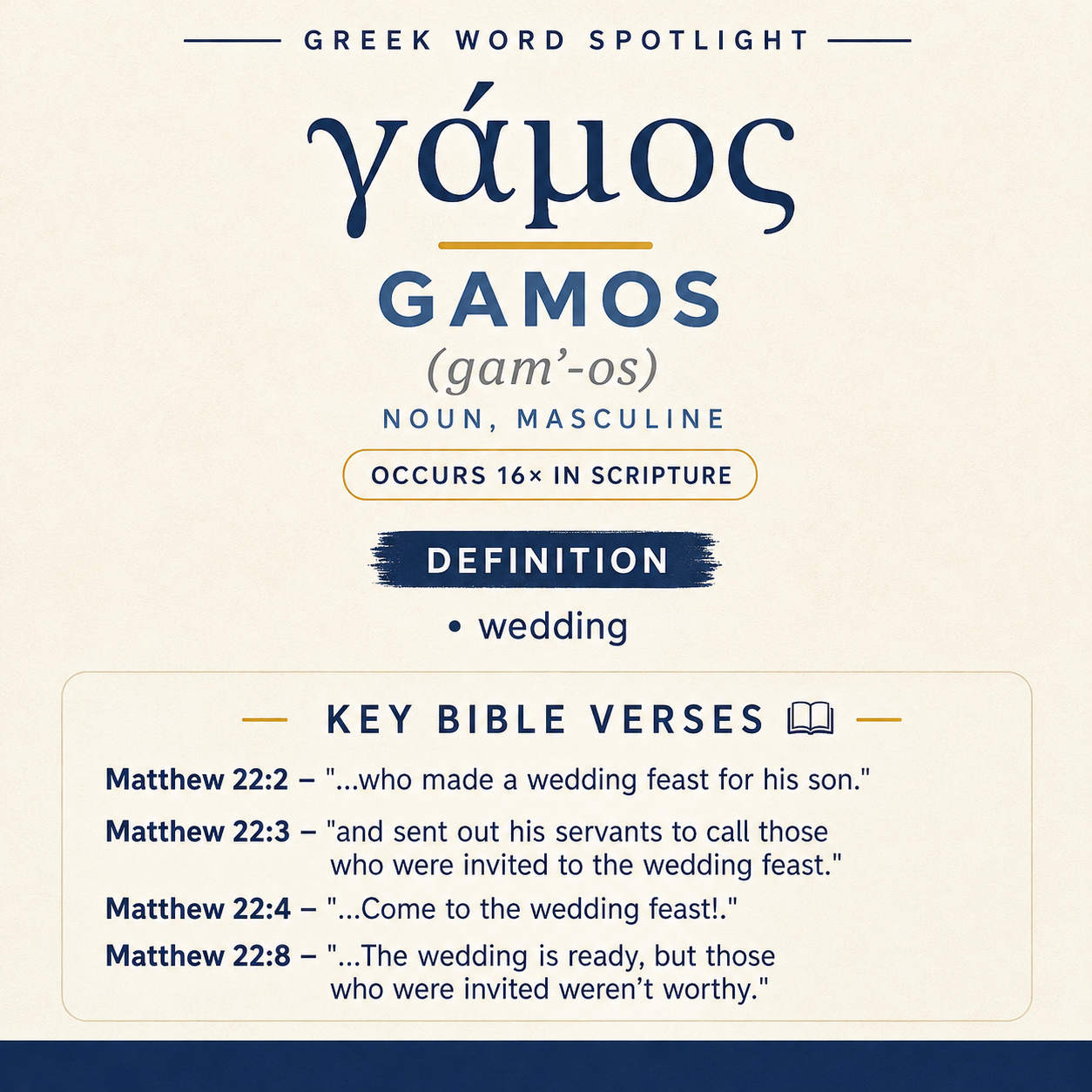
γάμος (Gamos) means “wedding” and appears 16 times in Scripture, including repeatedly in Matthew 22:2–12.
Core Meaning
γάμος is defined as “wedding.” In Matthew 22, it is connected with a king’s wedding feast for his son.
Learn More →Matthew 22 Focus
Matthew 22:2–12 uses γάμος throughout the parable of the wedding feast. It includes invitations to the feast and the issue of wedding clothing.
Learn More →Scripture Occurrences
This noun occurs 16 times in Scripture. The provided examples show multiple uses clustered in Matthew 22:2–12.
Learn More →γάμος refers to a wedding, and in these passages it appears as a setting for invitation, readiness, and ordered participation. The word is used both for an actual wedding in a named place and for wedding scenes framed as instructive comparisons.
Occurrences
“The Kingdom of Heaven is like a certain king, who made a wedding feast for his son,” (Matthew 22:2)
Here γάμος anchors the comparison by naming the celebratory occasion a king prepares for his son. The wedding is not incidental; it is the reason for the feast and the reason for the king’s public summons that follows in the story.
and sent out his servants to call those who were invited to the wedding feast, but they would not come. (Matthew 22:3)
γάμος marks the event to which people have already been invited, and it becomes the test of response: they “would not come.” The wedding feast is portrayed as a concrete occasion with a guest list and a real expectation of attendance.
Again he sent out other servants, saying, ‘Tell those who are invited, “Behold, I have prepared my dinner. My cattle and my fatlings are killed, and all things are ready. Come to the wedding feast!” ’ (Matthew 22:4)
The wedding feast is now associated with abundance and completion: “all things are ready.” γάμος functions as the destination for a renewed appeal, with the preparation of food presented as proof that the wedding celebration is underway and waiting for guests.
“Then he said to his servants, ‘The wedding is ready, but those who were invited weren’t worthy. (Matthew 22:8)
γάμος is described as “ready,” keeping the focus on the event’s preparedness rather than on delays caused by invitees. The sentence contrasts the readiness of the wedding with the assessed unworthiness of the original invitees, highlighting how the occasion stands while invitations may be reassigned.
Go therefore to the intersections of the highways, and as many as you may find, invite to the wedding feast.’ (Matthew 22:9)
The wedding feast becomes the reason for an expanded, urgent invitation. γάμος here is linked to open-ended gathering—“as many as you may find”—so the wedding is pictured as an event meant to be filled, not an exclusive banquet restricted to the first set of invitees.
Those servants went out into the highways, and gathered together as many as they found, both bad and good. The wedding was filled with guests. (Matthew 22:10)
γάμος is the space that receives a mixed crowd, “both bad and good,” and the narrative’s outcome is stated in terms of the wedding itself: it “was filled with guests.” The word therefore carries the idea of a populated celebration—an event defined not only by preparation but by attendees actually present within it.
But when the king came in to see the guests, he saw there a man who didn’t have on wedding clothing,” (Matthew 22:11)
γάμος narrows from the general feast to what is fitting within it: “wedding clothing.” The wedding setting supplies a standard of appropriateness, and the king’s inspection presumes that the event carries expectations about how one enters and participates.
and he said to him, ‘Friend, how did you come in here not wearing wedding clothing?’ He was speechless. (Matthew 22:12)
The wedding functions as the basis for questioning legitimacy of participation: “how did you come in here” without the appropriate clothing. γάμος thus frames not just invitation but accountability within the celebration; the guest’s silence underscores the seriousness of being present at a wedding while disregarding what the occasion calls for.
While they went away to buy, the bridegroom came, and those who were ready went in with him to the wedding feast, and the door was shut. (Matthew 25:10)
Here γάμος is tied to timing and readiness. Entry to the wedding feast happens at the bridegroom’s arrival, and access is pictured as decisive—“the door was shut”—so the wedding feast becomes the moment when preparation or lack of preparation has irreversible results for participation.
Be like men watching for their lord, when he returns from the wedding feast; that when he comes and knocks, they may immediately open to him. (Luke 12:36)
γάμος appears as a completed event from which “their lord” returns. The wedding feast sets the temporal scene: servants must be alert at an hour that is shaped by the lord’s movements, and the word contributes the picture of a household waiting at night for a master coming back from a wedding celebration.
“When you are invited by anyone to a wedding feast, don’t sit in the best seat, since perhaps someone more honorable than you might be invited by him,” (Luke 14:8)
The wedding feast becomes a familiar social setting used for instruction about seating and honor. γάμος supplies the context of invited guests and ranked places—“the best seat”—so the wedding feast is pictured as an event where choices in self-presentation have public consequences.
The third day, there was a wedding in Cana of Galilee. Jesus’ mother was there. (John 2:1)
γάμος here names a specific wedding located in “Cana of Galilee.” Unlike the parabolic wedding scenes, this occurrence places the word in a concrete narrative setting with time (“The third day”), place, and named attendance (“Jesus’ mother was there”), treating the wedding as a real community celebration.

Sense and Usage
Across these occurrences, γάμος consistently denotes a wedding as an identifiable occasion that gathers people. In Matthew 22 it is portrayed as an event that can be prepared, announced, and filled, with invitations extending outward until the celebration has guests. The wedding is “ready,” and the repeated calls to “come” portray it as a welcoming but definite occasion—something one either attends or refuses.
At the same time, the wedding setting carries expectations for participation. The focus on “wedding clothing” in Matthew 22:11–12 shows that presence at a wedding is not treated as a neutral fact; the event itself establishes what is fitting for those who enter. The wedding is therefore both generous in its summons (Matthew 22:9–10) and ordered in its internal standards (Matthew 22:11–12).
In Matthew 25:10, γάμος is the setting for a decisive transition—those who are ready “went in,” and then “the door was shut.” The word contributes the sense of a wedding as a real gathering with an opening and closing, a time when entry is granted and later denied because the celebration has moved forward. Luke 12:36 uses the wedding feast to supply a believable reason for a lord’s delayed return and thus a believable test of a servant’s watchfulness; the wedding is not the command itself but the circumstance that makes readiness meaningful.
Luke 14:8 treats γάμος as a socially recognizable venue where seating arrangements matter. Because a wedding feast draws invitees of varying status, the setting naturally raises the issue of honor and the embarrassment of being displaced by “someone more honorable.” In John 2:1, γάμος appears in straightforward narrative form, showing the word’s ordinary use for a wedding celebrated in a local place with family presence.
Imagery
The passages repeatedly picture a wedding as a joyful gathering that nevertheless has a threshold: one is invited, one comes in, one sits among others, one is properly clothed, and at a certain point the door can be shut. Whether the wedding is used as a setting for teaching (Matthew 22; Matthew 25; Luke 12; Luke 14) or as a named event in Cana (John 2:1), γάμος carries the concrete imagery of preparation, arrival, and participation in a communal celebration.
Sources: Lexical data from Strong’s Exhaustive Concordance and the Translators Brief Lexicon of Extended Strongs for Greek (STEPBible, CC BY). Occurrence data from the Translators Amalgamated Greek New Testament (STEPBible, CC BY). Scripture quotations from the World English Bible (public domain).




