
Exploring the Meaning of Gameo in Greek
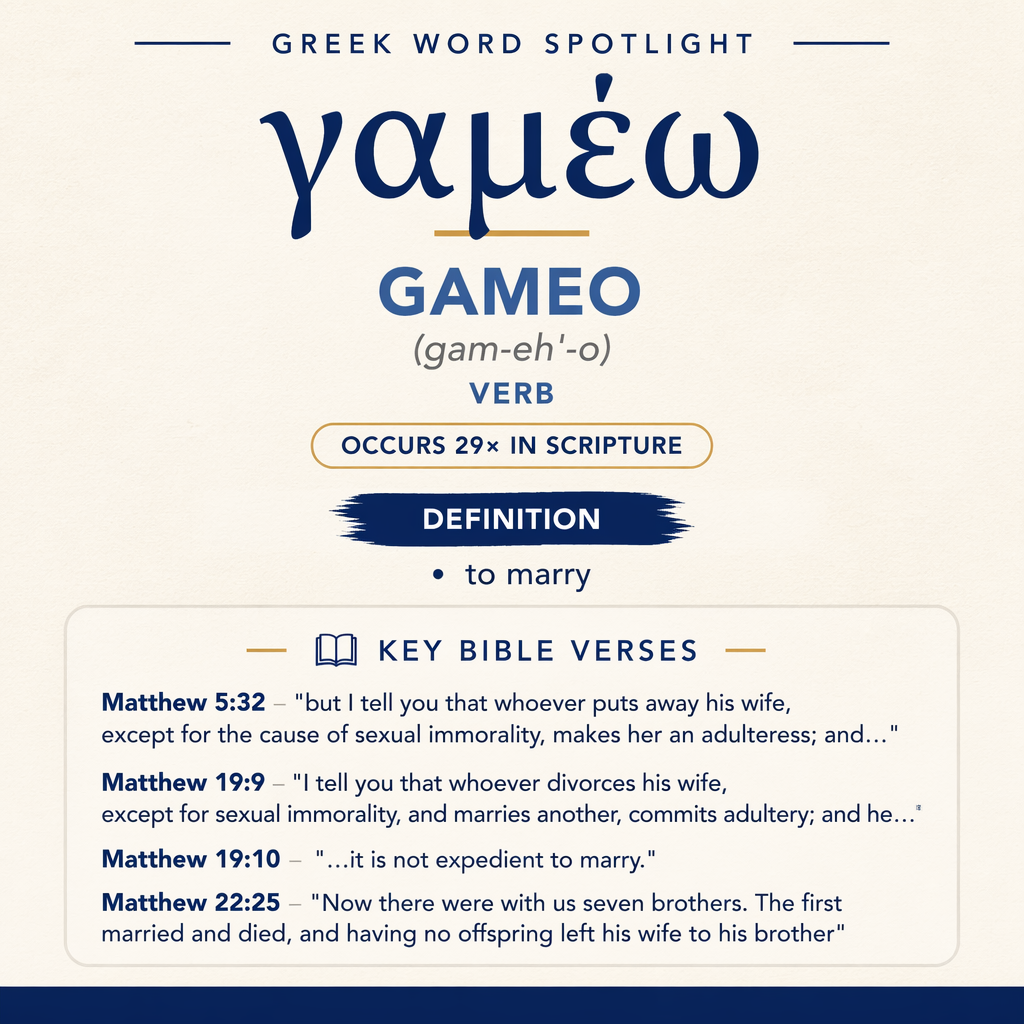
γαμέω means “to marry” and occurs 29 times in Scripture, including Matthew 5:32; 19:9–10; 22:25, 30; 24:38; Mark 6:17; 10:11.
Gospel Occurrences
This verb appears in multiple Gospel contexts, including Matthew and Mark. Examples include Matthew 19:10 and Mark 10:11.
Learn More →Usage Contexts
In the listed verses, γαμέω is used in teachings about divorce and remarriage (Matthew 5:32; 19:9). It also appears in discussions of resurrection life (Matthew 22:30).
Learn More →γαμέω means “to marry,” describing the act of entering a marriage in a range of settings: Jesus’ teaching on divorce and adultery, a legal-style case about seven brothers, ordinary social life, and a personal excuse from a banquet invitation. In these passages it is consistently tied to the concrete decision to take a spouse, with moral and social consequences made explicit in the surrounding lines.
Occurrences
Matthew 5:32: “but I tell you that whoever puts away his wife, except for the cause of sexual immorality, makes her an adulteress; and whoever marries her when she is put away commits adultery.”
Here γαμέω is placed in a chain of actions after a man “puts away his wife.” The clause “whoever marries her when she is put away” presents marriage as a real change in status that can be evaluated morally. The verse frames that marriage as a setting in which adultery is committed, showing that the act of marrying is not treated as a neutral formality but as an accountable step with implications for sexual faithfulness.
Matthew 19:9: “I tell you that whoever divorces his wife, except for sexual immorality, and marries another, commits adultery; and he who marries her when she is divorced commits adultery.”
γαμέω appears twice, once with “another” and once with “her when she is divorced.” The twofold use highlights two directions the act can take: marrying a new partner after divorce, and marrying the divorced woman. In both cases the surrounding statement evaluates the remarriage as an act connected to adultery, so marrying is treated as a decisive relational bond whose legitimacy is assessed in light of the prior marital tie.
Matthew 19:10: “His disciples said to him, “If this is the case of the man with his wife, it is not expedient to marry.”
In the disciples’ reaction, γαμέω is considered from the standpoint of prudence: “it is not expedient to marry.” The word here carries the plain sense of entering marriage, but the emphasis falls on its seriousness—marriage is portrayed as a commitment with constraints strong enough that, given the “case” just discussed, the disciples question whether taking that step is advantageous.
Matthew 22:25: “Now there were with us seven brothers. The first married and died, and having no offspring left his wife to his brother.”
In this scenario, γαμέω marks the first brother’s initial act of marrying before his death. The narrative then turns on the consequence of that marriage: he “left his wife to his brother” because he had “no offspring.” The verb anchors the whole sequence in an established marriage that creates obligations and raises questions about continuity of family and marital rights.
Matthew 22:30: “For in the resurrection they neither marry, nor are given in marriage, but are like God’s angels in heaven.”
Here γαμέω is contrasted with the resurrection state: “they neither marry, nor are given in marriage.” The pair of expressions sets marriage activity on both sides—someone marrying and someone being given in marriage—under a single denial. The verb’s contribution is to name a characteristic feature of present social life that is explicitly excluded from “the resurrection,” underscoring that marriage belongs to the current order rather than the described future condition.
Matthew 24:38: “For as in those days which were before the flood they were eating and drinking, marrying and giving in marriage, until the day that Noah entered into the ship,”
In this depiction of life “before the flood,” γαμέω is grouped with everyday activities: “eating and drinking, marrying and giving in marriage.” The verb functions as one item in a list of ordinary, socially approved routines, emphasizing normalcy and continuity—people continued forming marriages “until the day” a decisive event interrupted them. Marriage appears as part of the regular rhythm of human life, not as an exceptional or rare action.
Mark 6:17: “For Herod himself had sent out and arrested John, and bound him in prison for the sake of Herodias, his brother Philip’s wife, for he had married her.”
γαμέω is used to explain the relational situation driving the conflict: “for he had married her.” The verb identifies the act that established Herod’s bond with Herodias, who is simultaneously described as “his brother Philip’s wife.” In this narrative logic, the marriage is not an isolated personal choice; it is the relational fact that helps account for the imprisonment of John and the tension surrounding Herod’s household.
Mark 10:11: “He said to them, “Whoever divorces his wife, and marries another, commits adultery against her.”
In this saying, γαμέω is the second action following divorce: divorcing “his wife” and then marrying “another.” The moral evaluation is directed “against her,” the first wife, indicating that marrying another after divorce is treated as an offense with a personal target. The verb thus marks the concrete act that, in the stated logic, constitutes adultery in relation to the original spouse.
Mark 10:12: “If a woman herself divorces her husband, and marries another, she commits adultery.”
γαμέω here parallels the previous verse but with the subject as the woman: she divorces “her husband” and marries “another.” The form of the statement shows the same pattern—divorce followed by remarriage—and the same assessment—“she commits adultery.” The verb contributes the specific remarriage act that completes the scenario under evaluation.
Mark 12:25: “For when they will rise from the dead, they neither marry, nor are given in marriage, but are like angels in heaven.”
This repeats the resurrection contrast: those who “rise from the dead” do not engage in marrying or being given in marriage. γαμέω again names marriage as a practice characteristic of mortal social arrangements. Its inclusion in a paired denial highlights marriage as an activity with two sides, yet both are absent in the described risen condition.
Luke 14:20: ““Another said, ‘I have married a wife, and therefore I can’t come.’”
In this brief excuse, γαμέω appears in the perfect-like claim “I have married a wife,” presented as a reason for nonattendance: “therefore I can’t come.” The act of marrying is treated as immediately consequential for scheduling, priorities, and obligations. The wording assumes that entering marriage legitimately reshapes a person’s availability and commitments.
Luke 16:18: “Everyone who divorces his wife and marries another commits adultery. He who marries one who is divorced from a husband commits adultery.”
γαμέω is used twice to frame two related cases. First, a man divorces “his wife” and then marries “another,” which is labeled adultery. Second, a man marries “one who is divorced from a husband,” also labeled adultery. The repetition makes marriage the defining act that connects divorce to adultery, whether one marries after one’s own divorce or marries a person marked as divorced.

Sense and Usage
Across these passages, γαμέω consistently denotes the act of entering marriage, and the surrounding context supplies what is at stake when that act occurs. In several sayings (Matthew 5:32; Matthew 19:9; Mark 10:11–12; Luke 16:18), marrying is positioned as the pivotal step that, in the given scenarios, turns divorce into adultery. The logic in these lines is not abstract: it assumes recognizable social identities (“wife,” “husband,” “another,” “one who is divorced”) and treats the act of marrying as publicly meaningful—an action that establishes a new marital bond and therefore can conflict with an existing one.
In the resurrection sayings (Matthew 22:30; Mark 12:25), γαμέω functions differently. There it serves as a marker of present-age life rather than a moral test case. The denial “they neither marry, nor are given in marriage” uses the verb to represent marriage as a structured social practice—one that includes both the initiative to marry and the receiving of marriage arrangements—while asserting that such practices do not characterize the resurrected condition described.
Narrative uses show γαμέω embedded in lived circumstances rather than legal formulations. In Matthew 22:25, the first brother’s marriage creates a situation involving death, lack of offspring, and the transfer of the wife to another brother, making marriage the initial link in a chain of obligations and outcomes. In Mark 6:17, the statement “for he had married her” identifies the act that explains the relational entanglement involving Herodias and helps account for John’s imprisonment. In Luke 14:20, marrying a wife is offered as a decisive life change that reasonably prevents attendance at a social event. And in Matthew 24:38, marrying is listed alongside eating and drinking as part of ordinary life continuing uninterrupted “until the day that Noah entered into the ship,” portraying marriage as a normal, ongoing feature of society.
Imagery and Setting
The passages attach γαμέω to scenes that range from private household decisions to sweeping contrasts about life and resurrection. The word can be heard in the practical cadence of daily life (“eating and drinking, marrying and giving in marriage,” Matthew 24:38) and also in tightly framed statements where a single remarriage is weighed as an act of adultery (Mark 10:11–12). In the banquet excuse (“I have married a wife,” Luke 14:20), the imagery is domestic and immediate; in the resurrection sayings (Matthew 22:30; Mark 12:25), the same act is set at the boundary between the present order and the risen life described there.
Sources: Lexical data from Strong’s Exhaustive Concordance and the Translators Brief Lexicon of Extended Strongs for Greek (STEPBible, CC BY). Occurrence data from the Translators Amalgamated Greek New Testament (STEPBible, CC BY). Scripture quotations from the World English Bible (public domain).




