Exploring the Meaning of Exaporeomai in Greek
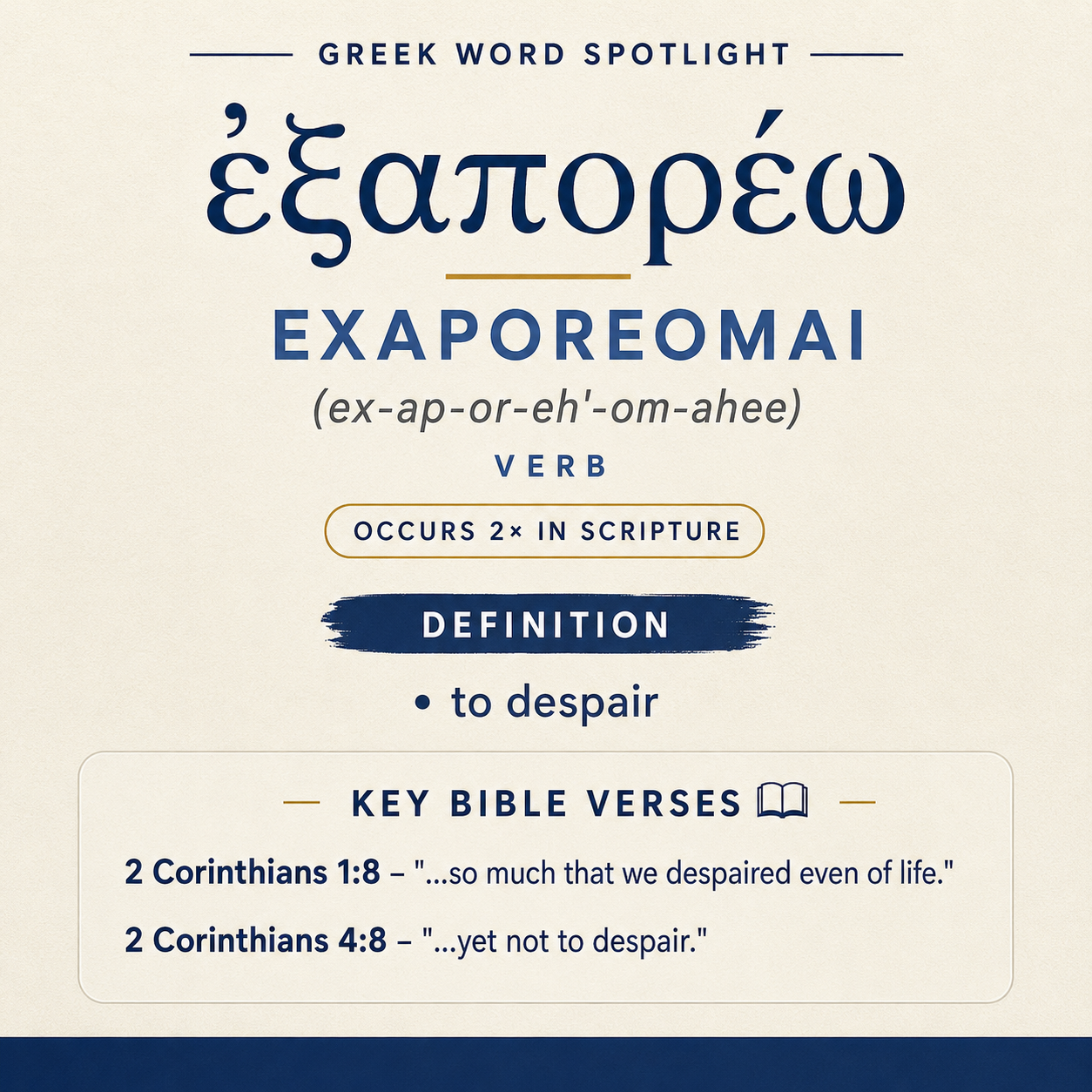
ἐξαπορέω means “to despair” and appears twice in Scripture, in 2 Corinthians 1:8 and 2 Corinthians 4:8.
New Testament Occurrences
It occurs 2 times in Scripture. Both occurrences are in 2 Corinthians (1:8; 4:8).
Learn More →Context in Corinthians
In 2 Corinthians 4:8 it is used in the phrase “yet not to despair.” In 2 Corinthians 1:8 it appears in the account of affliction in Asia.
Learn More →ἐξαπορέω means “to despair.” It appears in two places in 2 Corinthians, both in Paul’s descriptions of pressure so severe it threatens hope and endurance.
Root and Related Words
Exaporeomai is formed with the preposition ek (ἐκ), “out from,” and the verb aporeō (ἀπορέω), “be perplexed.” The combination expresses a movement “out from” a state of perplexity into the extreme condition named by the verb.

Occurrences
For we don’t desire to have you uninformed, brothers, concerning our affliction which happened to us in Asia, that we were weighed down exceedingly, beyond our power, so much that we despaired even of life. (2 Corinthians 1:8)
Here the verb is the climax of a mounting description of distress. Paul speaks of “affliction” that “happened to us in Asia,” then piles up intensifiers: “we were weighed down exceedingly,” and this burden is “beyond our power.” Within that portrayal, “we despaired even of life” presents despair as the inner effect of being pressed past human capacity. The phrase “even of life” anchors the despair to survival itself: the situation did not merely create discomfort or uncertainty, but drove the mind toward the conclusion that life would not continue. In this sentence, despair is not treated as a passing mood; it is a response matched to an affliction described as overpowering and weighty, an experience that overwhelms normal resources and brings a person to the edge of continuing.
We are pressed on every side, yet not crushed; perplexed, yet not to despair; (2 Corinthians 4:8)
In this line the verb appears in a series of paired contrasts. The first pair sets bodily or circumstantial pressure (“pressed on every side”) against an outcome that does not occur (“yet not crushed”). The second pair moves inward: “perplexed” names a disorienting condition, but “yet not to despair” marks a boundary the experience does not cross. The placement is significant: despair is presented as the possible endpoint of perplexity, but one that is resisted. The sentence portrays resilience under strain by distinguishing levels of hardship. Pressure and perplexity are real and admitted; despair is the line that is not reached. The verb therefore functions as a measure of extremity: it is what the hardships could produce, but in this instance do not.
Sense and Usage
Across these two occurrences, “to despair” operates in relation to intensity and limits. In 2 Corinthians 1:8, despair is reached because the affliction is described as surpassing strength—“beyond our power”—and the language of weight (“weighed down exceedingly”) conveys a crushing load that drives the sufferer toward a hopeless outlook regarding life itself. Despair is thus connected with the perception that one’s capacity has been exceeded and that the situation has become terminal.
In 2 Corinthians 4:8, the same verb functions differently: it is not the enacted result but the threatened result. The verse outlines hardships in escalating terms—external pressure (“pressed on every side”), then internal disorientation (“perplexed”)—and then denies the final collapse (“yet not crushed… yet not to despair”). Here despair stands as the ultimate inner breakdown that might follow perplexity. The contrast implies that perplexity can be present without surrendering to despair. The verb therefore can name either the point reached under unbearable weight (1:8) or the point avoided even while experiencing real confusion and pressure (4:8).
The related verb aporeō (“be perplexed”) helps frame this relationship in 4:8, where both ideas appear side by side. Perplexity describes the experience of being at a loss; despair names what can follow when that loss becomes total. With ek (“out from”) built into the verb, exaporeomai naturally suits contexts where stress seems to drive someone out from ordinary perplexity into a more final collapse of hope. In 1:8 that drive reaches its conclusion—despair “even of life.” In 4:8 it is checked—perplexed, “yet not to despair.”
Imagery in Context
Both passages cast despair in the imagery of crushing force and constriction. In 1:8 the weight is so great that life itself seems in question; in 4:8 the pressure comes “on every side,” and despair appears as the inward equivalent of being crushed. Taken together, the word evokes the edge where hardship presses a person toward hopelessness, whether that edge is crossed (1:8) or held back (4:8).
Sources: Lexical data from Strong’s Exhaustive Concordance and the Translators Brief Lexicon of Extended Strongs for Greek (STEPBible, CC BY). Occurrence data from the Translators Amalgamated Greek New Testament (STEPBible, CC BY). Scripture quotations from the World English Bible (public domain).