
Exploring the Meaning of Epanago in Greek
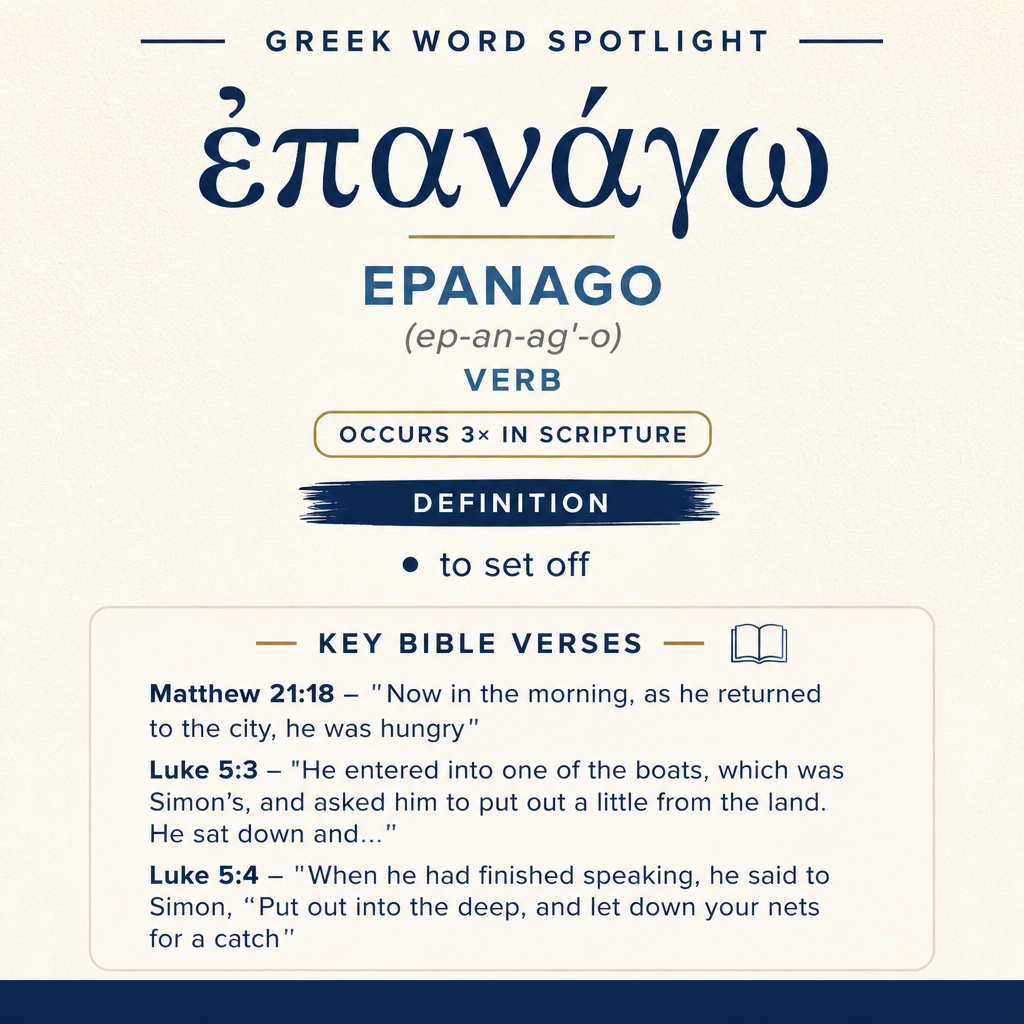
ἐπανάγω means “to set off” and occurs three times in Scripture: Matthew 21:18; Luke 5:3; Luke 5:4.
Scripture Occurrences
This verb occurs 3 times in Scripture: Matthew 21:18 and Luke 5:3–4.
Learn More →Context Snapshots
In Luke 5:3–4 it is used in boat instructions to put out from land and into the deep; in Matthew 21:18 it appears in a morning return to the city.
Learn More →ἐπανάγω expresses the action of setting off, and it appears in three Gospel scenes: one in Matthew’s account of Jesus returning to the city, and two in Luke’s account of Jesus directing a boat’s movement on the water. Across these settings, the word’s force is felt in the shift from stillness to motion, as a departure is initiated.
Root and Related Words
ἐπανάγω is connected with epi (ἐπί), “upon/to/against” (Strong’s G1909), and anago (ἀνάγω), “to lead” (Strong’s G321). Together these related elements frame the verb as a directed movement that is begun or resumed with a sense of being borne onward “upon” a course rather than remaining where one is.

Occurrences
“Now in the morning, as he returned to the city, he was hungry.” (Matthew 21:18)
In this brief narrative notice, ἐπανάγω marks the start of travel back toward a known destination: “the city.” The morning setting adds a natural sense of beginning and departure. The movement is not described in detail—no route, no companions, no obstacles—but the verb supplies the simple, decisive transition from one place to another, setting the scene for what follows by placing Jesus in motion and locating him again on the way into the city. The added note “he was hungry” keeps the focus on embodied, ordinary circumstances occurring during that setting off.

“He entered into one of the boats, which was Simon’s, and asked him to put out a little from the land. He sat down and taught the multitudes from the boat.” (Luke 5:3)
Here ἐπανάγω is tied to a concrete request: to move the boat away from shore—“put out a little from the land.” The action is small in distance (“a little”), but it is still a true setting off: the boat shifts from being beached or held at the shoreline into being afloat and positioned. Luke immediately links this movement to purpose and outcome: once the boat has been put out, Jesus “sat down and taught the multitudes from the boat.” The word therefore contributes a functional repositioning—setting off not for travel as an end in itself, but to create space and vantage for teaching, with the water forming a natural boundary between the speaker and the crowd.
“When he had finished speaking, he said to Simon, “Put out into the deep, and let down your nets for a catch.”” (Luke 5:4)
In the next verse the same basic action is intensified. Instead of “a little from the land,” the command is “into the deep.” ἐπανάγω here carries the sense of initiating a deliberate departure from the shallow, near-shore position into a more exposed location on the water. The setting off is paired with a second directive—“let down your nets”—so the boat’s movement is not merely relocation but the opening move in an intended task. The sequence “finished speaking… Put out… and let down” presents a clean transition from teaching to action, where setting off becomes the necessary first step toward the attempted catch.
Sense and Usage
Across these three occurrences, ἐπανάγω consistently conveys setting off as a shift from a stationary or settled position to purposeful motion. In Matthew, the destination is land-based and familiar (“returned to the city”), so the verb reads as the start of a return journey whose simplicity fits the understated narrative line. In Luke, the setting is maritime and immediate: the boat is first moved slightly off the land to serve teaching, then moved out to “the deep” to serve work. Taken together, the passages show that setting off can be measured or minimal (“a little from the land”) or decisive and farther-ranging (“into the deep”), but in each case it is an initiating act that positions a person or vessel for what comes next.
The word’s usage in Luke especially highlights how setting off can be commanded and responsive: Jesus “asked” for the boat to be put out, and later “said to Simon” to put out into deeper water. In both lines, the verb functions as an instruction that changes the physical arrangement of the scene. That change is not ornamental; it creates conditions for teaching (distance from land, stable platform) and then for fishing (access to deeper water, readiness to lower nets). Thus ἐπανάγω can carry a practical, scene-shaping force: the narrative turns on the moment when someone initiates departure from shore or from a prior position.
Even when the movement is not described with nautical detail, as in Matthew, the same basic idea holds: setting off is a simple but consequential hinge. The story does not linger on the mechanics of travel, but it depends on the fact that movement has begun, and that hunger is experienced within that moving, morning return.
Imagery
In these verses, ἐπανάγω is colored by everyday imagery: a morning walk back toward the city, a boat nudged off the shoreline, and then a push out into deep water. The word gathers these into a single picture of departure that is concrete and directed—setting off as the moment when a place behind and a destination or task ahead come into view through motion.
Sources: Lexical data from Strong’s Exhaustive Concordance and the Translators Brief Lexicon of Extended Strongs for Greek (STEPBible, CC BY). Occurrence data from the Translators Amalgamated Greek New Testament (STEPBible, CC BY). Scripture quotations from the World English Bible (public domain).





