Exploring the Meaning of Entulisso in Greek
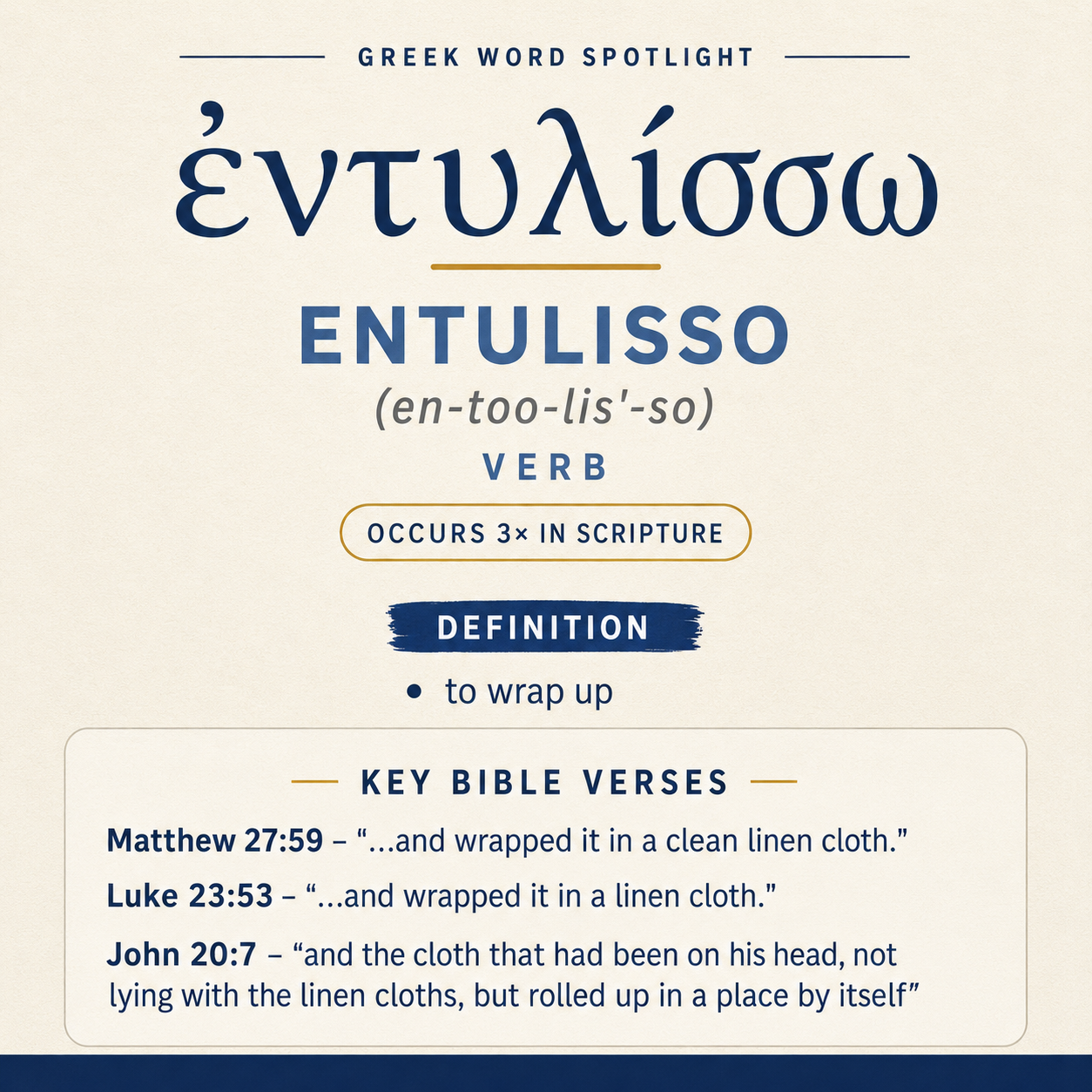
ἐντυλίσσω means “to wrap up” and appears in Matthew 27:59, Luke 23:53, and John 20:7.
Gospel Occurrences
This verb occurs three times in Scripture. All three occurrences are in the Gospels: Matthew, Luke, and John.
Learn More →Context In Verses
In Matthew 27:59 and Luke 23:53, a body is wrapped in linen cloth. In John 20:7, a head cloth is rolled up separately.
Learn More →ἐντυλίσσω means “to wrap up.” It appears in the burial accounts of Jesus in Matthew and Luke, and again in John in the description of the graveclothes left in the tomb.
Root and Related Words
The related word ἐν (en), “in/on/among” (Strong’s G1722), is linked to ἐντυλίσσω in Strong’s discussion of derivation.

Occurrences
“Joseph took the body, and wrapped it in a clean linen cloth,” (Matthew 27:59)
Here the action is performed by Joseph on “the body.” The verb marks a deliberate handling of the corpse: he does not leave it exposed but encloses it within “a clean linen cloth.” The stated cleanliness of the cloth highlights care in the burial process, and the wrapping itself functions as the immediate, practical step that prepares the body for burial. In the scene as narrated, wrapping is the central physical gesture Joseph performs after taking the body.
“He took it down, and wrapped it in a linen cloth, and laid him in a tomb that was cut in stone, where no one had ever been laid.” (Luke 23:53)
Luke places the wrapping between two other movements: “He took it down” and then “laid him in a tomb.” ἐντυλίσσω identifies the middle act that transitions from removal to interment. The body is first taken down; then it is wrapped; then it is laid in a specific burial place—“a tomb that was cut in stone”—described further as unused: “where no one had ever been laid.” The wrapping in “a linen cloth” is thus presented as an integral part of an orderly sequence, and its position in the sentence shows it as preparatory to placing the body into the tomb.
“and the cloth that had been on his head, not lying with the linen cloths, but rolled up in a place by itself.” (John 20:7)
John uses the verb for the state of a particular piece of burial fabric: “the cloth that had been on his head.” Instead of being “lying with the linen cloths,” it is “rolled up in a place by itself.” The description focuses on placement and condition, distinguishing one cloth from “the linen cloths” and noting its separated location. ἐντυλίσσω here contributes the idea of a cloth gathered into a compact form, emphasizing that it is not simply abandoned in a heap but arranged—“rolled up”—and set apart.
Sense and Usage
Across these passages, “to wrap up” is expressed in two closely related burial contexts: (1) the act of enclosing the body in linen and (2) the condition of burial cloths associated with the body. In Matthew and Luke the verb describes the hands-on act performed upon the body itself: a person takes the body and wraps it in linen. The linen is explicitly named in both accounts (“a clean linen cloth” in Matthew; “a linen cloth” in Luke), so the verb’s force is tangible and concrete—wrapping is what turns the taken body into a prepared body for burial.
John’s use keeps the action within the same sphere of burial cloths but shifts the perspective. The emphasis is not on someone wrapping the body, but on what is seen afterward: a head cloth that “had been on his head” is “rolled up in a place by itself.” Even though the immediate scene is not narrating a burial, the vocabulary and the objects in view belong to the burial setting already established by the mention of “linen cloths” and the head cloth. In this way, “to wrap up” extends naturally from wrapping a body in linen to the way a cloth can itself be wrapped or gathered into an orderly form.
The three occurrences also show that the verb can describe wrapping with different degrees of specification. Matthew qualifies the linen as “clean,” drawing attention to the character of what is used for the wrapping. Luke does not add that qualifier but adds spatial and narrative detail around the act: the body is wrapped and then placed in “a tomb that was cut in stone,” a tomb with the notable feature of having had no previous occupant. John, rather than describing the linen’s quality or the tomb’s construction, describes the arrangement of the cloth in relation to other cloths: “not lying with the linen cloths, but rolled up in a place by itself.” Thus, the same core idea of wrapping serves slightly different narrative aims: preparation for burial, orderly sequence in burial, and observed condition of burial items.
Imagery in Context
In Matthew 27:59 and Luke 23:53, ἐντυλίσσω evokes the image of a body being enclosed in linen as part of burial preparation: “wrapped it in a clean linen cloth” (Matthew 27:59) and “wrapped it in a linen cloth” (Luke 23:53). In John 20:7 the imagery narrows to a single item—“the cloth that had been on his head”—now “rolled up in a place by itself.” Together these scenes present wrapping as careful physical handling of linen in relation to death and burial, and then as the visible arrangement of those burial cloths in the tomb.
Sources: Lexical data from Strong’s Exhaustive Concordance and the Translators Brief Lexicon of Extended Strongs for Greek (STEPBible, CC BY). Occurrence data from the Translators Amalgamated Greek New Testament (STEPBible, CC BY). Scripture quotations from the World English Bible (public domain).