Exploring the Meaning of Entos in Greek
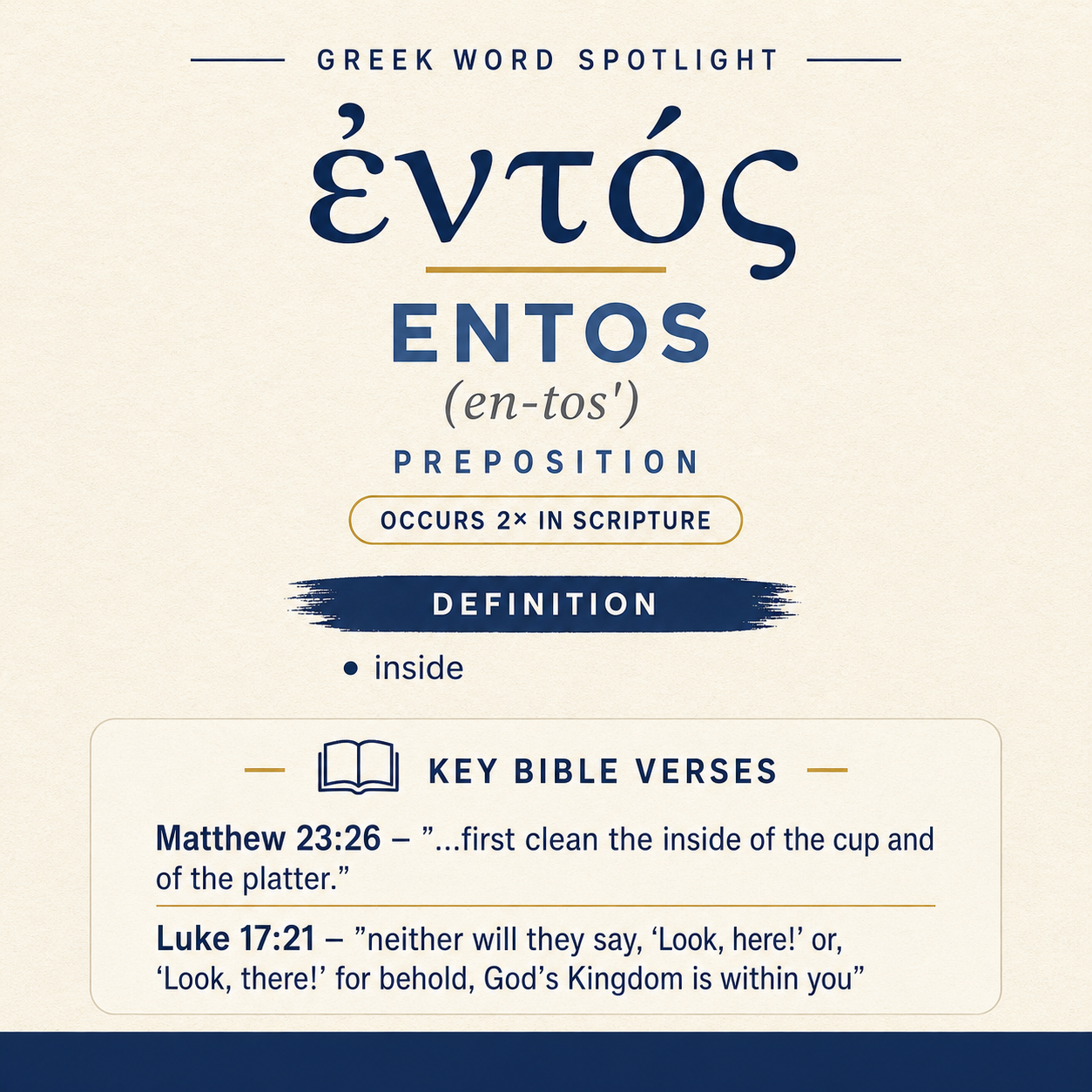
ἐντός means “inside” and appears twice in Scripture: Matthew 23:26 and Luke 17:21.
Core Meaning
ἐντός means “inside.” It points to what is within rather than outward appearance.
Learn More →Gospel Occurrences
It occurs in Matthew 23:26 about cleaning the inside of a cup and platter. It also appears in Luke 17:21: “God’s Kingdom is within you.”
Learn More →Usage Snapshot
In Matthew 23:26 it contrasts inside with outside in a cleansing illustration. In Luke 17:21 it locates God’s Kingdom “within you.”
Learn More →ἐντός means “inside.” In the New Testament it appears in Jesus’ rebuke about cleansing what is inside a vessel and in his statement that God’s Kingdom is within his hearers.
Root and Related Words
ἐντός is related to en (ἐν), “in/on/among” (Strong’s G1722).

Occurrences
“You blind Pharisee, first clean the inside of the cup and of the platter, that its outside may become clean also.” (Matthew 23:26)
Here ἐντός locates the focus of cleansing: the “inside of the cup and of the platter.” The sentence sets up a deliberate contrast between two regions of the same objects—an inner space and an outer surface—then orders the sequence: “first” attend to what is inside, “that its outside may become clean also.” In the logic of the rebuke, “inside” is not a vague metaphor but the defining starting point; the instruction depends on there being a real distinction between an interior that can be addressed directly and an exterior that is affected in consequence. By anchoring the command to the interior of ordinary tableware, ἐντός gives the critique a concrete, spatial clarity: what is hidden from casual view is treated as primary, and what is visible is treated as secondary and derivative. The word therefore carries the weight of priority and order in the single imperative, making the point not merely about cleanliness in general but about where cleansing must begin.
“neither will they say, ‘Look, here!’ or, ‘Look, there!’ for behold, God’s Kingdom is within you.” (Luke 17:21)
In this saying, ἐντός again marks an interior location, but the scene shifts from objects that can be handled to persons addressed by Jesus. The statement denies that the Kingdom can be pointed out as a visible, external target—“neither will they say, ‘Look, here!’ or, ‘Look, there!’”—and then gives the contrasting locator: “for behold, God’s Kingdom is within you.” The force of ἐντός is to place the Kingdom’s presence in an inner sphere rather than in a spot that can be indicated by direction. The word thus participates in the structure of the sentence: it answers the question implicitly raised by the rejected exclamations (“Where is it?”) by relocating the expected search from outward pointing to inward reality. The final clause depends on ἐντός to make the contrast sharp: what cannot be found by scanning the horizon is nevertheless present, but present as something located inside the ones being addressed.
Sense and Usage
Across its two uses, ἐντός consistently expresses interiority—what lies within a boundary—yet it does so in two different kinds of domains. In Matthew 23:26 the boundary is physical and obvious: the walls of a “cup” or “platter” define an inside that can contain and an outside that can be seen and touched. The interior is the hidden region that nevertheless governs the state of the whole object in Jesus’ reasoning (“first” clean it, and the outside “may become clean also”). In Luke 17:21 the boundary is personal rather than ceramic: the word locates something with respect to “you,” shifting the spatial idea of inside from a vessel’s cavity to an inward sphere associated with people. In both passages the term functions as a locator that sets an interpretive direction. It is not merely descriptive; it organizes attention by specifying the region that matters.
The two contexts also show how ἐντός can participate in contrasts. In Matthew, the implied counterpart is explicitly named (“outside”), and the contrast is used to establish proper order of action: inner first, then outer. In Luke, the contrast is built through negation and correction: not “here” or “there” (the language of external pointing), but “within you” (the language of interior presence). Though the subjects differ—cleaning tableware in one case and recognizing the presence of God’s Kingdom in the other—the same spatial sense gives both sayings their rhetorical edge. ἐντός supplies a concrete axis (inside versus outside) that makes the rebuke and the instruction intelligible in their respective scenes.
These two attestations also show that ἐντός naturally pairs with the language of perception. The outside is what can be observed at a glance; the inside is what must be attended to deliberately. Matthew’s imperative assumes that a person might present an outside appearance of cleanliness while neglecting the inside; the word “inside” exposes that difference in a way the hearer cannot evade, because the cup’s interior can be imagined immediately. Luke’s denial of “Look, here!” and “Look, there!” similarly assumes a kind of searching that depends on sight and location; ἐντός redirects the idea of where one should expect to encounter the Kingdom. In both, interiority is not defined by distance but by being enclosed, and the word’s placement in the sentences makes the inside the decisive realm: the realm to cleanse, and the realm where God’s Kingdom is present.
Imagery
Matthew 23:26 gives ἐντός an image drawn from everyday life: a cup and a platter with an interior that can be washed. The simple household picture makes “inside” tangible and memorable, turning the unseen space into the focal point of Jesus’ command. Luke 17:21 then carries the same interior language into a different kind of picture: not dishes on a table but the hearers themselves as the location named by “within you.” Together, the two passages let ἐντός evoke both the hidden space inside an object and the inward sphere of persons—each time emphasizing what is not located by outward display or outward pointing.
Sources: Lexical data from Strong’s Exhaustive Concordance and the Translators Brief Lexicon of Extended Strongs for Greek (STEPBible, CC BY). Occurrence data from the Translators Amalgamated Greek New Testament (STEPBible, CC BY). Scripture quotations from the World English Bible (public domain).