Exploring the Meaning of Entopios in Greek
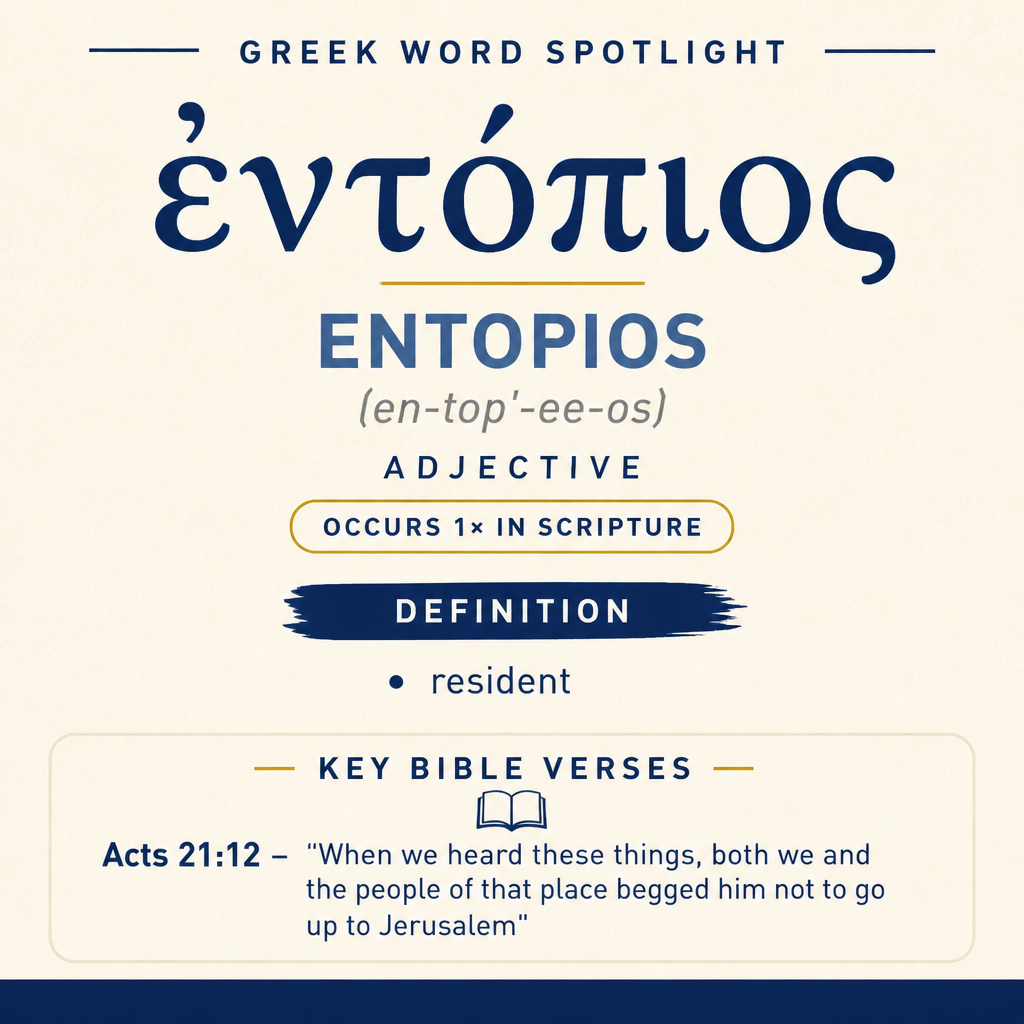
ἐντόπιος means “resident” and appears once in Scripture, in Acts 21:12.
Context in Acts
In Acts 21:12, “the people of that place” begged him not to go up to Jerusalem.
Learn More →ἐντόπιος means “resident” and appears in a single New Testament scene describing urgent pleading about a journey to Jerusalem. In that moment the word highlights how local people join with traveling companions in a shared appeal.
Root and Related Words
ἐντόπιος is formed from ἐν (en), “in/on/among” (Strong’s G1722), and τόπος (topos), “place” (Strong’s G5117). The combination naturally expresses the idea of being “in a place,” and so it marks someone characterized by connection to a particular locale.

Occurrences
Acts 21:12: “When we heard these things, both we and the people of that place begged him not to go up to Jerusalem.”
Here ἐντόπιος stands behind the phrase “the people of that place,” distinguishing a second group alongside “we.” The verse itself sets up a contrast of perspectives: “we” are already with Paul and share in hearing “these things,” while “the people of that place” are tied to the current location and are introduced as an additional voice in the appeal. Calling them “resident” frames their participation as coming from those who belong to the locale where the conversation is happening, not merely from members of the traveling party.
The word’s force in this sentence is social as much as geographic. The plea is not limited to close associates; it becomes communal, joined by those who are defined by the place they inhabit. The text depicts a widening circle of concern: the travelers (“we”) and the residents (“the people of that place”) together “begged him not to go up to Jerusalem.” ἐντόπιος thus supplies a way to name the local constituency whose attachment to the setting makes their response part of the scene’s urgency.
Sense and Usage
“Resident” in this context is a relational label: it identifies people by their settled association with a given place, as opposed to those who are present as visitors or co-journeyers. The verse portrays two groups who react to the same report (“When we heard these things”), but it takes care to specify that the second group is composed of locals. ἐντόπιος therefore helps the reader picture the situation as unfolding within a real community rather than in a private exchange.
In Acts 21:12, being a “resident” is not treated as a legal category or a civic status; it functions as a practical descriptor in narrative. The residents are those who are “of that place,” and their voice carries the weight of the immediate environment: they are embedded in the locale where the warning is heard and where the discussion about travel takes place. By marking them as residents, the line underscores that the concern about the journey is shared across different kinds of relationships to Paul—both companions and locals respond with the same emotional urgency (“begged”).
The sense also contributes to the movement implied in the verse. The appeal concerns going “up to Jerusalem,” so the narrative already has direction and destination. Naming “the people of that place” as residents intensifies that movement: there is a present location with its own people, and there is Jerusalem, the intended destination. ἐντόπιος anchors the reader in the “here” of the story even as the sentence points toward the “there” of Jerusalem. In that way, “resident” marks the community at the starting point of the contested journey, the people whose identity is tied to the immediate setting from which Paul would depart.
Because the term appears in a moment of pleading, its nuance is felt through the action it accompanies. The residents are not passive background; they actively “begged.” The word “resident” therefore serves to show that the appeal is not merely internal among the travelers but also arises from those rooted in the location. The verse’s structure—“both we and the people of that place”—makes the resident group parallel to “we,” presenting their entreaty as unified with that of the companions, though their connection to Paul is framed differently: the one group by shared travel and the other by shared place.
Imagery
The imagery carried by ἐντόπιος in Acts 21:12 is the image of local voices gathering around a decision at the edge of departure. “The people of that place” evokes a settled community reacting from within its own setting, joining hands—so to speak—with travelers in a single urgent request: “begged him not to go up to Jerusalem.” The word “resident” keeps the scene grounded in a specific location with its own inhabitants, making the moment feel like a public, communal appeal rather than a private travel discussion.
Sources: Lexical data from Strong’s Exhaustive Concordance and the Translators Brief Lexicon of Extended Strongs for Greek (STEPBible, CC BY). Occurrence data from the Translators Amalgamated Greek New Testament (STEPBible, CC BY). Scripture quotations from the World English Bible (public domain).