
Exploring the Meaning of Entellomai in Greek
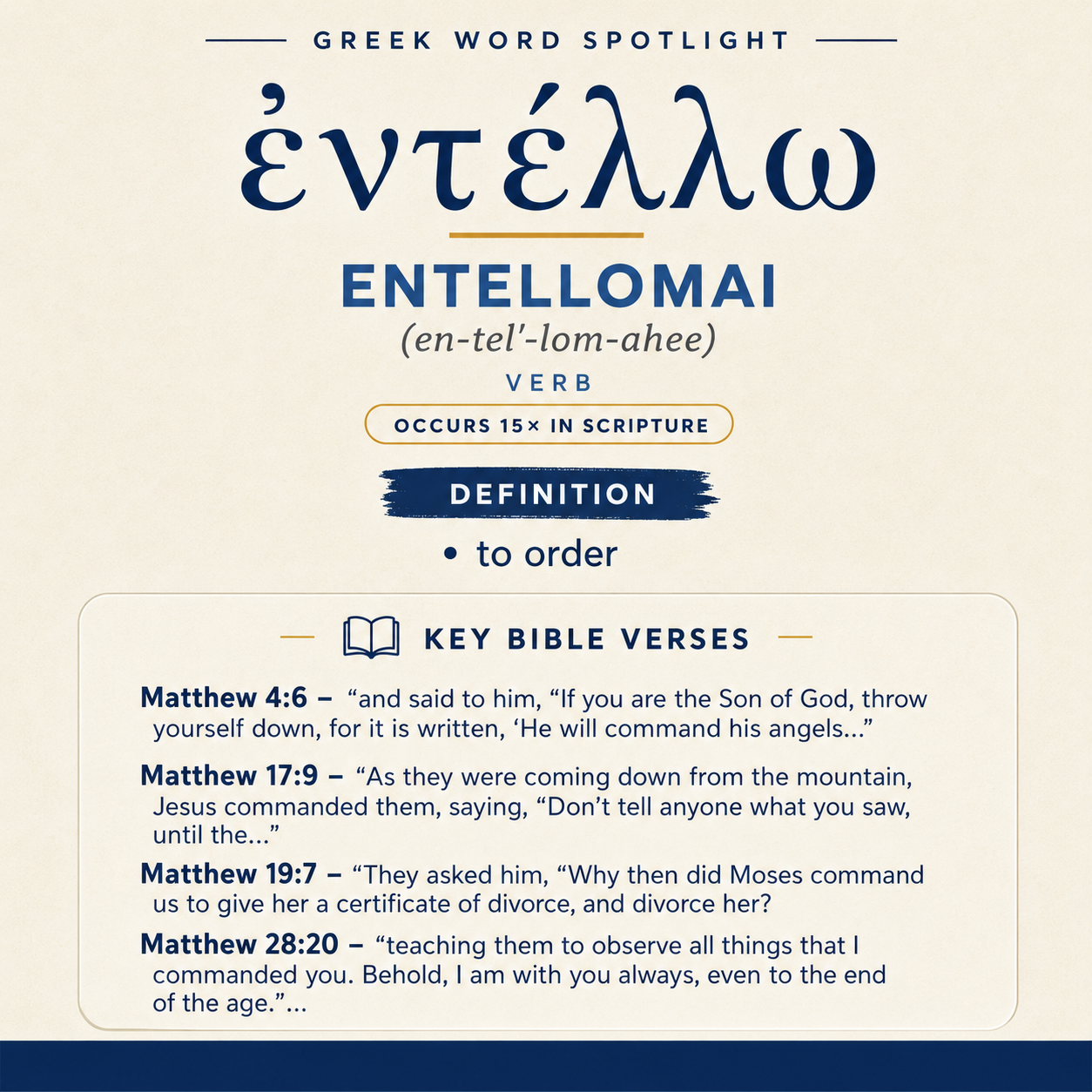
ἐντέλλω (Entellomai) means “to order” and occurs 15 times in Scripture, including passages in Matthew, Mark, Luke, and John.
Core Meaning
ἐντέλλω is defined as “to order.” In the listed verses, it is used for giving a command.
Learn More →Gospel Occurrences
Examples include Matthew 4:6; 17:9; 19:7; 28:20; Mark 10:3; 13:34; Luke 4:10; and John 8:5. These texts show the verb used in contexts of issuing commands.
Learn More →Command Contexts
The word is used for commands attributed to Jesus (Matthew 17:9; 28:20) and to Moses (Matthew 19:7; Mark 10:3; John 8:5). It also appears in quotations about angels being commanded (Matthew 4:6; Luke 4:10).
Learn More →ἐντέλλω expresses the giving of an order. In the passages where it appears, it marks speech or action that carries the force of an authoritative directive, whether attributed to Scripture, to Moses, to Jesus, to the Father, or to the apostles’ commission.
Occurrences
and said to him, “If you are the Son of God, throw yourself down, for it is written, ‘He will command his angels concerning you,’ and, ‘On their hands they will bear you up, so that you don’t dash your foot against a stone.’ ” (Matthew 4:6)
Here ἐντέλλω belongs to a written citation placed in the mouth of the tempter: angels are the recipients of a command “concerning you.” The scene frames ordering as something that can be attributed to God’s governance of heavenly agents; the “command” is presented as the reason the daring act should be safe, because it would set angelic protection in motion.
As they were coming down from the mountain, Jesus commanded them, saying, “Don’t tell anyone what you saw, until the Son of Man has risen from the dead.” (Matthew 17:9)
In this descent-from-the-mountain setting, ἐντέλλω introduces a concrete restriction: “Don’t tell anyone what you saw.” The order is time-bound (“until the Son of Man has risen from the dead”), so the commanding is not merely prohibitive; it controls when speech may happen, shaping the disciples’ witness by setting a boundary around disclosure.
They asked him, “Why then did Moses command us to give her a certificate of divorce, and divorce her?” (Matthew 19:7)
Here ἐντέλλω is used in a dispute question aimed at Jesus, and its force is legal: “Moses command us” to perform specified actions. The ordering is framed as an obligation resting on “us,” and the content of the command is procedural (“give her a certificate of divorce”) and decisive (“and divorce her”), highlighting the way an order can be appealed to as a settled norm.
teaching them to observe all things that I commanded you. Behold, I am with you always, even to the end of the age.” Amen. (Matthew 28:20)
In this commissioning context, ἐντέλλω defines the content of ongoing teaching: disciples are to be taught “to observe all things” Jesus previously ordered. The verb therefore connects past authoritative instruction (“I commanded you”) with future practice (“observe”), presenting commands as something remembered, transmitted, and enacted across time.
He answered, “What did Moses command you?” (Mark 10:3)
In Mark’s exchange, ἐντέλλω is used to direct attention to the authoritative source behind a debated practice: “Moses.” The question assumes that what Moses ordered has binding relevance; the command is treated as a reference point that can be cited and examined.
“It is like a man, traveling to another country, having left his house, and given authority to his servants, and to each one his work, and also commanded the doorkeeper to keep watch. (Mark 13:34)
In this parable-like comparison, ἐντέλλω appears as part of a household’s delegated structure. The man both “given authority to his servants” and “commanded the doorkeeper to keep watch,” so the ordering is one expression of exercised authority, assigning responsibility (watchfulness) to a specific role (the doorkeeper) while the master is away.
for it is written, ‘He will put his angels in charge of you, to guard you;’ (Luke 4:10)
This is the same wilderness temptation setting as Matthew’s citation, but with slightly different wording: the written line depicts angels being put “in charge of you, to guard you.” The order is portrayed as appointing angels to a task with a purpose clause (“to guard you”), emphasizing commanding as a means of establishing protective oversight.
Now in our law, Moses commanded us to stone such women. What then do you say about her?” (John 8:5)
In the confrontation over the woman’s case, ἐντέλλω again appears on the lips of those appealing to “our law” and to Moses. The command is represented as prescribing a penalty (“to stone such women”) and is used rhetorically to press Jesus for an answer: the claim of an established order becomes the lever for demanding a verdict.
But that the world may know that I love the Father, and as the Father commanded me, even so I do. Arise, let’s go from here. (John 14:31)
Here ἐντέλλω is placed within Jesus’ description of his obedience: the Father commanded, and Jesus does “even so.” The ordering is not presented as a bare decree; it is tied to relational purpose (“that the world may know that I love the Father”), and it is matched by immediate readiness for action (“Arise, let’s go from here”), portraying command as something that leads to doing.
You are my friends, if you do whatever I command you. (John 15:14)
In this statement, ἐντέλλω marks the condition attached to a relational designation: friendship is linked with doing what Jesus orders. The command is not described in content here, but the emphasis falls on comprehensive compliance (“whatever I command you”) as the practical expression of that relationship.
“I command these things to you, that you may love one another. (John 15:17)
In the same discourse setting, ἐντέλλω is explicitly connected to an intended outcome: “that you may love one another.” The ordering is therefore purposive; the command is aimed at shaping communal life, with the directive serving as the means toward the stated goal.
until the day in which he was received up, after he had given commandment through the Holy Spirit to the apostles whom he had chosen. (Acts 1:2)
Acts uses ἐντέλλω to characterize what Jesus did prior to being “received up”: he “had given commandment through the Holy Spirit to the apostles.” The ordering is presented as mediated (“through the Holy Spirit”) and directed to a defined group (“the apostles whom he had chosen”), locating command within the transition from Jesus’ earthly presence to the apostles’ commissioned role.

Sense and Usage
Across these passages, ἐντέλλω functions as a verb of ordering that regularly assumes an authority structure: one party issues directives, another receives them as binding. The “commander” varies—God as represented in written citation (Matthew 4:6; Luke 4:10), Moses as an emblem of covenantal/legal authority (Matthew 19:7; Mark 10:3; John 8:5), Jesus as teacher and Lord who directs disciples’ behavior and speech (Matthew 17:9; Matthew 28:20; John 15:14; John 15:17), and the Father as the one whose command Jesus enacts (John 14:31). Acts 1:2 gathers these strands by speaking of Jesus giving orders in a way connected with the Holy Spirit and aimed at the chosen apostles.
The content of the orders shows several recurring shapes. Some commands assign protective care by appointing agents to a task: angels are commanded or charged “to guard you” (Matthew 4:6; Luke 4:10). Other commands restrict or regulate speech: the disciples are ordered not to tell what they saw, with an “until” that sets the limit (Matthew 17:9). Several uses are legal-procedural, appealing to Moses as commanding specific actions and penalties (Matthew 19:7; John 8:5), and these claims become part of a disputational strategy—commands are invoked to compel an interpretation or response from Jesus. Elsewhere the emphasis is on ongoing discipleship: Jesus’ past commands become the curriculum for teaching and “observ[ing]” (Matthew 28:20), and his present commands define the contours of obedience within relationship (“if you do whatever I command you,” John 15:14) and within community (“that you may love one another,” John 15:17).
Several passages also highlight that ordering is not detached from action. Mark 13:34 sets command within delegated responsibility: authority is given, work is assigned “to each one,” and the doorkeeper receives a specific directive to “keep watch.” John 14:31 links command to immediate compliance (“even so I do”) and frames that compliance as publicly meaningful (“that the world may know”). Acts 1:2 similarly treats commanding as a key preparatory act before Jesus’ departure, suggesting that orders function to establish continuity of mission and practice among those addressed.
Imagery
The word often carries the imagery of a spoken directive that sets people—or even angels—into appointed motion. In the temptation citations (Matthew 4:6; Luke 4:10), commanding is pictured as sending guardians to prevent harm; in the household scene (Mark 13:34), it is the master’s voice assigning vigilance and work; and in the farewell and commissioning contexts (Matthew 28:20; John 14:31; Acts 1:2), it is the shaping force that binds teaching, obedience, and purposeful action together.
Sources: Lexical data from Strong’s Exhaustive Concordance and the Translators Brief Lexicon of Extended Strongs for Greek (STEPBible, CC BY). Occurrence data from the Translators Amalgamated Greek New Testament (STEPBible, CC BY). Scripture quotations from the World English Bible (public domain).




