
Exploring the Meaning of Energeo in Greek
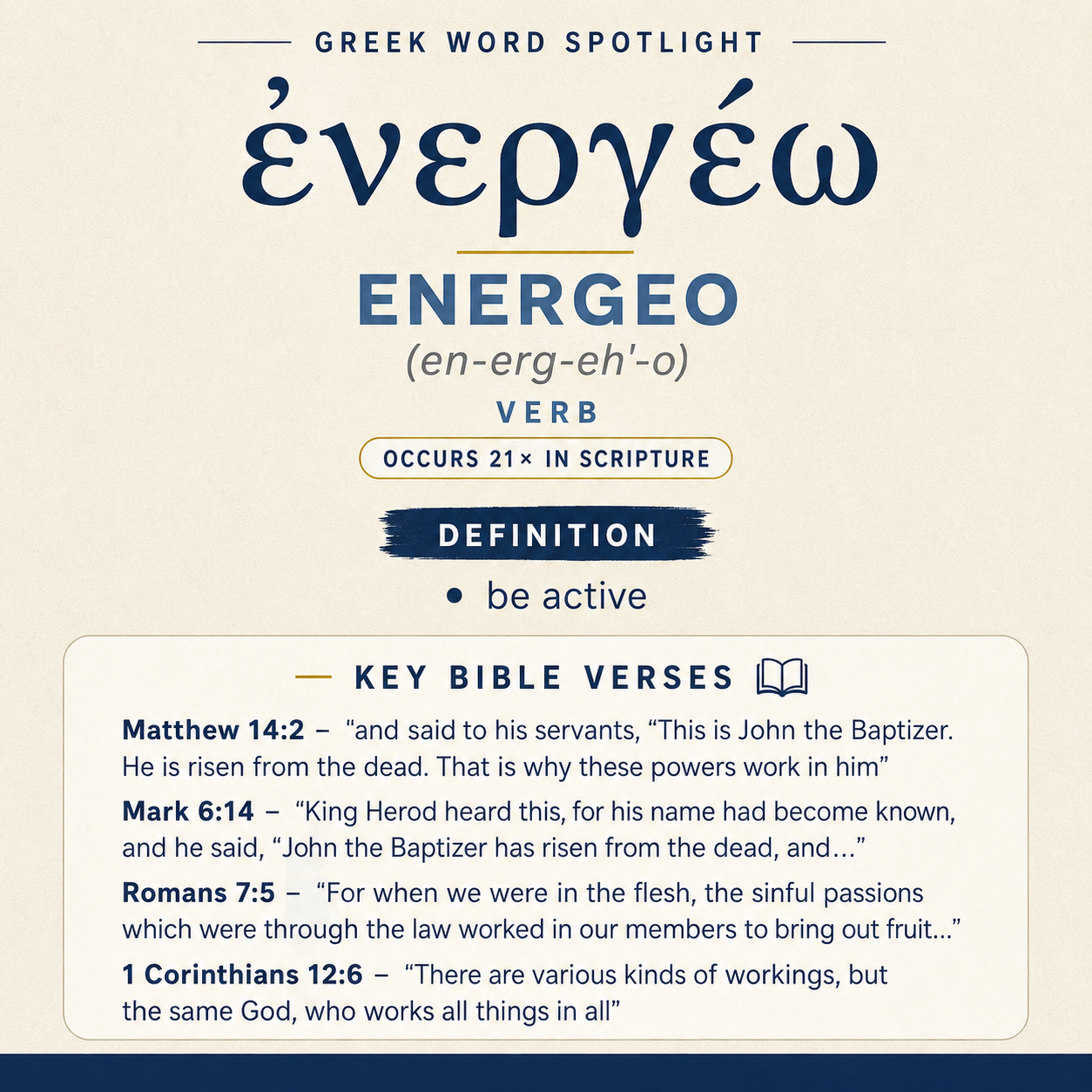
ἐνεργέω means “be active” and occurs 21 times in Scripture, including Matthew 14:2, Romans 7:5, and Galatians 2:8.
Core Meaning
ἐνεργέω is defined as “be active.” In the listed verses, it describes powers, passions, and divine working as active.
Learn More →Scripture Examples
In Matthew 14:2, powers “work in him.” In Romans 7:5, sinful passions “worked in our members” to bring out fruit.
Learn More →Divine Working
1 Corinthians 12:6 says God “works all things in all.” Galatians 2:8 applies the verb to God working through Peter and also through Paul.
Learn More →ἐνεργέω means “be active,” a verb used in several Gospel and Pauline settings to describe powers, passions, divine action, and inner effects within people and communities. In these passages it marks activity that is not merely potential but operative—something at work producing visible results.
Occurrences
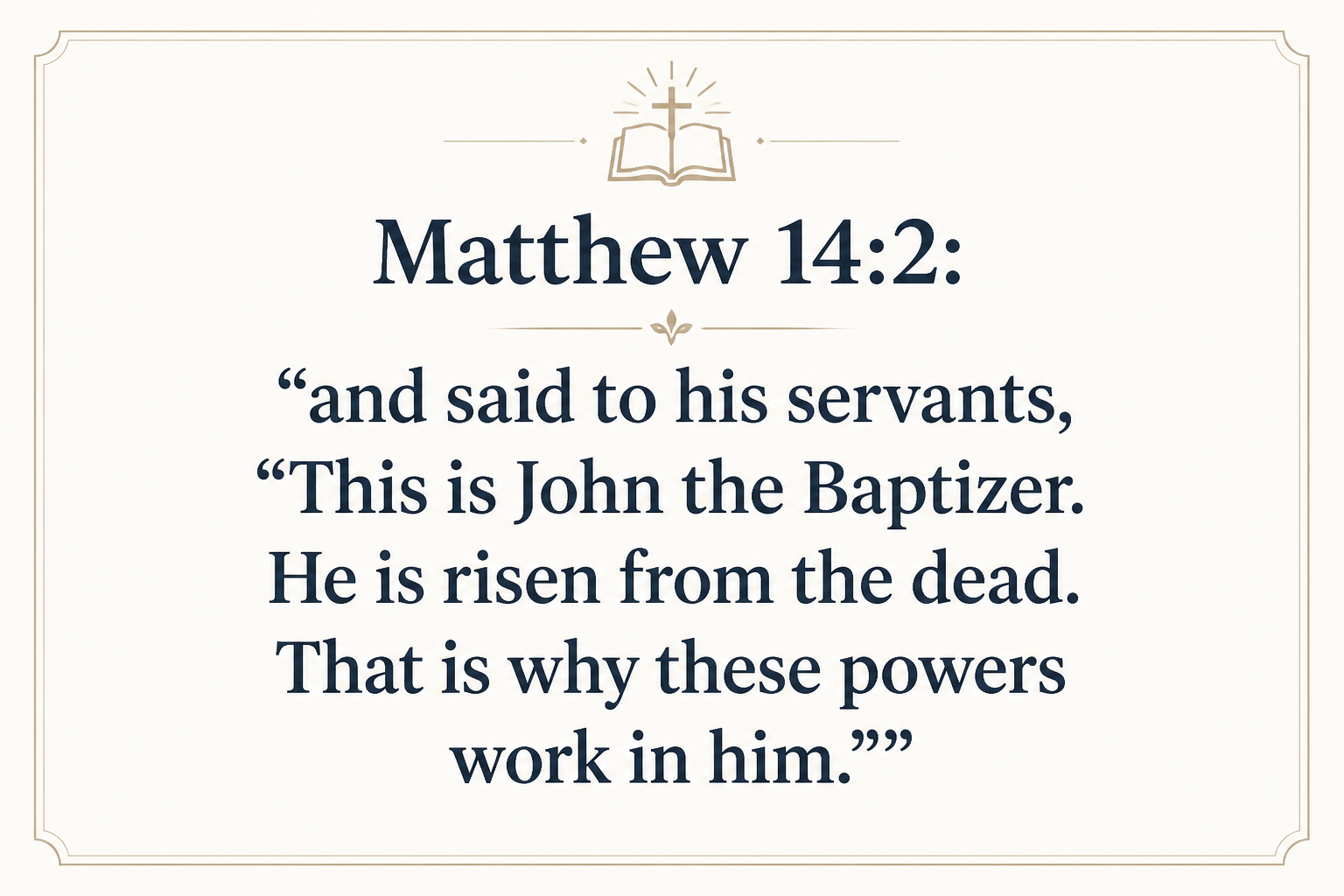
Matthew 14:2: “and said to his servants, “This is John the Baptizer. He is risen from the dead. That is why these powers work in him.””
Here the verb frames a causal explanation: the speaker points to “these powers” and describes them as actively working “in him.” The focus is on perceived operative power within a person, offered as the reason for remarkable effects associated with John the Baptizer.
Mark 6:14: “King Herod heard this, for his name had become known, and he said, “John the Baptizer has risen from the dead, and therefore these powers are at work in him.””
The same idea is restated in Herod’s conclusion: because John “has risen from the dead,” “these powers” are “at work in him.” ἐνεργέω conveys ongoing operation—powers functioning within a person as an explanatory mechanism for what Herod “heard.”
Romans 7:5: “For when we were in the flesh, the sinful passions which were through the law worked in our members to bring out fruit to death.”
In this line, the subject is “the sinful passions,” and their activity is located “in our members.” The verb characterizes these passions as effectively operative, not inert: their working has a direction and outcome, “to bring out fruit to death.” The clause links internal activity to produced result, with “fruit” as the tangible expression of what has been at work.
1 Corinthians 12:6: “There are various kinds of workings, but the same God, who works all things in all.”
ἐνεργέω here is predicated of God, set against “various kinds of workings.” The statement is sweeping in scope: God “works all things in all,” presenting divine activity as comprehensive and pervasive. The verb places emphasis on active operation that extends across “all things” and “all,” aligning diverse effects under a single active source.
1 Corinthians 12:11: “But the one and the same Spirit produces all of these, distributing to each one separately as he desires.”
This verse depicts the Spirit as the effective agent behind varied outcomes: the Spirit “produces all of these” and distributes as desired. Within the same thematic setting as “workings,” the verb contributes the idea of active production and effectual distribution—activity that results in concrete allotments “to each one separately.”
2 Corinthians 1:6: “But if we are afflicted, it is for your comfort and salvation. If we are comforted, it is for your comfort, which produces in you the patient enduring of the same sufferings which we also suffer.”
The verb is used for an effect occurring “in you”: comfort “produces in you the patient enduring” of shared sufferings. ἐνεργέω thus marks an inward, experiential operation—comfort is not only received but actively generates endurance as a lived outcome amid “the same sufferings.”
2 Corinthians 4:12: “So then death works in us, but life in you.”
This compact contrast portrays two active forces in two locations: “death works in us,” and correspondingly “life in you.” The verb depicts both “death” and “life” as operative realities, each exerting an active presence within a community relationship (“in us” / “in you”). The line is framed as an ongoing condition (“So then”), not a momentary event.
Galatians 2:8: “for he who worked through Peter in the apostleship with the circumcised also worked through me with the Gentiles—”
Here ἐνεργέω describes a single agent’s activity “through” two persons in distinct spheres of ministry: through Peter “with the circumcised” and through Paul “with the Gentiles.” The verb underscores effective operation mediated through human instruments, highlighting continuity of active agency across different audiences and callings.
Galatians 3:5: “He therefore who supplies the Spirit to you and does miracles among you, does he do it by the works of the law, or by hearing of faith?”
The activity in view is public and observable: supplying the Spirit “to you” and doing “miracles among you.” ἐνεργέω contributes the notion of effective action that takes place within a community (“among you”), raising a question about the basis or means by which such active deeds occur—“by the works of the law, or by hearing of faith?”
Galatians 5:6: “For in Christ Jesus neither circumcision amounts to anything, nor uncircumcision, but faith working through love.”
In this evaluative contrast, the only element described as operative is “faith,” specifically “working through love.” The verb marks faith as active rather than merely identified or professed; its activity is expressed “through love,” which functions as the channel or sphere in which faith becomes effective.
Ephesians 1:11: “We were also assigned an inheritance in him, having been foreordained according to the purpose of him who does all things after the counsel of his will,”
The clause presents God as the one “who does all things after the counsel of his will.” ἐνεργέω expresses purposeful, effective action aligned with “purpose” and “counsel.” The inheritance is framed within a larger account of divine activity that carries out intention, not arbitrary motion.
Ephesians 1:20: “which he worked in Christ, when he raised him from the dead and made him to sit at his right hand in the heavenly places,”
Here the verb is attached to a particular divine action “in Christ,” specified by two events: raising him “from the dead” and seating him “at his right hand in the heavenly places.” ἐνεργέω portrays this as effectual operation—an act carried out with decisive results, moving from death to exalted position.

Sense and Usage
Across these passages, ἐνεργέω consistently marks activity that is actually operating, not merely present. In the Gospel contexts (Matthew 14:2; Mark 6:14), it is applied to “powers” perceived as functioning within a person; the verb supports an explanatory claim, connecting an asserted cause (John’s being “risen from the dead”) to observable effects attributed to active powers.
In Romans 7:5, the verb becomes a diagnostic term for inward moral dynamics: “sinful passions” are described as working “in our members,” and their activity is traced to a product described as “fruit to death.” The wording ties internal operation to consequence, showing how what is active within people issues in outcomes that can be named and recognized.
In 1 Corinthians 12, the word-group context is “workings” and distribution of diverse effects. The verb’s application to God (“who works all things in all,” 12:6) places comprehensive effectiveness at the center: varied “workings” are unified under one active agent. The subsequent depiction of the Spirit producing and distributing (12:11) reinforces that this activity is purposeful and differentiated—effective action that results in distinct allotments “to each one separately as he desires.” Together, these lines present ἐνεργέω as a term suited to describing agency that is both universal in reach and particular in expression.
In 2 Corinthians, ἐνεργέω highlights effects within relational and experiential settings. Comfort “produces in you the patient enduring” of shared sufferings (1:6), presenting comfort as an operative force that generates endurance rather than merely alleviating pain. The stark antithesis “death works in us, but life in you” (4:12) uses the verb to depict contrasting operative realities in two parties; the activity is not abstract but situated—“in us” and “in you”—and it frames how one group’s experience relates to another’s.
In Galatians, the verb is used to describe effective divine action through persons (2:8), effective divine action among a community (3:5), and effective personal quality expressed in conduct (5:6). The “worked through Peter… also worked through me” formulation (2:8) makes agency explicit: the operative one acts through human channels in different mission fields. The question about supplying the Spirit and doing miracles “among you” (3:5) keeps the focus on concrete activity experienced in communal life. Finally, “faith working through love” (5:6) places operative activity within the ethical-relational sphere: faith is not evaluated by external markers in that verse, but by being active in a way that passes through love.
Ephesians 1 uses ἐνεργέω to articulate purposeful, counsel-aligned divine action (1:11) and a specific decisive action “in Christ” (1:20). The verb bridges comprehensive scope (“does all things”) and particular accomplishment (“worked in Christ” when raising and seating him). In both, the notion of being active is framed as directed action that achieves stated results and fits within intention (“purpose,” “counsel,” “will”).
Imagery and Effects
The passages pair ἐνεργέω with vivid results: “powers” operative within a figure of public attention, “sinful passions” producing “fruit to death,” comfort generating endurance under suffering, and the contrasting operation of “death” and “life” in different groups. Alongside these internal and communal effects stands the portrayal of God and the Spirit as active agents whose operation is comprehensive (“all things in all”), distributive (“to each one separately”), and decisive (“raised him from the dead and made him to sit at his right hand”).
Sources: Lexical data from Strong’s Exhaustive Concordance and the Translators Brief Lexicon of Extended Strongs for Greek (STEPBible, CC BY). Occurrence data from the Translators Amalgamated Greek New Testament (STEPBible, CC BY). Scripture quotations from the World English Bible (public domain).





