Exploring the Meaning of Energeia in Greek
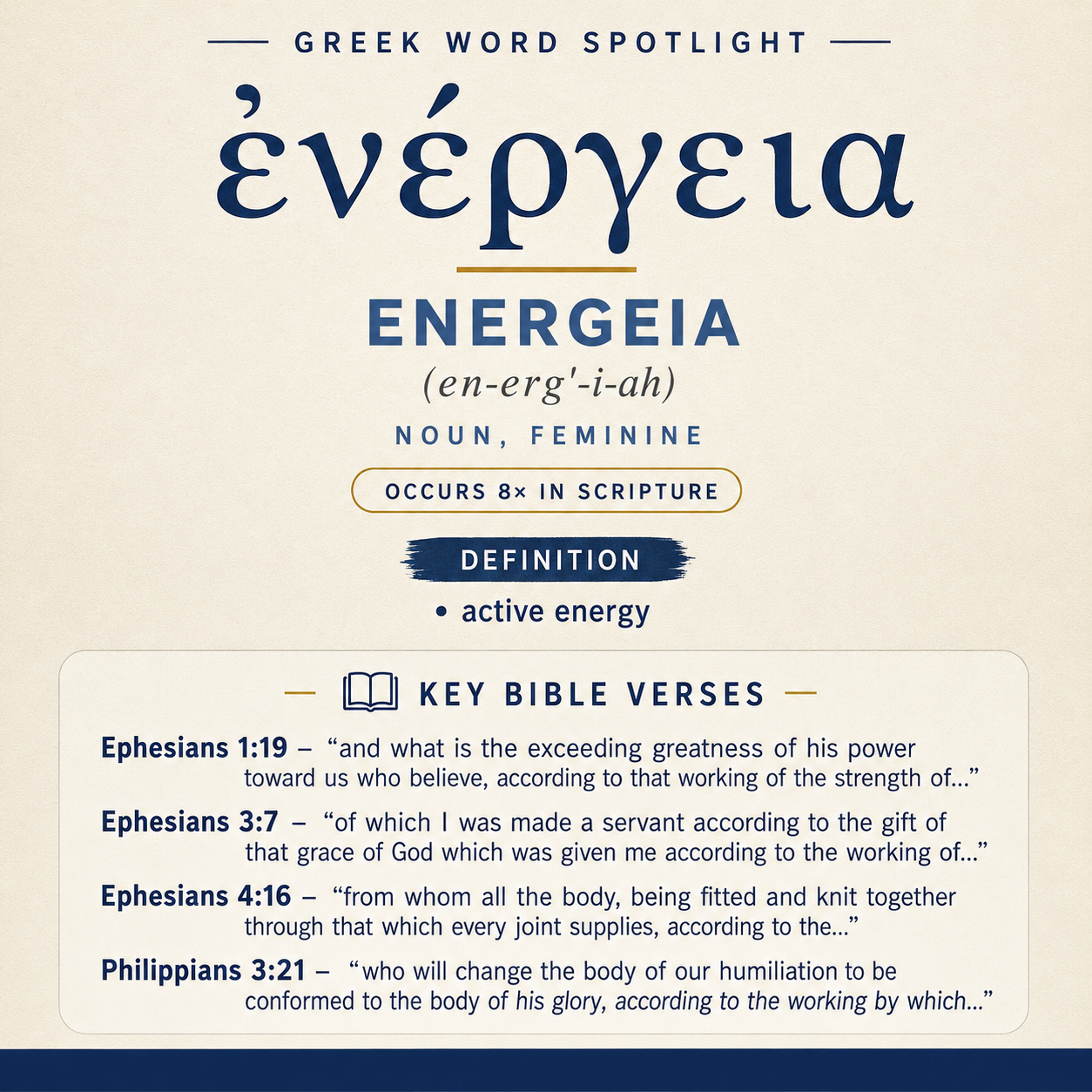
ἐνέργεια (Energeia) means “active energy” and occurs 8 times in Scripture, including Ephesians, Philippians, Colossians, and 2 Thessalonians.
Core Meaning
ἐνέργεια is defined as “active energy.” In its listed occurrences it is rendered as “working.”
Learn More →Where It Appears
It occurs in Ephesians 1:19; 3:7; 4:16; Philippians 3:21; Colossians 1:29; 2:12; and 2 Thessalonians 2:9, 2:11.
Learn More →Contextual Usage
In these verses it describes God’s working (Ephesians; Colossians; Philippians) and also Satan’s working and a “working of error” (2 Thessalonians 2:9, 2:11).
Learn More →ἐνέργεια expresses “active energy” as it appears in passages that speak of divine power at work, the church’s growth, resurrection life, and also deceptive power associated with Satan and error. Across its uses, the term frames power not as a static possession but as power in operation, producing recognizable effects.
Occurrences
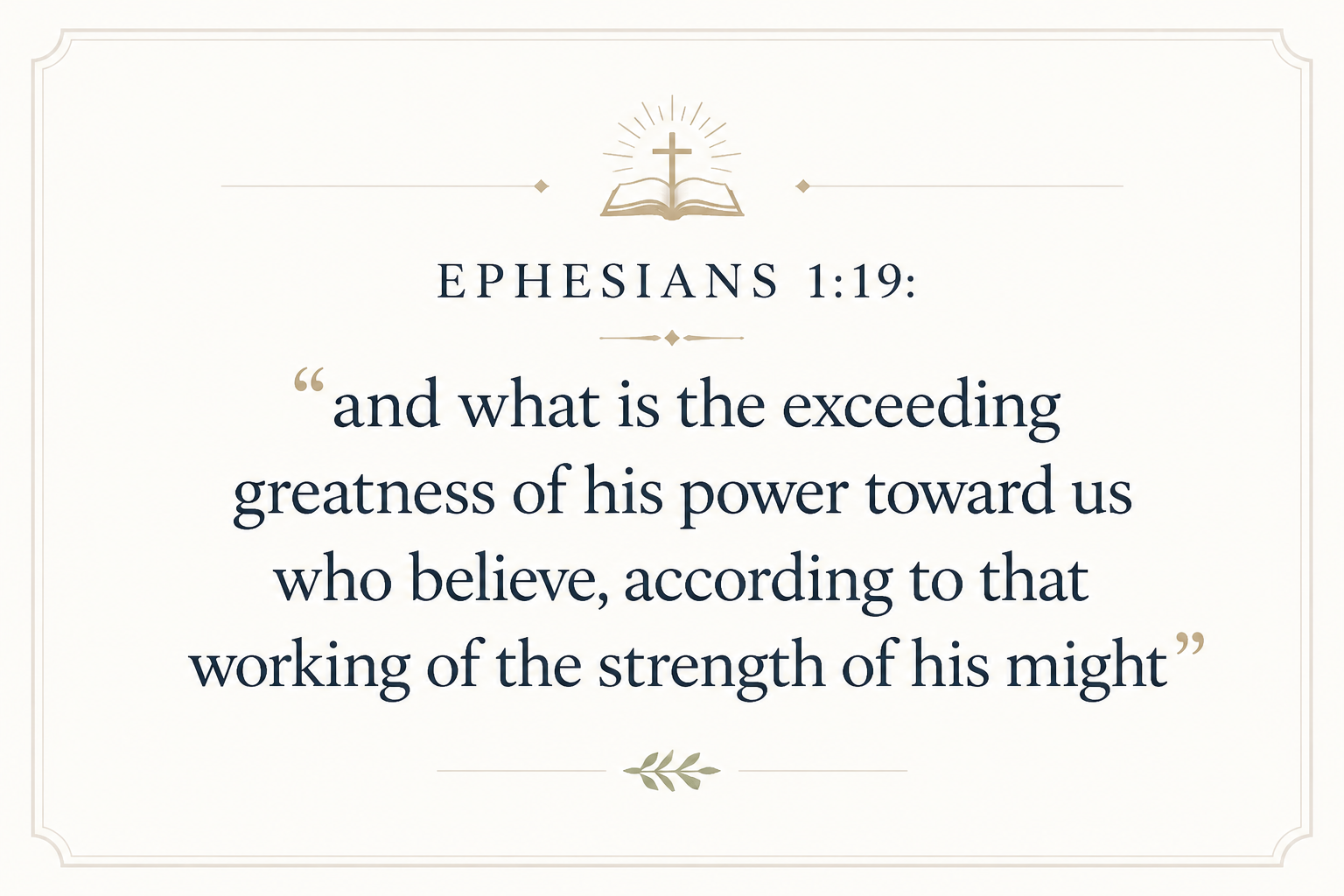
Ephesians 1:19: “and what is the exceeding greatness of his power toward us who believe, according to that working of the strength of his might”
Here ἐνέργεια is the measuring standard for “the exceeding greatness of his power toward us who believe.” The phrase “according to that working” ties God’s “power” to an active exertion described as “the strength of his might.” In this setting, “active energy” portrays divine power as something being exercised toward believers, not merely something God possesses in reserve.
Ephesians 3:7: “of which I was made a servant according to the gift of that grace of God which was given me according to the working of his power.”
In this verse the word is attached to Paul’s appointment and service: he became “a servant” in line with a “gift” of grace, and that gift is further characterized “according to the working of his power.” ἐνέργεια contributes the idea that the grace-gift is accompanied by effective divine power in action, shaping the capacity and reality of ministry rather than describing a mere authorization.
Ephesians 4:16: “from whom all the body, being fitted and knit together through that which every joint supplies, according to the working in measure of each individual part, makes the body increase to the building up of itself in love.”
Here ἐνέργεια is applied to the church pictured as a body. The body’s coherence (“fitted and knit together”) and its growth (“makes the body increase”) are linked to a distributed operation: “according to the working in measure of each individual part.” “Active energy” is individualized and proportioned (“in measure”), expressed through the contribution of “every joint” and “each individual part,” producing the communal result of being “built up…in love.”
Philippians 3:21: “who will change the body of our humiliation to be conformed to the body of his glory, according to the working by which he is able even to subject all things to himself.”
In this promise of bodily transformation, ἐνέργεια names the operative basis of Christ’s ability. The change from “the body of our humiliation” to conformity with “the body of his glory” is “according to the working” that also enables him “even to subject all things to himself.” The term presents this transformation as an effect of active power already capable of universal subjection, connecting the future change directly to effective ability in action.
Colossians 1:29: “for which I also labor, striving according to his working, which works in me mightily.”
In this intensely personal line, ἐνέργεια undergirds Paul’s “labor” and “striving.” His effort is “according to his working,” and that working is further described as something “which works in me mightily.” The word therefore frames Paul’s exertion as corresponding to an active divine energy operating within him, with a strong emphasis on felt effect (“mightily”) and inward operation (“in me”).
Colossians 2:12: “having been buried with him in baptism, in which you were also raised with him through faith in the working of God, who raised him from the dead.”
Here ἐνέργεια is the object of faith: believers are “raised with him through faith in the working of God.” The word attaches “active energy” to God’s raising action (“who raised him from the dead”) and makes that operative divine action the focus through which faith is described. In the verse’s sequence—buried, raised—ἐνέργεια emphasizes that the raising is not abstract but grounded in God’s effective power at work.
2 Thessalonians 2:9: “even he whose coming is according to the working of Satan with all power and signs and lying wonders,”
In this context ἐνέργεια is connected not with God but with Satan. The “coming” is “according to the working of Satan,” and this working is accompanied “with all power and signs and lying wonders.” The term thus conveys an active energy that produces observable phenomena—“signs” and “wonders”—while the description “lying wonders” marks the character of what that activity yields within the verse’s portrayal.
2 Thessalonians 2:11: “Because of this, God sends them a working of error, that they should believe a lie;”
Here ἐνέργεια is joined to “error” as something sent: “God sends them a working of error.” The clause that follows—“that they should believe a lie”—portrays this “active energy” as effective toward a specific outcome in belief. In this use, the term highlights error not merely as a mistaken idea but as an operative force with directional impact on what people come to accept.

Sense and Usage
Across these passages, ἐνέργεια consistently functions as the “active energy” by which power becomes operative and produces effects. Several texts place it in a measuring construction (“according to the working”), so that what happens is aligned with the scale and character of the energy at work. In Ephesians 1:19 and 3:7, that alignment ties divine power to believer-directed benefit and to the grace that appoints a servant; the energy is not described as vague intensity but as a concrete basis for what is given and what is done.
Ephesians 4:16 broadens the field by speaking of “the working in measure of each individual part.” Here ἐνέργεια is still “active energy,” yet it is presented in a distributed pattern: each part has a measured operation, and the combined result is the body’s increase and self-building “in love.” The verse’s imagery makes “active energy” relational and organic: supply through joints, coordinated fitting, and growth arising from many measured operations rather than a single isolated action.
Philippians 3:21 places ἐνέργεια behind an eschatological act—changing the body—yet grounds that act in present capability: the same operative energy by which Christ can “subject all things to himself.” In that construction, “active energy” speaks of ability expressed as effective rule, and bodily transformation is portrayed as a particular instance of that wider effective power.
Colossians 1:29 and 2:12 press the term into experiential and faith-related registers. In 1:29, active energy is internalized: it “works in me mightily,” making the word apt for describing a divine operation that energizes human labor without reducing the labor to passivity (“I also labor, striving”). In 2:12, active energy is the content of trust: faith is directed “in the working of God,” specifically the raising action associated with life out of burial. Together these show ἐνέργεια used both to describe what empowers effort and what anchors belief in God’s effective action.
The two occurrences in 2 Thessalonians 2 show that ἐνέργεια can denote “active energy” irrespective of moral valuation; the same kind of “working” language can be attached to Satan’s activity and to a sent “working of error.” In 2:9, the energy is linked with “power and signs and lying wonders,” stressing outward manifestations; in 2:11, it is linked with an inward cognitive outcome, “that they should believe a lie.” These uses sharpen the term’s profile as effect-producing operation, whether the effect is displayed in wonders or realized in belief.
Imagery and Effects
The repeated “according to” framing gives ἐνέργεια a sense of measurable, directed operation: power is shown in what it accomplishes. The images range from strength exerted “toward us who believe” (Ephesians 1:19), to a body’s coordinated growth through each part’s measured supply (Ephesians 4:16), to the transformation of “the body of our humiliation” (Philippians 3:21). Even where the word is attached to deception (2 Thessalonians 2:9, 2:11), the emphasis remains on active energy that produces concrete outcomes—signs, wonders, and shaped belief—making ἐνέργεια a term of operation, effect, and realized power in these contexts.
Sources: Lexical data from Strong’s Exhaustive Concordance and the Translators Brief Lexicon of Extended Strongs for Greek (STEPBible, CC BY). Occurrence data from the Translators Amalgamated Greek New Testament (STEPBible, CC BY). Scripture quotations from the World English Bible (public domain).