Exploring the Meaning of Empleko in Greek
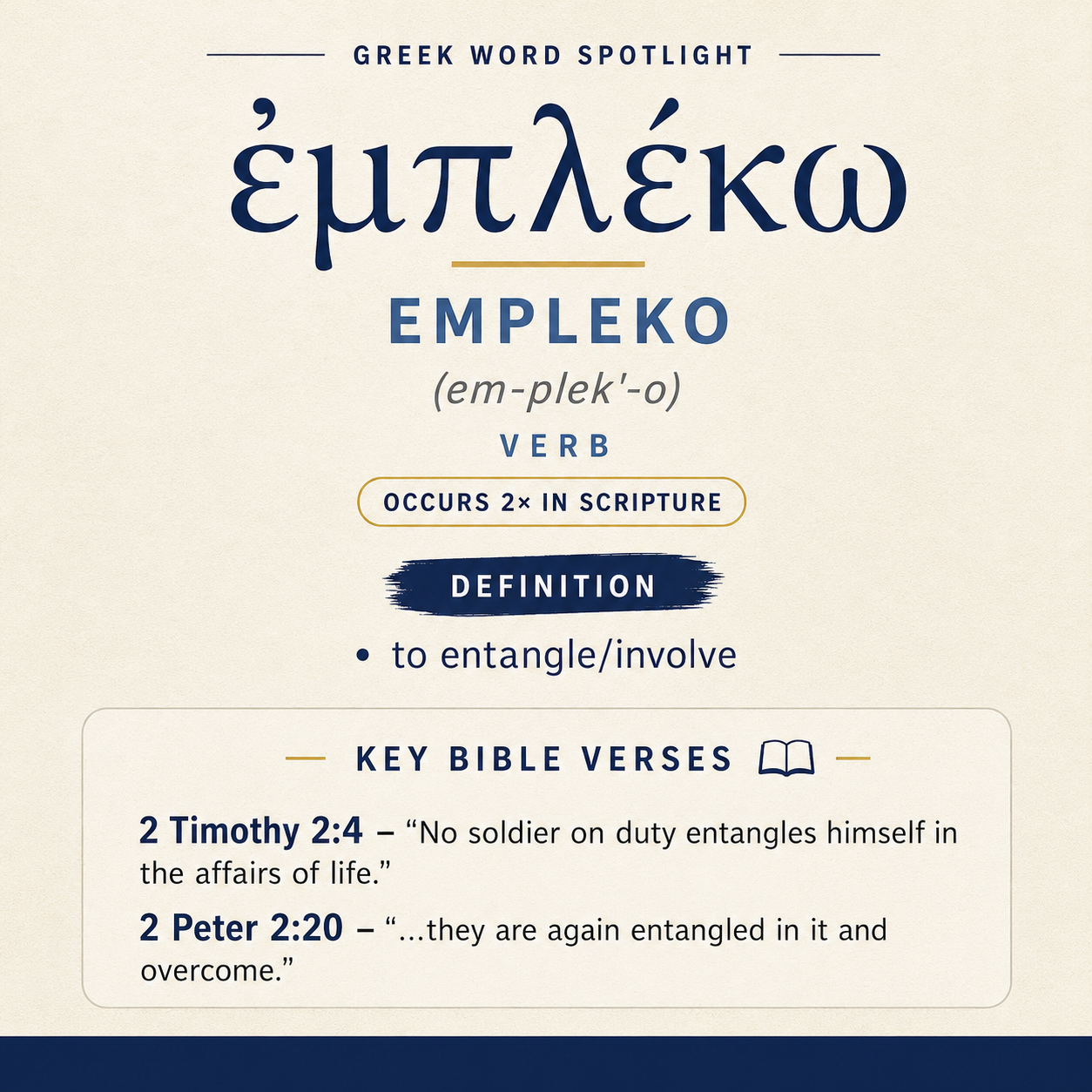
ἐμπλέκω means “to entangle/involve” and appears twice in Scripture: 2 Timothy 2:4 and 2 Peter 2:20.
Biblical Occurrences
It occurs 2 times in Scripture. These are 2 Timothy 2:4 and 2 Peter 2:20.
Learn More →Usage Snapshot
In 2 Timothy 2:4, a soldier “entangles himself in the affairs of life.” In 2 Peter 2:20, it appears in a warning context after escaping the world’s defilement through knowing Jesus Christ.
Learn More →ἐμπλέκω expresses the idea of becoming entangled or involved. It appears in two New Testament exhortations that warn against being drawn into competing commitments and being caught again in what one has escaped.
Root and Related Words
ἐμπλέκω is connected with the preposition ἐν (en), “in/on/among” (Strong’s G1722), and the verb πλέκω (pleko), “to weave” (Strong’s G4120). Together these related ideas support the picture of being “in” something that has been woven around a person’s life so that movement and freedom are constrained.

Occurrences
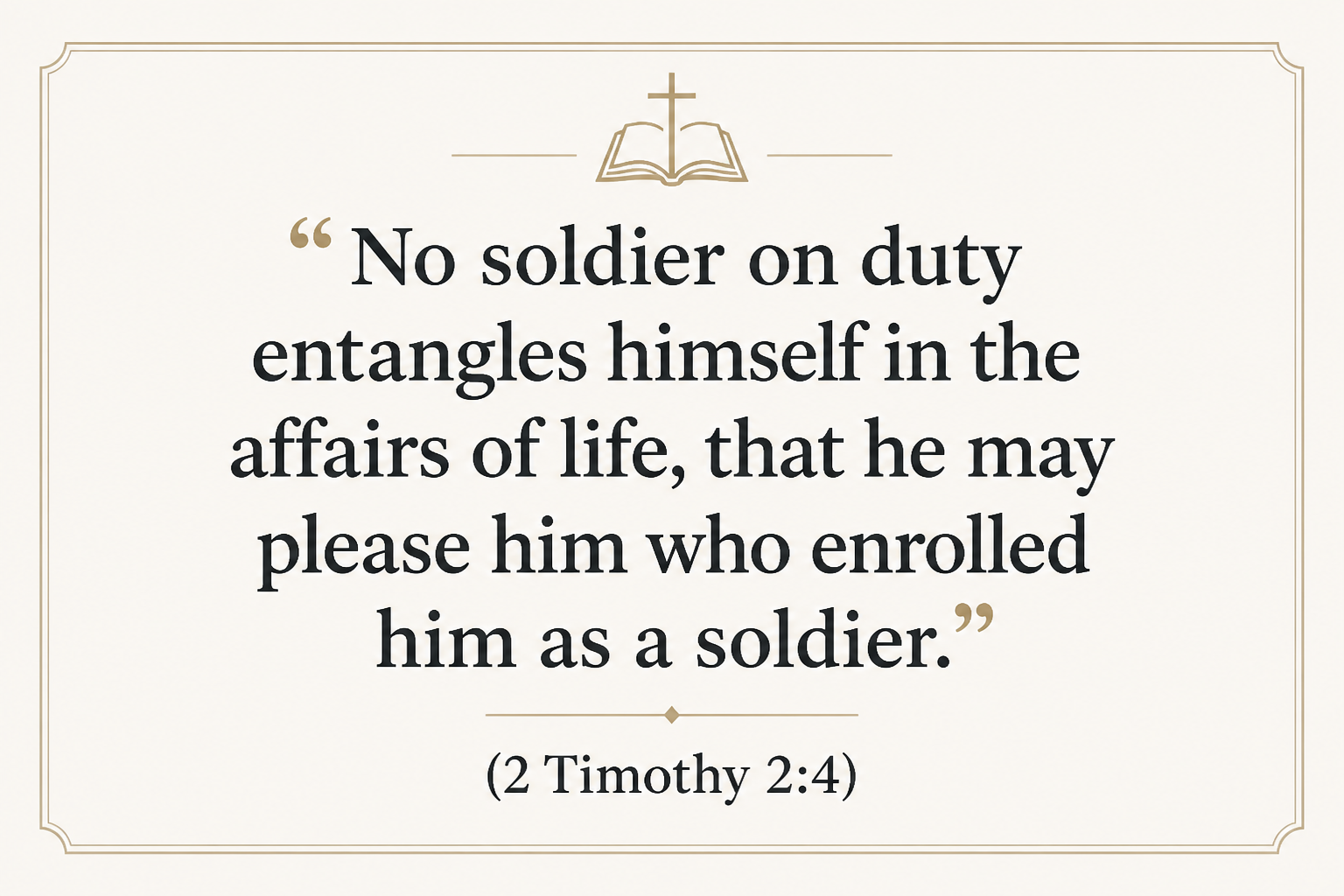
“No soldier on duty entangles himself in the affairs of life, that he may please him who enrolled him as a soldier.” (2 Timothy 2:4)
Here ἐμπλέκω describes what a soldier actively avoids while “on duty.” The line sets two aims side by side: not becoming entangled “in the affairs of life,” and pleasing “him who enrolled him as a soldier.” The verb therefore carries the sense of involvement that binds a person’s time and attention so tightly that it competes with a clear chain of responsibility. The metaphor works because military service assumes focus and readiness; entanglement suggests the opposite—being caught up in everyday concerns to the point that one’s primary obligation is hindered. In this sentence, ἐμπλέκω is framed as a self-directed action (“entangles himself”), emphasizing personal responsibility for what one allows to wrap around one’s calling.
“For if, after they have escaped the defilement of the world through the knowledge of the Lord and Savior Jesus Christ, they are again entangled in it and overcome, the last state has become worse for them than the first.” (2 Peter 2:20)
In this warning, ἐμπλέκω is set within a before-and-after sequence. A group is described as having “escaped the defilement of the world through the knowledge of the Lord and Savior Jesus Christ,” but later being “again entangled in it and overcome.” The verb marks a return to involvement—being drawn back into what had been left behind. The coupling of “entangled” with “overcome” shows entanglement as more than casual contact: it is involvement that results in defeat, as though what ensnares also gains control. The phrase “again entangled in it” anchors the verb to a specific sphere (“the defilement of the world”), portraying re-entanglement as re-entry into a contaminated environment that has the power to reclaim the one who re-engages it. The final clause (“the last state has become worse for them than the first”) underscores the gravity of such renewed involvement: entanglement is not neutral; it is a condition with consequences that worsen a person’s situation.
Sense and Usage
Across these two passages, ἐμπλέκω consistently portrays involvement that constricts. In 2 Timothy 2:4, the entanglement is with “the affairs of life,” a broad category of everyday matters that can wrap around a person’s duties. The point is not that such affairs exist, but that becoming enmeshed in them can interfere with the clear objective of pleasing the one who enlisted the soldier. The soldier image highlights how entanglement can fracture loyalty and reduce effectiveness: obligations multiply, attention is divided, and readiness is compromised.
In 2 Peter 2:20, the entanglement is with something explicitly described as defiling, and it is entanglement “again.” The verb therefore covers not only initial involvement but also re-involvement after a period of escape. The passage adds a further dimension by joining entanglement to being “overcome,” indicating that what begins as involvement can become domination. Entanglement here is not merely being “around” something but being caught in it so that it gains the upper hand.
Taken together, these uses show ἐμπλέκω functioning as a warning verb: it names a kind of involvement that is sticky, binding, and progressively limiting. It can arise from the ordinary pressures of daily life (2 Timothy) or from a return to corrupting patterns that one had left (2 Peter). In both, the logic of the sentence turns on the consequences of entanglement: it prevents pleasing the enlisting authority (2 Timothy 2:4), and it leads to being overcome with a worse final condition (2 Peter 2:20). The word’s force lies in portraying involvement not as a momentary choice but as a condition that can tighten around a person and redirect outcomes.
Imagery
The imagery carried by ἐμπλέκω in these texts is tactile and restrictive: something like threads, cords, or nets that catch and hold. In 2 Timothy 2:4 the picture fits a soldier whose movement is impeded by being wrapped up in “the affairs of life,” while in 2 Peter 2:20 it fits someone who, after escaping, steps back into what can ensnare and then “overcome.” In both settings, the verb evokes involvement that does not remain superficial but tightens into a binding hold.
Sources: Lexical data from Strong’s Exhaustive Concordance and the Translators Brief Lexicon of Extended Strongs for Greek (STEPBible, CC BY). Occurrence data from the Translators Amalgamated Greek New Testament (STEPBible, CC BY). Scripture quotations from the World English Bible (public domain).