Exploring the Meaning of Ekdemeo in Greek
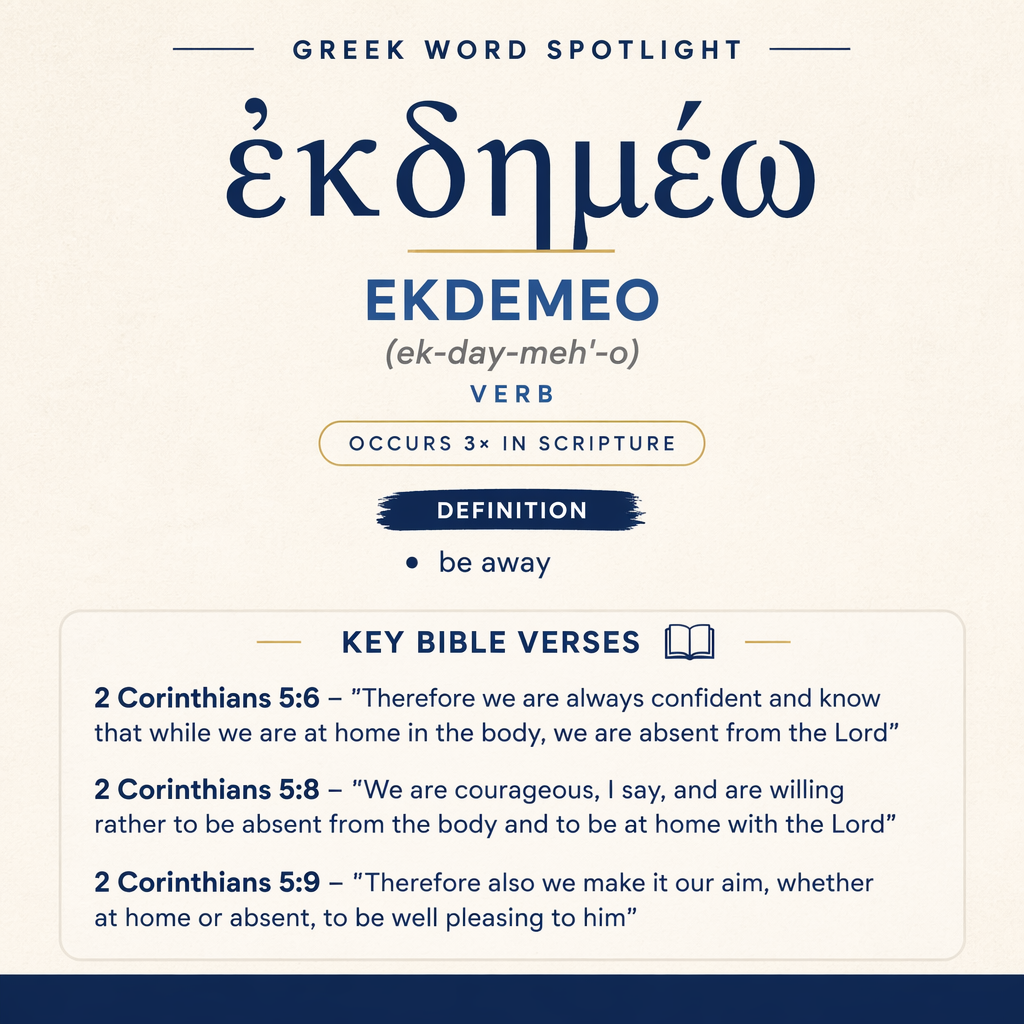
ἐκδημέω means “be away” and occurs three times, all in 2 Corinthians 5:6, 5:8, and 5:9.
Core Meaning
ἐκδημέω is defined as “be away.” In 2 Corinthians 5 it describes being absent in relation to body or Lord.
Learn More →Paul’s Contrast
In 2 Corinthians 5:6, being at home in the body is paired with being absent from the Lord. In 5:8, being absent from the body is paired with being at home with the Lord.
Learn More →Aim and Conduct
In 2 Corinthians 5:9, Paul speaks of making it the aim to be pleasing to Him whether at home or absent. The word appears within this at-home/absent contrast.
Learn More →ἐκδημέω expresses being away, and it appears in Paul’s discussion of confidence, courage, and purpose in 2 Corinthians 5:6, 5:8, and 5:9. In these sentences it marks a state of absence, set in deliberate contrast with being “at home.”
Root and Related Words
ἐκδημέω is connected with ἐκ (ek), “out from” (Strong’s G1537), and δῆμος (demos), “people” (Strong’s G1218). The combination of these elements frames the verb in terms of being “out from” one’s people—language well suited to the relational and locational contrasts Paul draws in the immediate context.

Occurrences
“Therefore we are always confident and know that while we are at home in the body, we are absent from the Lord;” (2 Corinthians 5:6)
Here ἐκδημέω anchors a paired contrast: being “at home in the body” is set alongside being “absent from the Lord.” The verb does not stand alone as a bare statement of location; it functions inside Paul’s reasoning (“Therefore… and know…”), describing what is true “while” the condition holds. The result is a way of speaking that treats present embodied life as a kind of being away in relation to “the Lord,” even while the speaker maintains “always” confidence. The force of ἐκδημέω in this line is to name the distance implied by the contrast: one can be at home in one sphere (the body) and, at the same time, away with respect to another (the Lord).

“We are courageous, I say, and are willing rather to be absent from the body and to be at home with the Lord.” (2 Corinthians 5:8)
In this occurrence ἐκδημέω is placed opposite a different “home” phrase: instead of “at home in the body” (v. 6), Paul speaks of being “absent from the body” and “at home with the Lord.” The verb thus marks the first half of a preference (“willing rather”) that is not merely about leaving something behind but about arriving somewhere: absence from the body is coordinated with being “at home with the Lord.” In this construction ἐκδημέω carries a clean, almost spatial clarity: it names the away-state (“from the body”), and that away-state is immediately balanced by a home-state (“with the Lord”). The verse’s tone—“courageous… willing rather”—shows that the awayness indicated by ἐκδημέω is not presented as fearful; it is part of a hoped-for, chosen comparison within Paul’s argument.
“Therefore also we make it our aim, whether at home or absent, to be well pleasing to him.” (2 Corinthians 5:9)
Here ἐκδημέω appears without an explicit object like “from the body” or “from the Lord,” because the contrast itself supplies the frame: “whether at home or absent.” The verb serves as one side of a comprehensive pair that covers both possible conditions under discussion. Paul’s “aim” is stated as stable across the alternatives: regardless of being at home or away, the goal is “to be well pleasing to him.” In this sentence ἐκδημέω therefore contributes a practical, ethical implication to the earlier contrasts. It is not only a description of where one is; it is a condition under which the same settled purpose is pursued. The verb helps Paul speak of continuity of intention across changing circumstances: the away-state is included in the “whether… or…” that defines the whole scope of his aim.
Sense and Usage
Across these three verses, ἐκδημέω functions as the language of absence within a tight network of “home” and “away” contrasts. It does not float as a vague metaphor; it is consistently paired with “at home” language and given concrete relational reference points: “absent from the Lord” (5:6) and “absent from the body” (5:8), and then the compact alternative “at home or absent” (5:9). The repeated pairing gives the verb a steady profile: it names the away-side of an either/or that Paul treats as meaningful for confidence (5:6), for courage and preference (5:8), and for deliberate purpose (5:9).
The usage also shows how absence is evaluated in context. In 5:6, absence from the Lord is stated as the present condition “while” one is at home in the body, yet it is spoken with confidence. In 5:8, absence from the body is part of a preferred condition because it is joined to being “at home with the Lord.” In 5:9, whether the condition is home or away, the governing concern is to be pleasing “to him.” Thus ἐκδημέω marks a real distinction in condition without becoming the controlling center of Paul’s exhortation; the verb helps structure the contrast, but the thrust of the passage moves toward courage and a settled aim.
Because ἐκδημέω appears in sentences that explicitly contrast two domains (“the body” and “the Lord”), its sense in this context is relational as well as situational: it describes a state of being away in reference to someone or something that could be called “home.” The verbal choice supports Paul’s conceptual pairing: “at home” language is applied both to the body (5:6) and to the Lord (5:8), while ἐκδημέω names the corresponding absences (“from the Lord,” “from the body”). The result is a consistent rhetorical pattern in which “away” and “at home” are not mere opposites but coordinates that clarify what is meant by each sphere.
Imagery in Context
The imagery carried by ἐκδημέω in these verses is that of dwelling and distance: being “at home” in one relation while “absent” in another (5:6), and exchanging one absence for another home (5:8). In 5:9 the home/away imagery becomes a way to speak about an aim that spans both conditions, as Paul commits himself “whether at home or absent, to be well pleasing to him.”
Sources: Lexical data from Strong’s Exhaustive Concordance and the Translators Brief Lexicon of Extended Strongs for Greek (STEPBible, CC BY). Occurrence data from the Translators Amalgamated Greek New Testament (STEPBible, CC BY). Scripture quotations from the World English Bible (public domain).