
Exploring the Meaning of Ekdechomai in Greek
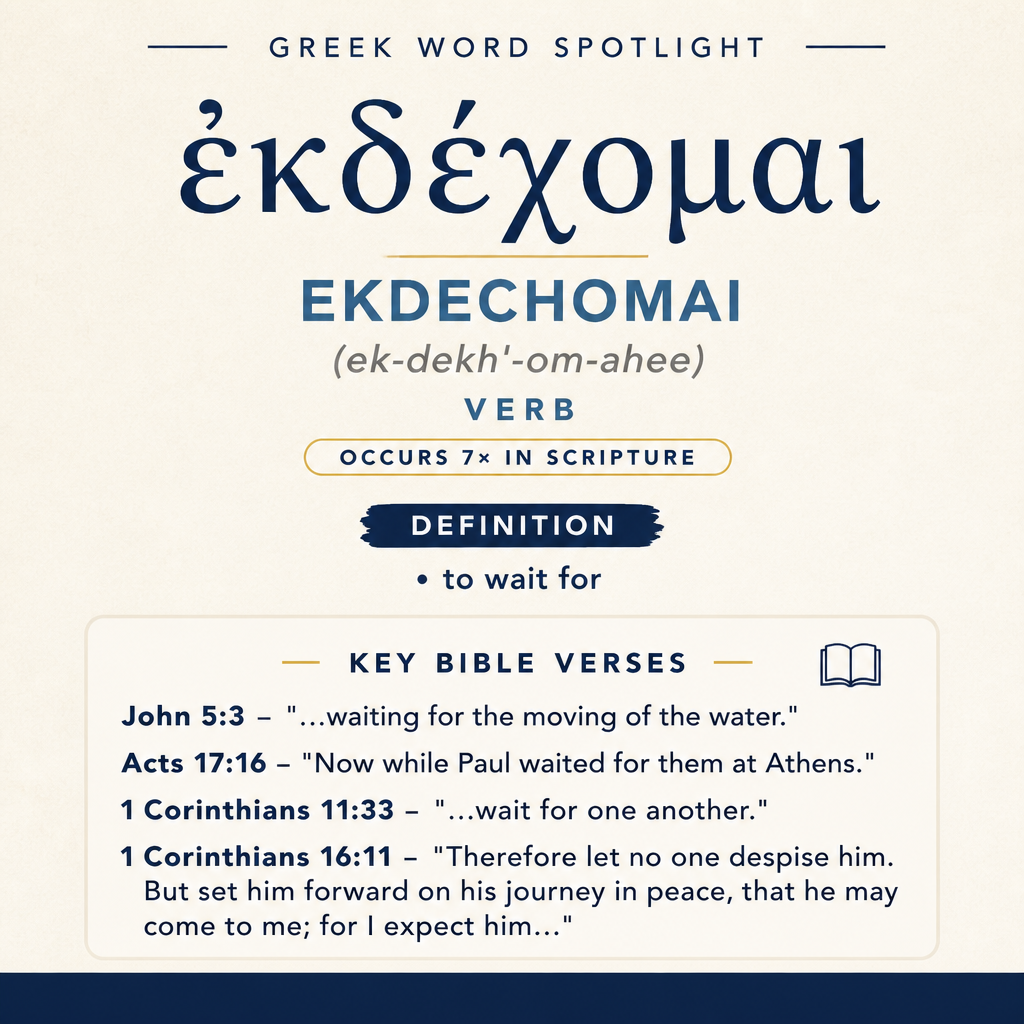
ἐκδέχομαι means “to wait for” and occurs 7 times in Scripture: John 5:3; Acts 17:16; 1 Corinthians 11:33; 16:11; Hebrews 10:13; 11:10; James 5:7.
Core Meaning
ἐκδέχομαι means “to wait for.” It is used for both waiting and expecting.
Learn More →Scripture Occurrences
It appears in John 5:3; Acts 17:16; 1 Corinthians 11:33 and 16:11; Hebrews 10:13 and 11:10; James 5:7. These contexts include waiting for moving water, waiting for people, and looking for what God will bring.
Learn More →Usage Snapshots
In 1 Corinthians 11:33 it instructs believers to “wait for one another.” In Hebrews 10:13 and James 5:7 it describes waiting in patience until a future outcome.
Learn More →ἐκδέχομαι expresses the act of waiting for someone or something, and it appears in scenes ranging from a healing pool to apostolic travel plans to long-range hope fixed on what God will bring about. Across its uses, the word attaches waiting to concrete circumstances—places, people, timing, and expected outcomes—so that waiting is shown as a lived posture rather than an abstract idea.
Occurrences
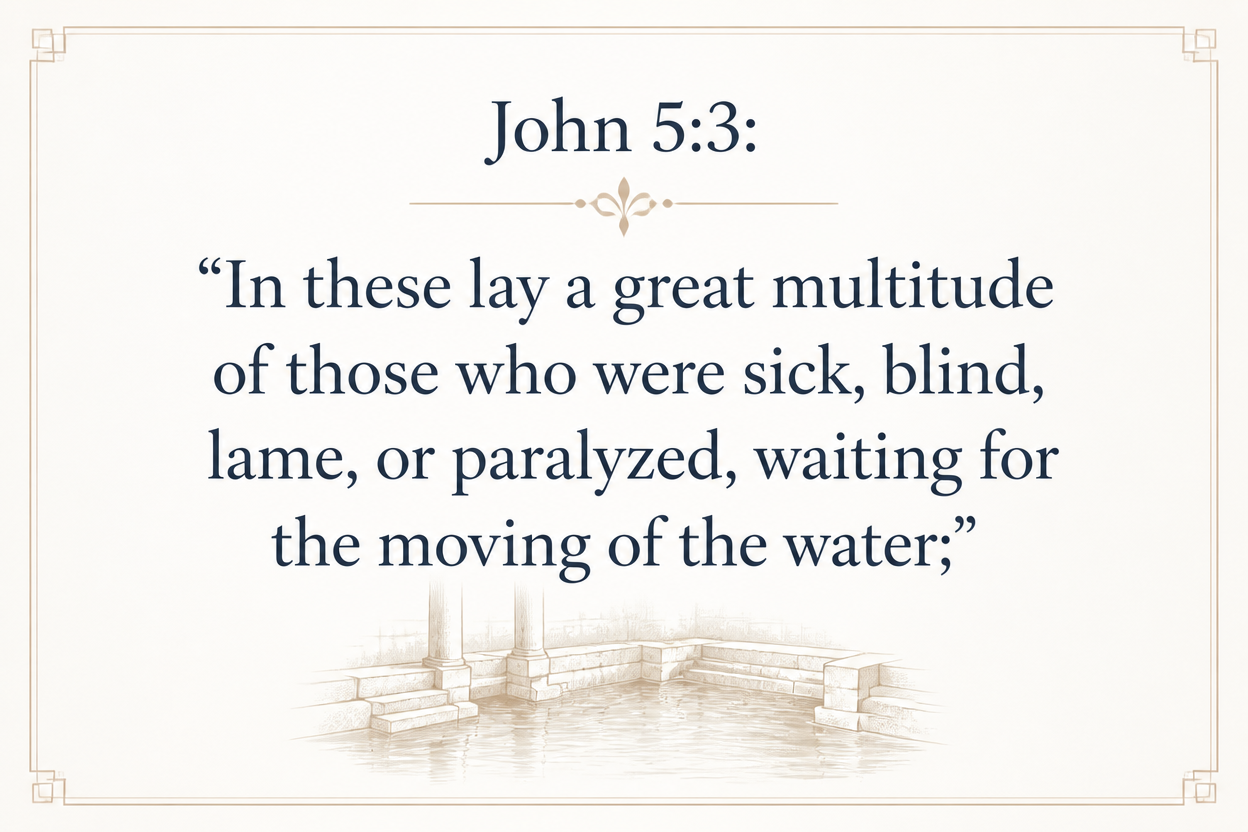
John 5:3: “In these lay a great multitude of those who were sick, blind, lame, or paralyzed, waiting for the moving of the water;”
Here the waiting is collective and situational: “a great multitude” lies in the porticoes, defined by need (“sick, blind, lame, or paralyzed”) and by a shared focus (“the moving of the water”). The word frames their posture as sustained expectancy tied to a particular sign or moment. The scene is not one of aimless delay; it is waiting oriented toward a hoped-for change within a specific setting.
Acts 17:16: “Now while Paul waited for them at Athens, his spirit was provoked within him as he saw the city full of idols.”
Paul’s waiting is anchored to a location (“at Athens”) and to people (“for them”). The verse places the waiting alongside perception and reaction: as he waits, he “saw the city full of idols,” and this observation shapes his interior response (“his spirit was provoked within him”). The word marks a period of pause that is nevertheless active in awareness; waiting becomes the temporal frame in which Paul’s evaluation of the city occurs.
1 Corinthians 11:33: “Therefore, my brothers, when you come together to eat, wait for one another.”
In this instruction the waiting is mutual and communal: “wait for one another” governs the manner of a shared meal (“when you come together to eat”). The word contributes a norm for gathered behavior, requiring the assembled group to coordinate their timing so that the act of eating is not individualistic. Waiting is presented as a chosen restraint for the sake of others who are part of the same gathering.
1 Corinthians 16:11: “Therefore let no one despise him. But set him forward on his journey in peace, that he may come to me; for I expect him with the brothers.”
Here the waiting is relational and anticipatory: Paul speaks of someone’s arrival (“that he may come to me”) and grounds his appeal for respectful treatment (“let no one despise him”) in that expectation. The word connects Paul’s future-oriented posture (“I expect him”) with the community’s present responsibility to help the traveler (“set him forward on his journey in peace”). Waiting is not passive; it shapes how others are to act now so that the awaited meeting can occur properly.
Hebrews 10:13: “from that time waiting until his enemies are made the footstool of his feet.”
This use places waiting in a definitive timeline: it begins “from that time” and continues “until” a specific outcome is realized (“his enemies are made the footstool of his feet”). The word highlights a purposeful interval bounded by a promised end. The content of what is awaited is expressed in a strong image of subjection, and waiting functions as the posture that bridges the present moment to that declared completion.
Hebrews 11:10: “For he looked for the city which has the foundations, whose builder and maker is God.”
The waiting here is directed toward a destination described with permanence and divine workmanship: “the city which has the foundations, whose builder and maker is God.” The word casts the subject’s orientation as future-facing and purposeful, not merely longing but a settled gaze toward a defined object of expectation. The emphasis falls on what is awaited—a city characterized by foundations and by God as its maker—so waiting takes the shape of sustained orientation toward a promised place.
James 5:7: “Be patient therefore, brothers, until the coming of the Lord. Behold, the farmer waits for the precious fruit of the earth, being patient over it, until it receives the early and late rain.”
James places waiting alongside patience and uses agriculture to make it tangible. The command sets a horizon (“until the coming of the Lord”), and the illustration shows what such waiting resembles: “the farmer waits for the precious fruit of the earth,” persisting “until it receives the early and late rain.” The word contributes the idea of waiting that respects processes outside one’s control—rain and growth—and endures across seasons. Waiting is presented as steady persistence aimed at a valued result (“precious fruit”).

Sense and Usage
Across these passages, ἐκδέχομαι consistently portrays waiting as an oriented stance: it is waiting for something identifiable, whether an event, a person, an outcome, or a promised arrival. John 5:3 shows waiting tied to a hoped-for moment within a physical environment, where a crowd’s posture is shaped by expectation. Acts 17:16 sets waiting within travel and companionship, yet makes clear that the interval can be filled with observation and inward response; waiting does not suspend perception.
In the Corinthian letters, the word moves into the social fabric of the churches. In 1 Corinthians 11:33, waiting is a discipline of shared time—an ethic expressed by delaying oneself so others are not excluded. In 1 Corinthians 16:11, waiting is woven into logistics and honor: expectation of someone’s arrival provides a reason to ensure that person is treated well and helped forward “in peace.” In both, waiting serves relationships, either by synchronizing a communal act or by shaping the way a community handles a traveler.
Hebrews and James use the word to speak of longer horizons. Hebrews 10:13 depicts waiting as an interval that stretches toward a decisive end, marked by an “until” that gives waiting a clear terminus. Hebrews 11:10 presents waiting as a forward-looking orientation toward a city defined by its foundations and by God’s craftsmanship—waiting characterized less by delay than by direction. James 5:7 joins waiting to patience and emphasizes the appropriate tempo of waiting: like a farmer, the one who waits does so with endurance, allowing time for what must occur (rain, growth) before the desired outcome arrives. Taken together, these uses show waiting that ranges from immediate (a meal, an arrival) to extended (a coming, a city, the subjection of enemies), yet in every case remains purposeful and object-directed.
Imagery and Texture
The word’s imagery is often carried by what surrounds the act of waiting. In John, waiting is pictured in bodies lying near water, fixed on a moment of movement. In Acts, waiting is set against a cityscape that provokes a reaction in the observer. In Corinthians, waiting takes the shape of timing at a table and the peaceful forwarding of a traveler. In Hebrews, waiting is stretched between a starting point and a climactic “until,” and it is also aimed at a city with foundations made by God. In James, waiting is embodied in a farmer watching the earth, living through early and late rain while looking toward “precious fruit.” In these scenes, ἐκδέχομαι gives waiting a concrete feel: it is time lived toward an expected end.
Sources: Lexical data from Strong’s Exhaustive Concordance and the Translators Brief Lexicon of Extended Strongs for Greek (STEPBible, CC BY). Occurrence data from the Translators Amalgamated Greek New Testament (STEPBible, CC BY). Scripture quotations from the World English Bible (public domain).




