
Exploring the Meaning of Demos in Greek
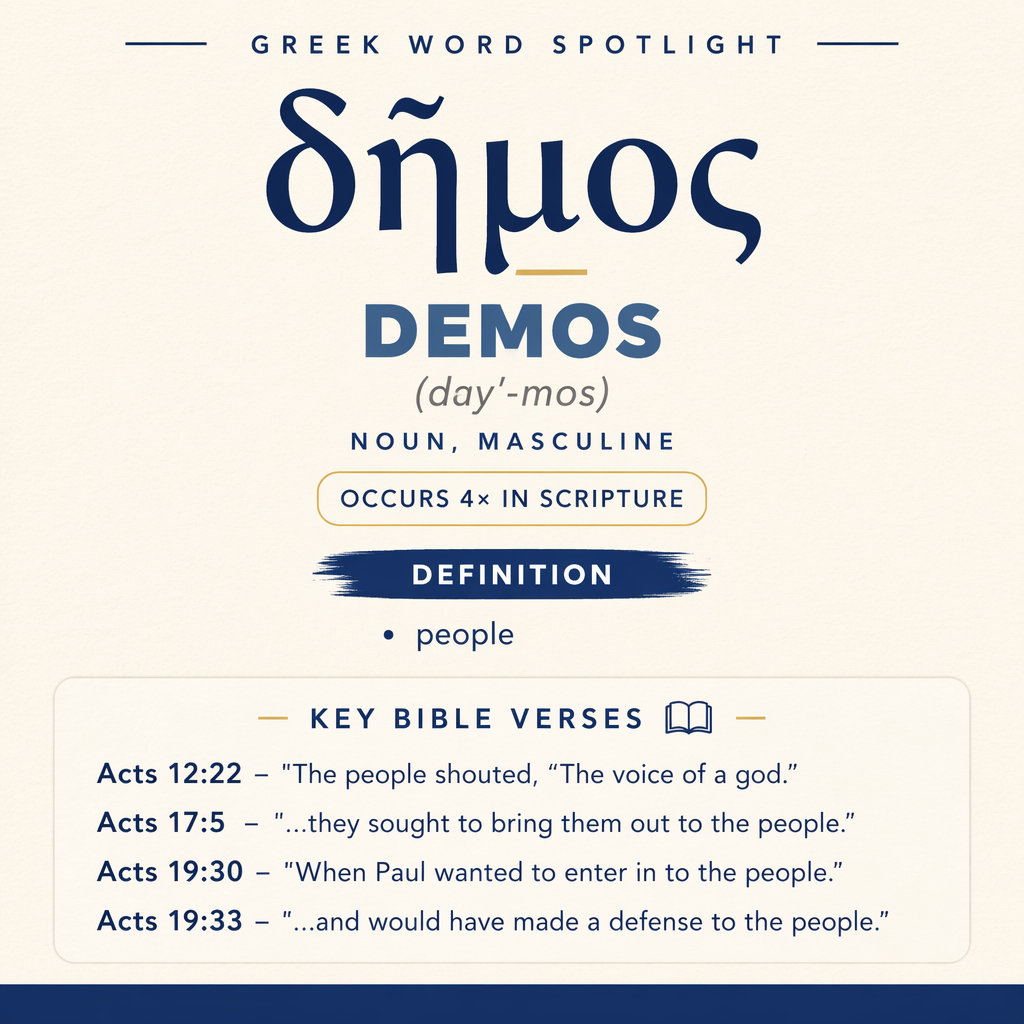
δῆμος means “people” and appears four times in Acts (12:22; 17:5; 19:30; 19:33).
Core Meaning
δῆμος is defined as “people.” In Acts it refers to a gathered populace or crowd.
Learn More →Acts References
It occurs in Acts 12:22; 17:5; 19:30; and 19:33. Each occurrence places δῆμος within a public scene involving a crowd.
Learn More →Context Snapshots
In Acts 12:22 the people shout, “The voice of a god, and not of a man!” In Acts 19:30 Paul wants to enter in to the people, but the disciples do not allow him.
Learn More →δῆμος means “people” and appears in Acts in scenes where a gathered public reacts, is addressed, or is the object of attempted communication. In these contexts, the word consistently points to a collective body whose response affects events in the city and in public controversy.
Root and Related Words
Strong’s relates δῆμος to the verb δέω (deo, “to bind”; Strong’s G1210).
Occurrences
Acts 12:22 — “The people shouted, “The voice of a god, and not of a man!””
Here δῆμος denotes a unified public whose speech becomes the defining sound of the moment: “The people shouted.” The word frames the acclaim as corporate rather than private; the cry is not a single person’s opinion but a collective outburst. The content of the shout elevates the speaker beyond humanity (“The voice of a god, and not of a man!”), and δῆμος marks that escalation as something produced and amplified by a crowd. The scene is shaped by mass reaction—an assembled public giving vocal recognition in a way that can carry social weight precisely because it comes from “the people” together.
Acts 17:5 — “But the unpersuaded Jews took along some wicked men from the marketplace, and gathering a crowd, set the city in an uproar. Assaulting the house of Jason, they sought to bring them out to the people.”
In this account, δῆμος stands as the intended audience and arena of exposure: the agitators “sought to bring them out to the people.” The verse describes deliberate steps—recruiting “wicked men,” “gathering a crowd,” and stirring “the city in an uproar”—all aimed at moving the conflict into the public space where “the people” are present as witnesses or participants. δῆμος, placed at the end of the verse, functions as the destination of the hostile action: the accused are to be produced before the populace. The collective body is therefore not merely background noise; it is the social setting in which accusation, pressure, and potential judgment can be exerted.
Acts 19:30 — “When Paul wanted to enter in to the people, the disciples didn’t allow him.”
Here δῆμος is the group Paul intends to face directly: he wants “to enter in to the people.” The phrasing portrays the people as a defined public assembly or mass into which one might “enter,” implying a boundary between Paul and the crowd that must be crossed. The disciples’ restraint (“didn’t allow him”) underscores that the crowd carries risk or volatility; what matters is not a single opponent but the collective presence of “the people.” δῆμος thus conveys the force of public concentration: an encounter with the crowd is different in kind from an exchange with individuals, and the narrative treats access to the people as a consequential tactical move.
Acts 19:33 — “They brought Alexander out of the multitude, the Jews putting him forward. Alexander beckoned with his hand, and would have made a defense to the people.”
In this scene, δῆμος is explicitly the audience of a formal attempt at explanation: Alexander “would have made a defense to the people.” The verse draws a contrast between “the multitude” (from which Alexander is brought out) and “the people” as the addressed public. Alexander’s gesture—“beckoned with his hand”—fits a setting where one addresses a crowd, seeking silence or attention before speaking. The word δῆμος highlights the collective whose opinion or reaction matters; a “defense” presupposes that the public has heard charges, suspicions, or commotion and now stands in need of an answer. The effort is oriented toward the crowd as a single social body capable of receiving (or rejecting) a public justification.
Sense and Usage
Across these four uses, δῆμος consistently points to people considered together as a public body, especially in situations of vocal response or public confrontation. In Acts 12:22, the people function as a chorus whose shouting bestows acclaim; δῆμος captures the way collective speech can ascribe status. In Acts 17:5, the people are the arena of exposure: bringing someone “out to the people” is a strategy to shift a dispute into public view, where crowd dynamics can intensify pressure. In Acts 19:30 and 19:33, δῆμος is the audience of attempted engagement—first when Paul wishes to enter the crowd, then when Alexander attempts to address it with a defensive speech.
The word’s contribution in these passages is less about identifying individuals and more about depicting a social mass with agency. The people shout, are appealed to, are approached or avoided, and serve as the final audience before whom matters are contested. In each case, δῆμος implies that what is happening is not confined to private conversation: the public setting makes reactions louder, consequences broader, and actions more charged. The scenes also show the people as impressionable and powerful—capable of being rallied (“gathering a crowd”), capable of being addressed (“made a defense”), and capable of creating a defining moment through unified speech (“shouted”).
Within this limited set of occurrences, δῆμος regularly stands at the point where speech meets public reception. Shouting, uproar, entering in, beckoning, and making a defense are all communicative or crowd-facing actions. The word therefore naturally belongs to scenes where the communal presence of the populace is the decisive factor: a person’s safety, reputation, or reception is shaped by what happens when the matter reaches “the people.”
Imagery
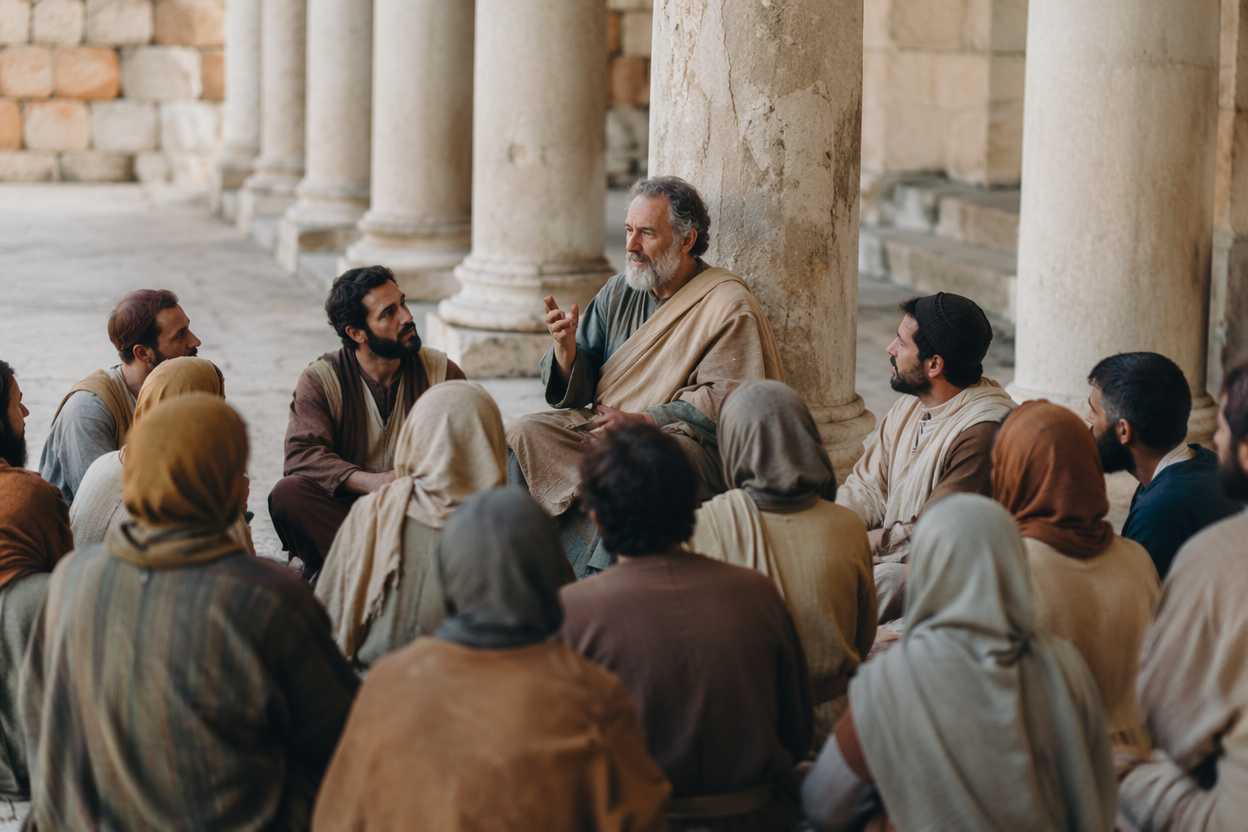
The imagery attached to δῆμος in these passages is the press and sound of a crowd: people shouting acclaim (Acts 12:22), people as the destination of a forced public appearance (Acts 17:5), people as a mass one might try to enter (Acts 19:30), and people as an audience before whom a speaker raises his hand to begin a defense (Acts 19:33). Together, these snapshots present “the people” as a gathered public whose attention and reaction can propel events.
Sources: Lexical data from Strong’s Exhaustive Concordance and the Translators Brief Lexicon of Extended Strongs for Greek (STEPBible, CC BY). Occurrence data from the Translators Amalgamated Greek New Testament (STEPBible, CC BY). Scripture quotations from the World English Bible (public domain).




