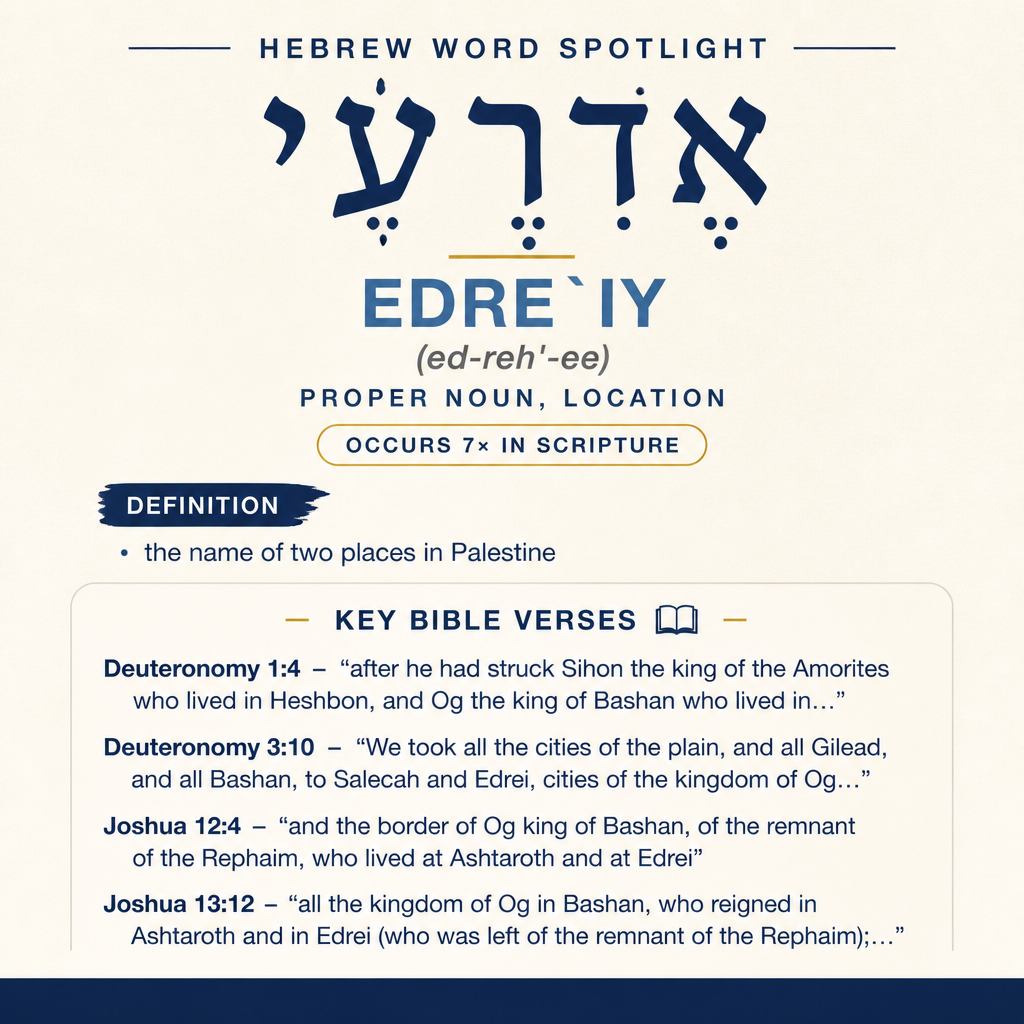
‘edre`iy

ed-reh’-ee
Parts of Speech: Proper Name Location

‘edre`iy Definition

NAS Word Usage – Total: 8
Edrei = “goodly pasture”

  1. a chief city of Bashan, north of Jabbok river

Understanding ‘edre`iy in Hebrew

When exploring the Hebrew language, one may encounter the word ‘edreiy. A direct translation of 'edreiy is often rendered as “stately” or “majestic.” Understanding this word, along with its context and usage, can help bring clarity to Hebrew texts, particularly in biblical literature.

Books Worth Reading:
Sponsored
Book 3154Book 3131Book 3162Book 3129Book 3161

This article dives into the meaning of ‘edre`iy, exploring its etymology, applications in scriptural contexts, and how its connotations enrich our understanding of various passages.

Etymology of ‘edre`iy

The word ‘edre`iy derives from the root word ‘edr, which connotes grandeur or majesty. In Hebrew, roots typically consist of three consonants that form the basis for a family of words related to that meaning. The root ‘edr evokes feelings of nobility and significance.

The suffix ‘-i’ suggests that it is an adjective, likely describing a quality or characteristic of a noun. Therefore, ‘edre`iy can be understood as something that possesses grandeur or stateliness—an important trait in both personal and communal contexts.

Books Worth Reading:
Sponsored
Book 3154Book 3131Book 3162Book 3129Book 3161

Biblical Contexts

Use in Poetry

In biblical poetry, adjectives often carry heavy emotional weight. They are not merely descriptive; they convey deeper meanings and connections to the overall themes of the text. For example, in Psalm 96:6, the phrase could be associated with descriptions of God’s presence. The mention of God’s ‘edre`iy’ qualities elevates the reverence surrounding Him.

Imagine a psalmist using this term to describe the heavenly majesty during a moment of worship. The imagery it evokes helps the congregation visualize the greatness of God, not just as a distant being but as intimately involved in the grandness of creation. Such usage invites readers to experience spirituality through a lens of richness and significance.

Character Descriptions

In biblical narratives, characters often embody various traits that can be highlighted by adjectives like ‘edre`iy. For example, when describing a king or ruler, the use of this word would elevate the character’s stature within the narrative.

Books Worth Reading:
Sponsored
Book 3154Book 3131Book 3162Book 3129Book 3161

Consider the depiction of King Solomon in the Book of Kings. Often referred to as the wisest and wealthiest of rulers, his life offers numerous opportunities to reflect on how ‘edreiy encapsulates his royal essence. When the text describes Solomon’s court or his splendid temple, using 'edreiy ties the physical beauty and splendor of these settings to the majestic qualities of the ruler himself.

In this case, when a storyteller describes Solomon as having ‘edre`iy stature, it aids the listener to perceive not just his physical attributes, but also the impact of his wisdom and wealth on his kingdom. The audience is meant to grasp that his reign embodies both material abundance and moral authority.

Correlations and Synonyms

Synonyms in Hebrew

Hebrew is rich with synonyms that convey similar meanings. Words such as ‘kavod’ (glory), ‘ziv’ (brightness), and ‘ta’ana’ (perks or embellishments) can serve as deep wells of expressive possibilities when discussing the notion of majesty or grandeur.

Books Worth Reading:
Sponsored
Book 3154Book 3131Book 3162Book 3129Book 3161

For instance, ‘kavod’ captures the idea of honor and respect, while ‘ziv’ emphasizes light and radiance. Depending on the context, these words could interchange with ‘edre`iy’ to communicate slightly varied but still profound meanings.

In a poetic setting, utilizing ‘kavod’ might highlight the biblical figure’s respected status, while ‘edre`iy’ might emphasize their grand appearance or the splendor of their surroundings.

Application in Modern Hebrew

Modern Hebrew speakers continue to utilize ‘edreiy' and its related forms. For example, in discussions about architecture, particularly when referencing buildings designed to inspire awe and admiration, 'edreiy’ might closely align with descriptions of impressive public structures like museums or concert halls.

Books Worth Reading:
Sponsored
Book 3154Book 3131Book 3162Book 3129Book 3161

Imagine a teacher explaining the importance of employing grand architectural styles in modern design. They might relate this concept to ‘edre`iy’ to showcase how such designs evoke feelings of stateliness, calling upon the beauty associated with biblical descriptions.

Nuances of Meaning in Translations

The Challenge of Translation

One challenge in translating ‘edre`iy is capturing its full emotional and cultural resonance. While the straightforward translation is “stately” or “majestic,” the word compels deeper consideration due to its biblical roots. Translators may need to balance literal meanings with the emotional undertones that carry significance in biblical contexts.

For instance, a translator might come across a verse where ‘edre`iy’ describes a natural scene, drawing a connection between the divine and the beauty of creation. In this case, translational interpretations may aim to convey not just visual splendor but a feeling of awe that transcends simple appearances.

Books Worth Reading:
Sponsored
Book 3154Book 3131Book 3162Book 3129Book 3161

Examples from Modern Translations

When examining English translations of biblical texts that use ‘edreiy', one can see varied approaches. In the New International Version (NIV), 'edreiy’ may be translated with a focus on its visual impact, while the New Revised Standard Version (NRSV) may emphasize the emotional connection.

This variance underlines how just one word can encapsulate a wide range of feelings and associations. The challenge for translators remains to portray an accurate understanding of Hebrew culture while providing language that resonates with contemporary readers.

The Role of ‘edre`iy in Worship

Enhancing Worship Practices

The qualities associated with ‘edre`iy’ are also worth noting in the context of worship. Jewish worship traditions frequently employ grandeur to surround spiritual experiences, whether through clothing, music, architecture, or liturgical settings.

Books Worth Reading:
Sponsored
Book 3154Book 3131Book 3162Book 3129Book 3161

When congregants gather to praise, the atmosphere created can often mirror the majesty described in biblical texts. For example, synagogues are designed with aesthetic features meant to inspire awe and reverence. Elements of the architecture might incorporate ‘edre`iy’ characteristics—bold designs, elevated ceilings, and elegant details contribute to a worshipful environment.

Experiential Examples

In a real-world worship setting, imagine a synagogue filled with beautiful stained glass windows that let in the light of day. As the sun filters through these windows, captivating shapes and colors dance across the floor. The beauty of this setting can be described as ‘edre`iy’, vividly embodying the splendor of the moment. Participants may find themselves inspired, connecting the physical space with their spiritual experience.

This application reinforces how ‘edre`iy’ moves beyond a mere descriptor. It illustrates a philosophy of creating a sacred experience that mirrors the majesty of spiritual texts.

Books Worth Reading:
Sponsored
Book 3154Book 3131Book 3162Book 3129Book 3161

Cultural Significance of ‘edre`iy’

Historical Connotations

The cultural significance of ‘edre`iy’ stretches across historical periods. Ancient Hebrew literature often utilized such terms to reinforce values of leadership and divinity.

For example, nobility was an important concept in ancient Israelite society. Those who held powerful positions were often associated with qualities that made them ‘edre`iy’. This usage underlines the importance of connecting one’s persona to their role within the community, showcasing both authority and moral responsibility.

Modern Perspectives

In modern Hebrew discussions, ‘edre`iy’ takes on new dimensions, often associated with leadership qualities beyond the monarchy. In contemporary contexts, discussions of statecraft, governance, and even business leadership may invoke this word, celebrating qualities like dignity and ethical governance.

Books Worth Reading:
Sponsored
Book 3154Book 3131Book 3162Book 3129Book 3161

Imagine a community leader addressing an audience about the need for ethical practices in governance; invoking the term ‘edre`iy’ could elevate the conversation, setting a standard for the values they aspire to embody in their public service.

Understanding the term ‘edreiy' unfolds multiple layers of significance. By portraying grandeur not only in appearance but also in character, 'edreiy’ becomes a rich adjective used to convey a vital aspect of Hebrew culture and biblical narratives.

Little Known Secrets

The Hebrew word ‘edre`iy (אֱדְרֵי) carries fascinating meanings and connections that may surprise many.

Books Worth Reading:
Sponsored
Book 3154Book 3131Book 3162Book 3129Book 3161
  • ‘Edre`iy is often translated as “the mighty” or “the powerful,” which reflects its roots in strength and authority.
  • This word appears in the context of descriptions of God or powerful leaders, emphasizing their might and impact on the world.
  • The root of ‘edre`iy is linked to the Hebrew term “gedor,” which means a “fence” or “enclosure,” suggesting protection and security along with power.
  • In ancient texts, ‘edre`iy was sometimes used to refer to strong warriors or those who were particularly formidable in battle, highlighting their ability to protect their people.
  • Interestingly, ‘edre`iy is indicative of an idealized leader in Jewish tradition, one who combines strength with moral leadership and responsibility towards the community.
  • This term is also connected to the broader themes found in biblical literature, often exploring the balance between power and stewardship, reflecting the belief that strength must be accompanied by justice.
  • In certain translations of the Hebrew Bible, ‘edre`iy can be linked to descriptions of animals, particularly in metaphorical contexts where power and might are represented through creatures like lions or eagles.

Conclusion

In understanding the term ‘edreiy in Hebrew, we see how language reflects deeper meanings and cultural insights. While it can be translated to describe a deep or lofty place, it also carries connotations of strength and stability. This word takes us on a journey through ancient texts, offering a glimpse into the way Hebrew speakers view relationships and their environment. Whether in Scripture or modern usage, 'edreiy reminds us of the richness of the Hebrew language and its ability to convey profound ideas through simple words. As we continue to explore such terms, we gain a greater appreciation for the beauty and complexity of Hebrew.

Common Questions Related to What Does ‘edre`iy Mean In Hebrew

Q. What does the Hebrew word ‘edreiy mean?
A. 'Edre
iy means “herdsman” or “shepherd” in Hebrew.

Q. What is the root word of ‘edreiy?
A. The root of 'edre
iy is related to the word “edro,” which means “to herd” or “to lead.”

Books Worth Reading:
Sponsored
Book 3154Book 3131Book 3162Book 3129Book 3161

Q. In what context is ‘edreiy used in the Bible?
A. 'Edre
iy is used to describe someone who takes care of animals, typically sheep or goats.

Q. Is ‘edre`iy a common word in Hebrew?
A. It is not very common today but can be found in biblical texts, especially in stories related to shepherds.

Q. Are there other words related to ‘edre`iy in the Bible?
A. Yes, other related words include “ro’eh,” which also means shepherd, and “tz’on,” meaning flock.

Books Worth Reading:
Sponsored
Book 3154Book 3131Book 3162Book 3129Book 3161

Q. Why is being an ‘edreiy important in biblical times?
A. Being a shepherd ('edre
iy) was essential because it provided food, wool, and security for the community.

Q. Can ‘edre`iy refer to anyone who looks after animals?
A. Yes, while it primarily means shepherd, it can refer to anyone responsible for herding and caring for livestock.

Q. Does ‘edre`iy appear in any famous Bible stories?
A. Yes, it appears in stories about David, who was a shepherd before he became king.

Books Worth Reading:
Sponsored
Book 3154Book 3131Book 3162Book 3129Book 3161

Q. Are there any symbolic meanings associated with ‘edre`iy?
A. Yes, shepherds often symbolize guidance, protection, and care, representing leaders in the community or even God’s care for His people.

Q. How is ‘edreiy pronounced in Hebrew?
A. 'Edre
iy is pronounced as “eh-dreh-ee.”

About the Author

Ministry Voice

{"email":"Email address invalid","url":"Website address invalid","required":"Required field missing"}

Want More Great Content?

Check Out These Articles 

mba ads=90