
Discovering the Meaning of ‘Edomiy’ in Hebrew
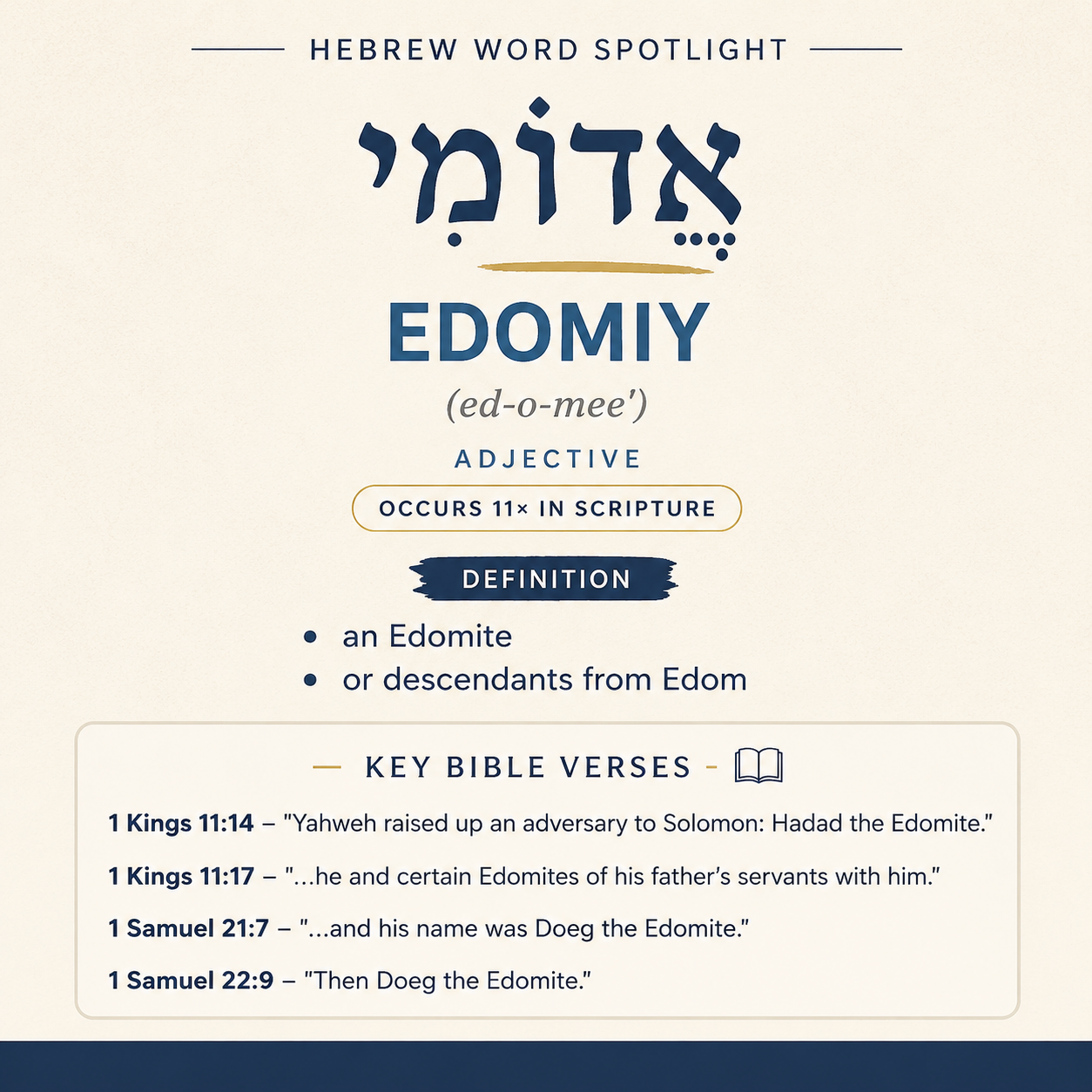
אֱדֹמִי (Edomiy) means “an Edomite,” a descendant from Edom, and appears 11 times in Scripture including 1 Kings, 1 Samuel, and 2 Chronicles.
Named Individuals
1 Kings 11 uses it of Hadad the Edomite. 1 Samuel 21–22 uses it repeatedly of Doeg the Edomite.
Learn More →People Groups
2 Chronicles uses it for “the Edomites,” including events in 25:14 and 28:17.
Learn More →אֱדֹמִי (Edomiy) designates an Edomite—someone belonging to Edom or descended from Edom. In the passages where it appears, it can mark an individual’s identity (especially in the narratives about Hadad and Doeg), or it can label a group involved in war, captives, and religious influence.
Occurrences
1 Kings 11:14
“Yahweh raised up an adversary to Solomon: Hadad the Edomite. He was one of the king’s offspring in Edom.” (1 Kings 11:14)
Here Edomiy functions as an identifying label attached to Hadad. The verse sets his origin and political significance side by side: he is “Hadad the Edomite,” and he becomes “an adversary to Solomon.” The adjective anchors the conflict in a concrete people and place (“in Edom”) while distinguishing Hadad from Israel’s own leadership circle.
1 Kings 11:17
“Hadad fled, he and certain Edomites of his father’s servants with him, to go into Egypt, when Hadad was still a little child.” (1 Kings 11:17)
In this flight narrative, Edomiy marks a small company defined by their association with Hadad’s household—“Edomites of his father’s servants.” The word draws attention to shared identity as the basis of solidarity and accompaniment in exile. Their destination (“into Egypt”) highlights that the group’s defining feature is not location but descent and affiliation.
1 Samuel 21:7
“Now a certain man of the servants of Saul was there that day, detained before Yahweh; and his name was Doeg the Edomite, the best of the herdsmen who belonged to Saul.” (1 Samuel 21:7)
Edomiy is used as part of a formal introduction: “Doeg the Edomite.” The narrative also places him within Saul’s service (“the best of the herdsmen who belonged to Saul”) and within a religious setting (“detained before Yahweh”). The adjective contributes an ethnic-national descriptor that stands out within Israel’s court environment, setting Doeg apart even while he is integrated into Saul’s administration.
1 Samuel 22:9
“Then Doeg the Edomite, who stood by the servants of Saul, answered and said, “I saw the son of Jesse coming to Nob, to Ahimelech the son of Ahitub.” (1 Samuel 22:9)
Again the word fixes Doeg’s identity at the very moment he speaks. He is positioned as one “who stood by the servants of Saul,” and he provides testimony about David’s movements. Edomiy helps the reader track the speaker consistently across scenes and underscores that the information shaping Saul’s actions comes through this particular figure, introduced and remembered by his Edomite identity.
1 Samuel 22:18
“The king said to Doeg, “Turn and attack the priests!” Doeg the Edomite turned, and he attacked the priests, and he killed on that day eighty-five people who wore a linen ephod.” (1 Samuel 22:18)
In this climactic moment, Edomiy accompanies Doeg’s name while he carries out the king’s command. The verse emphasizes both the command and the execution—Doeg “turned,” “attacked,” and “killed.” The identifying adjective, repeated at the moment of violence, attaches this act to the same Doeg earlier introduced in Saul’s service and seen near the sanctuary. The label keeps his identity sharply in view as the agent of the massacre.
1 Samuel 22:22
“David said to Abiathar, “I knew on that day, when Doeg the Edomite was there, that he would surely tell Saul. I am responsible for the death of all the persons of your father’s house.” (1 Samuel 22:22)
Here Edomiy appears within David’s reflection and confession of responsibility. Doeg’s presence (“was there”) and anticipated report (“he would surely tell Saul”) are linked to the tragic result. The adjective keeps Doeg’s identity consistent as the remembered figure whose actions connect the earlier encounter to the later deaths. The label functions less as a description of geography and more as an established identifier in the narrative’s moral accounting.
2 Chronicles 25:14
“Now after Amaziah had come from the slaughter of the Edomites, he brought the gods of the children of Seir, and set them up to be his gods, and bowed down himself before them, and burned incense to them.” (2 Chronicles 25:14)
Edomiy here is plural and collective—“the slaughter of the Edomites.” The word identifies the defeated group in Amaziah’s campaign. Yet the verse immediately connects that military victory to religious compromise: Amaziah takes “the gods of the children of Seir” and worships them. The label “Edomites” therefore helps frame a reversal: the defeated people’s objects of worship become influential in Judah through the king’s actions.
2 Chronicles 28:17
“For again the Edomites had come and struck Judah, and carried away captives.” (2 Chronicles 28:17)
In this brief report, Edomiy identifies the aggressors. The adverb “again” places the action within a pattern of repeated hostility. The verb sequence—“come,” “struck Judah,” “carried away captives”—portrays the Edomites as a force capable of incursion and removal of people, making the label a marker of threat in Judah’s political and social experience.
2 Kings 16:6
“At that time Rezin king of Syria recovered Elath to Syria, and drove the Jews from Elath; and the Syrians came to Elath, and lived there, to this day.” (2 Kings 16:6)
This verse is part of a territorial account centered on Elath and the movements of “the Jews” and “the Syrians.” In the wider set of occurrences, Edomiy belongs to this same theme of borderlands, displacement, and control of strategic towns. The term’s presence in this cluster of texts highlights how identity labels (who belongs where) matter when land is “recovered,” populations are “driven,” and new residents “lived there.”
Deuteronomy 23:7
“You shall not abhor an Edomite, for he is your brother. You shall not abhor an Egyptian, because you lived as a foreigner in his land.” (Deuteronomy 23:7)
Here Edomiy is singular and generic—“an Edomite”—used in direct instruction. The rationale given is relational: “for he is your brother.” The word thus functions not as a war label but as a category within Israel’s moral obligations. The command addresses attitudes (“shall not abhor”) and places the Edomite within a framework of kinship, even while remaining a distinct identity.
Psalm 52:2
“Your tongue plots destruction, like a sharp razor, working deceitfully.” (Psalm 52:2)
In this psalm line, the speech being condemned is calculated and harmful—“plots destruction” and “working deceitfully.” In the narrative cluster where Edomiy is tied to Doeg’s report to Saul and the resulting deaths, this kind of deceitful speech forms a fitting portrait of the danger of a tongue that cuts like “a sharp razor.” Within the set of passages where Edomiy is remembered through a particular individual, this verse supplies the poetic language for the destructive power associated with such testimony.

Sense and Usage
Edomiy operates as a descriptor of belonging: it can attach to a named person (“Hadad the Edomite,” “Doeg the Edomite”) or it can stand as a plural collective (“the Edomites”). When attached to individuals, the word works like a durable identifier across multiple scenes—especially in 1 Samuel—allowing the narrative to keep the same figure in focus as settings shift (court service, a place “before Yahweh,” royal interrogation, and violent command). In these stories, the label does not merely provide background; it becomes part of how the text remembers the character and traces responsibility.
When used collectively, Edomiy marks a people in relation to Judah and its kings: they can be defeated (“the slaughter of the Edomites,” 2 Chronicles 25:14) or they can be aggressors (“had come and struck Judah,” 2 Chronicles 28:17). The term therefore carries political weight in the chronicle-style reports of conflict and captives. Yet the same identity word also appears in instruction that regulates Israel’s posture toward outsiders: “You shall not abhor an Edomite, for he is your brother” (Deuteronomy 23:7). That juxtaposition—warfare on the one hand, kinship-based restraint on the other—shows that Edomiy can name a people involved in real hostilities while also being treated as a category within ethical teaching about how to regard others.
Across these passages, Edomiy consistently signals descent or national identity rather than a temporary role. Hadad’s flight with “certain Edomites” (1 Kings 11:17) and Amaziah’s appropriation of “the gods of the children of Seir” after slaughtering “the Edomites” (2 Chronicles 25:14) both show that the word can locate people within a wider network—household servants, neighboring populations, and religious artifacts—where shared origin remains the defining line.
Imagery in Context
Several scenes give Edomiy a concrete narrative texture: a refugee child fleeing with retainers to Egypt (1 Kings 11:17), a court official standing among Saul’s servants and speaking a decisive report (1 Samuel 22:9), a commanded attack that leaves “eighty-five people who wore a linen ephod” dead (1 Samuel 22:18), and raids that “carried away captives” (2 Chronicles 28:17). Alongside those images stands a different picture in the law: an Edomite addressed not as an enemy but as “your brother” (Deuteronomy 23:7). The word thus moves between the register of conflict and the register of commanded restraint, while remaining a steady marker of Edomite identity.
Sources: Lexical data from Strong’s Exhaustive Concordance and the Open Scriptures Hebrew Lexicon. Occurrence data from the Westminster Leningrad Codex with STEPBible reference data (CC BY). Scripture quotations from the World English Bible (public domain).





