
Exploring the Meaning of ‘edra` (Aramaic) in Hebrew
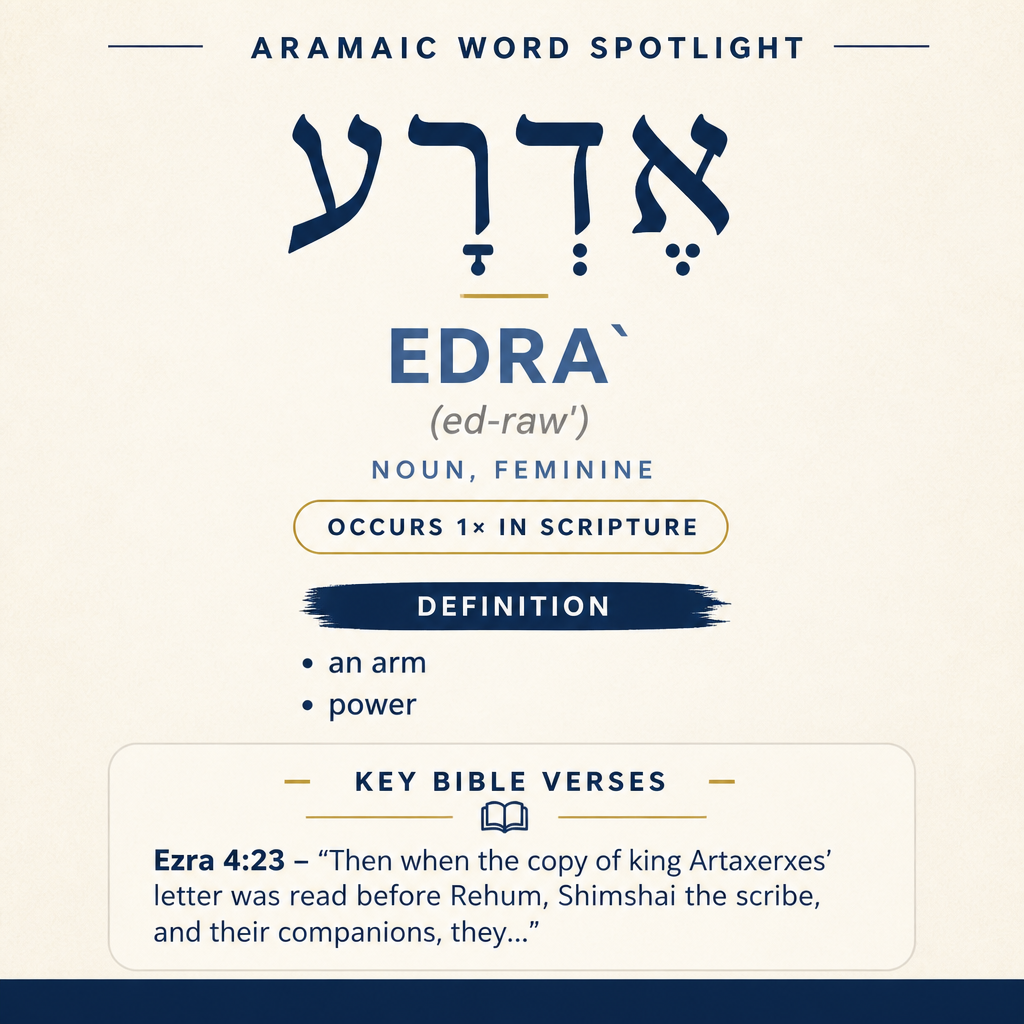
אֶדְרָע (edra`) means “an arm; power” and appears once in Scripture, in Ezra 4:23.
Biblical Occurrence
This noun occurs 1 time in Scripture. Its single reference is Ezra 4:23.
Learn More →Ezra Context
In Ezra 4:23, it appears within the narrative about reading King Artaxerxes’ letter before Rehum and Shimshai the scribe.
Learn More →אֶדְרָע (edraʿ) denotes “an arm” and, by extension, “power,” and it appears in a single narrative notice in Ezra describing the enforcement of a royal order. In that setting it names the kind of coercion used to stop the Jews’ work in Jerusalem.
Occurrences
“Then when the copy of king Artaxerxes’ letter was read before Rehum, Shimshai the scribe, and their companions, they went in haste to Jerusalem to the Jews, and made them to cease by force of arms.” (Ezra 4:23)
In Ezra 4:23, אֶדְרָע stands within the phrase “by force of arms,” describing the means by which Rehum, Shimshai, and their companions bring about the command’s effect. The verse is carefully staged: first, “the copy of king Artaxerxes’ letter was read”; then the officials “went in haste to Jerusalem”; finally, they “made them to cease.” אֶדְרָע belongs to that last action, characterizing the cessation as compelled rather than voluntary. The wording presents a movement from document to immediate action (“went in haste”) to physical enforcement (“force of arms”), so that the “arm” imagery marks power in motion—power not merely spoken in the king’s letter, but enacted on the ground.
The immediate objects of this action are concrete and local: “to Jerusalem to the Jews.” The phrase “force of arms” frames the officials’ intervention as a direct, embodied imposition at Jerusalem, not simply an administrative notice. Within this single sentence, אֶדְרָע serves to sharpen the contrast between a written communication (“the copy … was read”) and the tangible pressure applied afterward; the arm is the instrument through which official authority becomes effective. Thus the noun’s sense of “arm” naturally supports its sense of “power”: the power in view is not abstract prestige but the power to stop activity through strength.

Sense and Usage
The two-fold definition (“an arm; power”) is tightly interwoven in Ezra 4:23. “Arm” names a bodily member associated with reaching, grasping, pushing, and striking; “power” names the capacity to bring about an intended result. In the verse’s depiction, what is achieved is cessation: they “made them to cease.” The expression “by force of arms” links the result to compulsion, and therefore to power exercised in a physical register. The word does not stand alone as a bare anatomical term; it functions in a phrase that makes “arm” a vehicle for describing the kind of power used.
Because אֶדְרָע is used here with “force,” the “arm” is not neutral. It evokes the arm as an instrument of constraint: an arm can restrain, seize, or drive away. The scene emphasizes speed (“went in haste”) and effectiveness (“made them to cease”), and these features align with the semantic extension from limb to potency. In other words, the arm imagery conveys that the officials’ power is applied actively and decisively, not merely held as a right or status.
Within the verse, the arm-based power is also contrasted with the power of the written word. The letter from “king Artaxerxes” is read aloud “before Rehum, Shimshai the scribe, and their companions,” and then the group goes out to enforce it. The narrative thus presents two modes of power: the authority conveyed by the royal letter and the immediate strength by which local agents “made them to cease.” אֶדְרָע belongs to the second mode. It indicates that the outcome depended not only on the existence of an order but also on the ability—and willingness—of officials to bring that order to effect through coercive action.
The word’s sense of “power” in this verse is therefore power understood as capacity to compel. The phrase “force of arms” portrays an asymmetry between the officials and “the Jews”: one party acts, the other is made to stop. In such a context, “arm” is a fitting metonymy for power: the limb stands for the exertion of strength that accomplishes the imposed cessation.
Although only one occurrence is attested here, the single setting clarifies the kind of “power” this word can bear. It is power expressed through force, associated with enforcement and interruption. It is neither internal resolve nor persuasive influence; it is strength that constrains another party’s activity. The verse thus anchors the semantic range of אֶדְרָע at the point where physical arm and practical power meet.
Imagery
Ezra 4:23 attaches the “arm” image to a moment of abrupt stoppage. After the letter is read, officials hurry to Jerusalem and bring the work to an end “by force of arms.” The imagery is that of authority becoming palpable: the arm represents power that can reach into a community and halt its work by direct pressure.
Sources: Lexical data from Strong’s Exhaustive Concordance and the Open Scriptures Hebrew Lexicon. Occurrence data from the Westminster Leningrad Codex with STEPBible reference data (CC BY). Scripture quotations from the World English Bible (public domain).





