
Discovering the Meaning of ‘Abiy in Hebrew
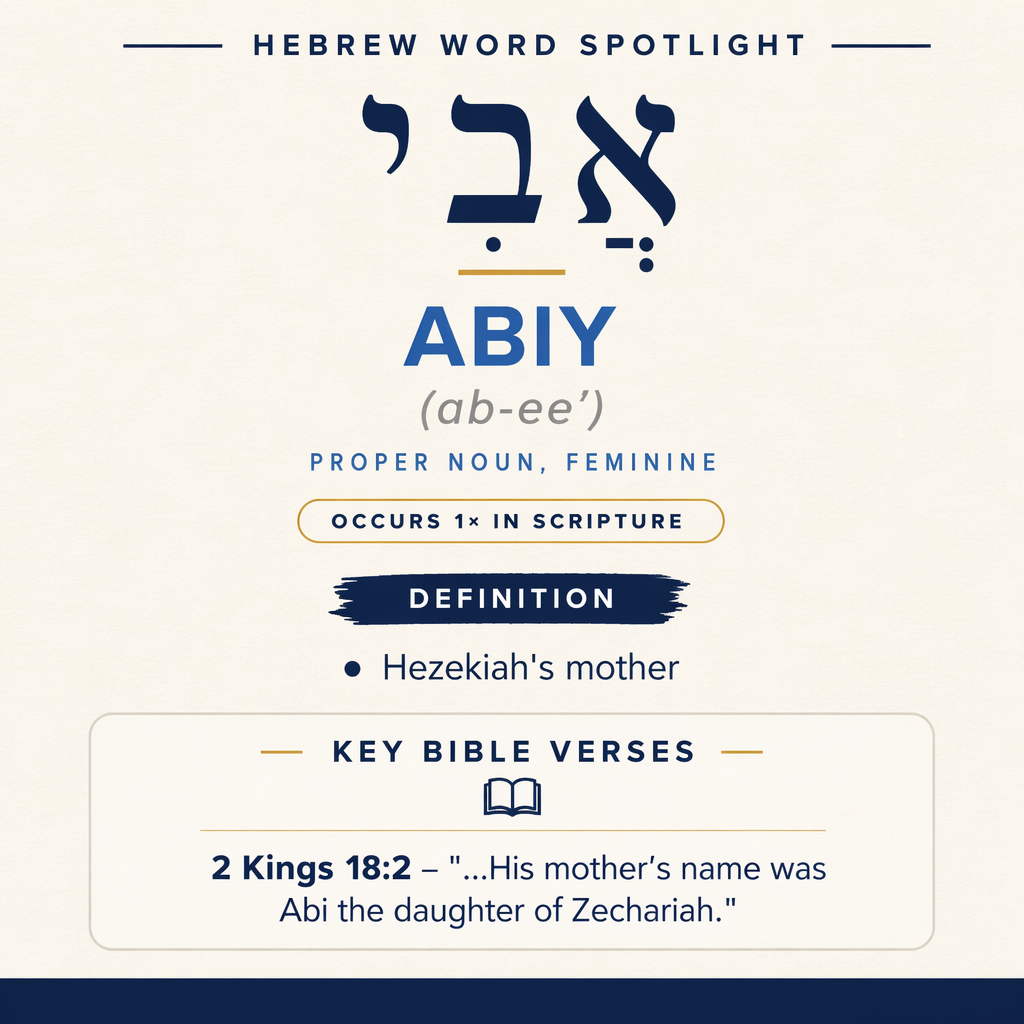
אֲבִי (Abiy) names Hezekiah’s mother and appears once in Scripture, in 2 Kings 18:2.
Verse Context
It appears in 2 Kings 18:2 within the notice of Hezekiah’s mother’s name.
Learn More →אֲבִי (Abiy) is the name of Hezekiah’s mother. It appears in a single narrative notice that situates her within Hezekiah’s royal biography and family line.
Occurrences
“He was twenty-five years old when he began to reign, and he reigned twenty-nine years in Jerusalem. His mother’s name was Abi the daughter of Zechariah.” (2 Kings 18:2)
In this reign-summary the name אֲבִי (Abiy) enters as part of a compact set of identifying facts: Hezekiah’s age at accession (“twenty-five years old”), the duration and location of his reign (“twenty-nine years in Jerusalem”), and a maternal identification (“His mother’s name was Abi the daughter of Zechariah.”). The sentence does not treat Abi as an acting character; rather, it places her within the frame that introduces Hezekiah’s rule. Her name functions as a fixed point in the king’s personal profile, anchoring his origin in a stated maternal line and associating her with her own parent (“the daughter of Zechariah”).
Because the verse names both mother and maternal grandfather, Abi’s appearance serves genealogical clarity inside a royal notice. The form “Abi the daughter of Zechariah” presents her not merely as “His mother,” but as an individual whose identity is itself traced through descent. Within the immediate wording, the naming of Abi is tied to the administrative and dynastic context of kingship in Jerusalem: a king is introduced not only by numbers and place but by family connections, and Abi is the maternal connection given.

Sense and Usage
As “Hezekiah’s mother,” אֲבִי (Abiy) carries the kind of significance that a mother’s name has in a royal formula: it marks the king’s maternal origin as part of what is publicly remembered about his reign. In 2 Kings 18:2 the notice reads like an official summary: time markers and geography are paired with lineage markers. Abi’s name therefore functions as an identifying element in the presentation of Hezekiah, much as age and reign-length identify his place in time. Her identity is expressed relationally—first to Hezekiah (“His mother’s name was Abi”) and then to Zechariah (“the daughter of Zechariah”)—so her usage is strictly familial and descriptive, not narrative or dialogical.
The verse also implies a hierarchical ordering of information: Hezekiah stands at the center as the subject of reign, and Abi appears as part of the background that defines him. Yet the text gives her a proper name rather than leaving her anonymous, and it connects her to her father by name. In this way the name Abi contributes precision. It prevents Hezekiah’s maternal line from being a blank space and embeds his kingship in a specific family network, presented as a matter of record within Jerusalem’s royal history.
Within this single attestation, the semantic force of the word is concentrated: it does not develop multiple nuances, roles, or titles. Its sense is fulfilled by being spoken as a name in a formulaic introduction. The clarity of the construction—“His mother’s name was Abi”—shows the word functioning as a straightforward personal identifier, while the appended lineage phrase—“the daughter of Zechariah”—situates that identifier within a family chain that the verse treats as worth recording alongside the principal facts of reign.
Portrait in Context
The imagery attached to Abi in this passage is the quiet concreteness of a royal register: years counted, a city named, and a mother identified. The verse does not describe Abi’s life or actions, but it does present her name as part of the king’s formal introduction, giving the reader a brief glimpse of the familial setting from which Hezekiah’s reign emerged—Jerusalem as the seat of rule, and a maternal line traced through “Abi the daughter of Zechariah.”
Sources: Lexical data from Strong’s Exhaustive Concordance and the Open Scriptures Hebrew Lexicon. Occurrence data from the Westminster Leningrad Codex with STEPBible reference data (CC BY). Scripture quotations from the World English Bible (public domain).




