Exploring the Meaning of Bradutes in Greek
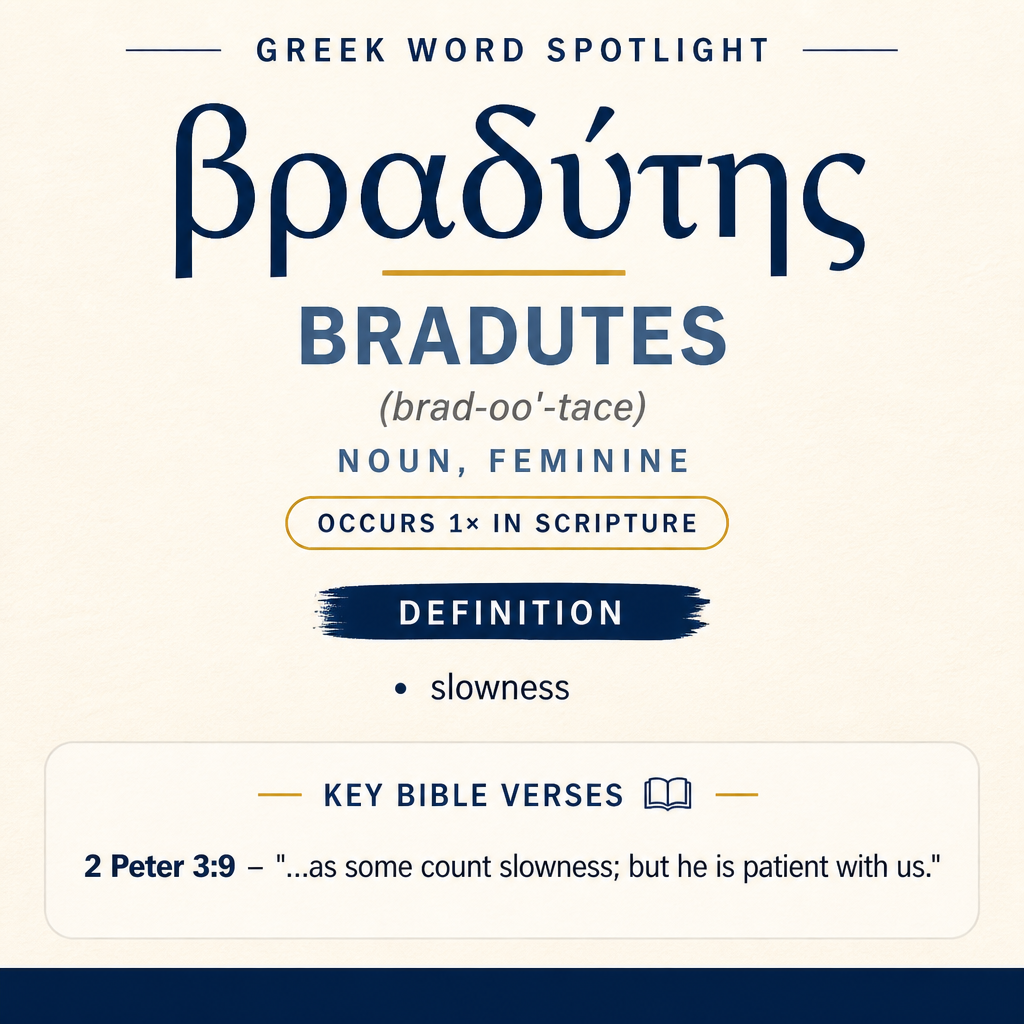
βραδύτης means “slowness” and appears once in Scripture, in 2 Peter 3:9.
Biblical Occurrence
This word occurs 1 time in Scripture. Its single occurrence is in 2 Peter 3:9.
Learn More →Verse Context
In 2 Peter 3:9, it appears in the phrase “as some count slowness,” in relation to the Lord’s promise.
Learn More →βραδύτης denotes “slowness” and appears in a single New Testament context that contrasts human evaluations of delay with the Lord’s faithful intention. In its lone occurrence it functions as a term some people apply to God’s timing, and the surrounding sentence explains why that label is misplaced.
Root and Related Words
βραδύτης is related to bradys (βραδύς), “slow” (Strong’s G1021). The relationship is signaled by the shared form and the semantic connection between the adjective “slow” and the noun expressing the corresponding quality.

Occurrences
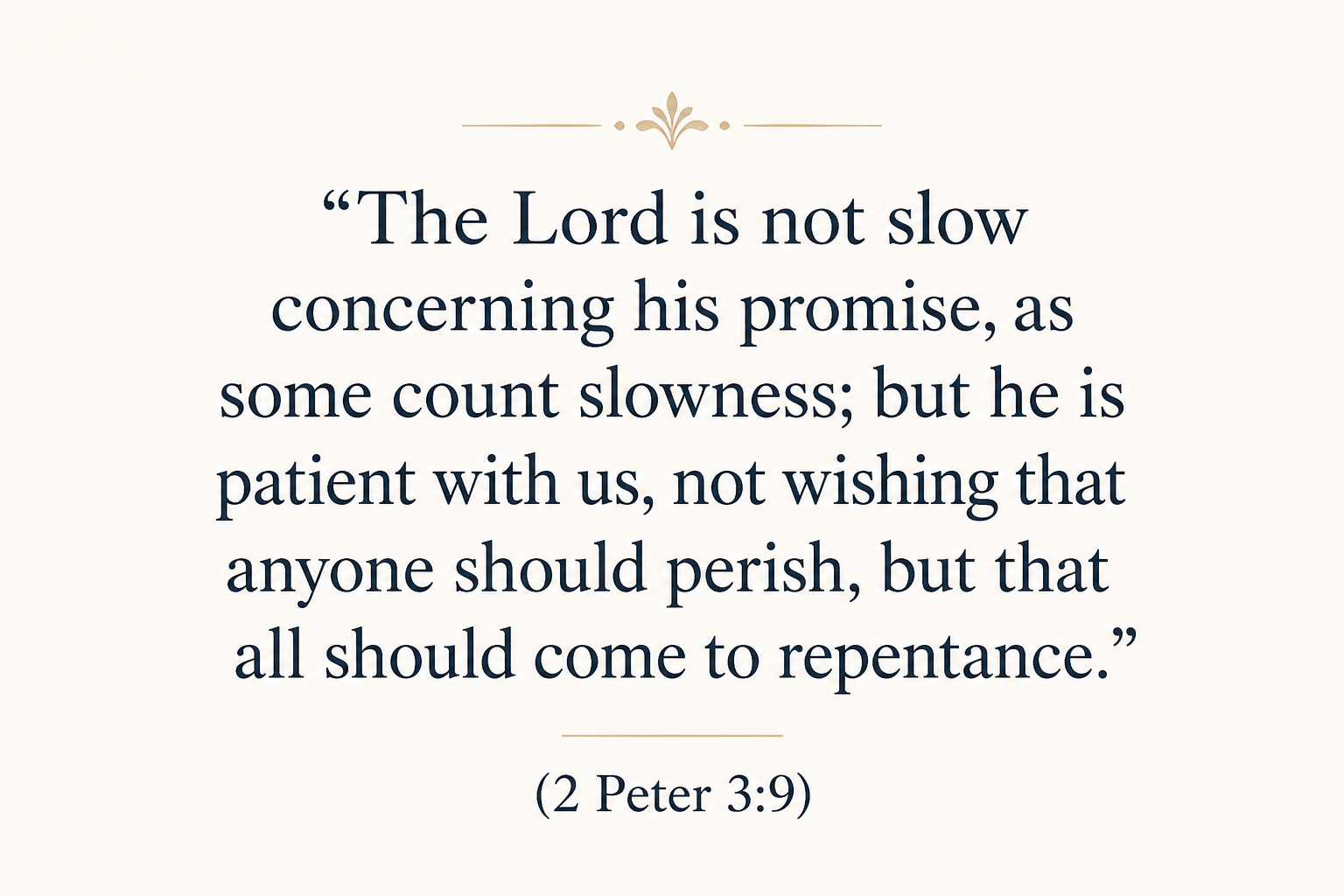
“The Lord is not slow concerning his promise, as some count slowness; but he is patient with us, not wishing that anyone should perish, but that all should come to repentance.” (2 Peter 3:9)
Here βραδύτης names the category some observers use when they assess the Lord’s fulfillment of “his promise.” The sentence is built around a contrast: on the one hand, the Lord is described negatively—“not slow concerning his promise”—and on the other hand, a human perspective is introduced—“as some count slowness.” Within that framing, βραδύτης is not presented as a divine trait; it is the interpretive label that certain people apply when they measure the interval between promise and fulfillment.
The author’s wording depicts “slowness” as something that can be “counted,” that is, evaluated or calculated by human judgment. In the logic of the verse, the charge of βραδύτης arises because the Lord’s action is being timed and assessed on a human scale. The noun thus points to a perceived delay, not to a deficiency in the promise itself. The text immediately redirects the reader from the category of “slowness” to a different explanatory category: “but he is patient with us.” In this way, βραδύτης functions as the foil for the stated reason behind the Lord’s timing.
The remainder of the verse fills out the practical stakes of this contrast. The Lord’s patience is oriented toward people (“with us”) and is described in two coordinated phrases: “not wishing that anyone should perish” and “but that all should come to repentance.” βραδύτης therefore sits in a context where what looks like delay is interpreted in light of the Lord’s intention toward repentance rather than perishing. The noun’s role in the sentence is to mark the mistaken conclusion drawn from outward timing, while the explanation that follows anchors the same time period in divine purpose.
Sense and Usage
Because βραδύτης is attested here in a disputive comparison (“as some count slowness”), its “slowness” is relational and evaluative: it is “slowness” with respect to an expected schedule for a promise. The verse does not treat βραδύτης as an abstract concept detached from circumstance; it is the descriptor attached to the perceived gap between promise and fulfillment. This is reinforced by the immediate proximity of “concerning his promise,” which gives βραδύτης a specific object and arena—how quickly or slowly the promise seems to be realized.
The syntax also highlights that βραδύτης can exist as a human accounting even where it is denied as the true explanation. The statement “The Lord is not slow … as some count slowness” sets up a distinction between reality (the Lord is not characterized by this) and perception (some people classify the situation as slowness). In that sense, βραδύτης in this passage functions as a diagnosis offered by onlookers; the author rejects the diagnosis and replaces it with a different interpretive frame (“but he is patient”).
In this single verse, “slowness” implicitly carries a moral or theological evaluation, because it is set in contrast to the reliability of the Lord’s promise and to the Lord’s will regarding perishing and repentance. Calling the Lord’s timing βραδύτης would suggest that the promise is being mishandled or unduly postponed; the author’s denial prevents that inference from taking hold. Instead, the verse reframes the same temporal experience: what is being “counted” as slowness is to be read as patience that makes space for repentance.
Even though the noun itself remains a straightforward designation of slowness, its rhetorical force in 2 Peter 3:9 is sharpened by the verb “count.” “Slowness” is something people tally up and use to reach a conclusion; the passage challenges that conclusion by giving a competing account of why time is unfolding as it is. Thus, in usage, βραδύτης becomes a term of interpretation attached to delayed fulfillment, one that the author treats as an inadequate explanation when set beside the Lord’s patience and stated desire that people come to repentance rather than perish.
Imagery
The verse evokes the image of waiting for a promise to be completed and the temptation to label the waiting period as “slowness.” Against the backdrop of that waiting, the word carries the feel of measured time—time observed, calculated, and judged—yet the passage insists that the same stretch of time is better understood through the lens of patience directed toward repentance.
Sources: Lexical data from Strong’s Exhaustive Concordance and the Translators Brief Lexicon of Extended Strongs for Greek (STEPBible, CC BY). Occurrence data from the Translators Amalgamated Greek New Testament (STEPBible, CC BY). Scripture quotations from the World English Bible (public domain).