Understanding the Significance of Braduno in Greek
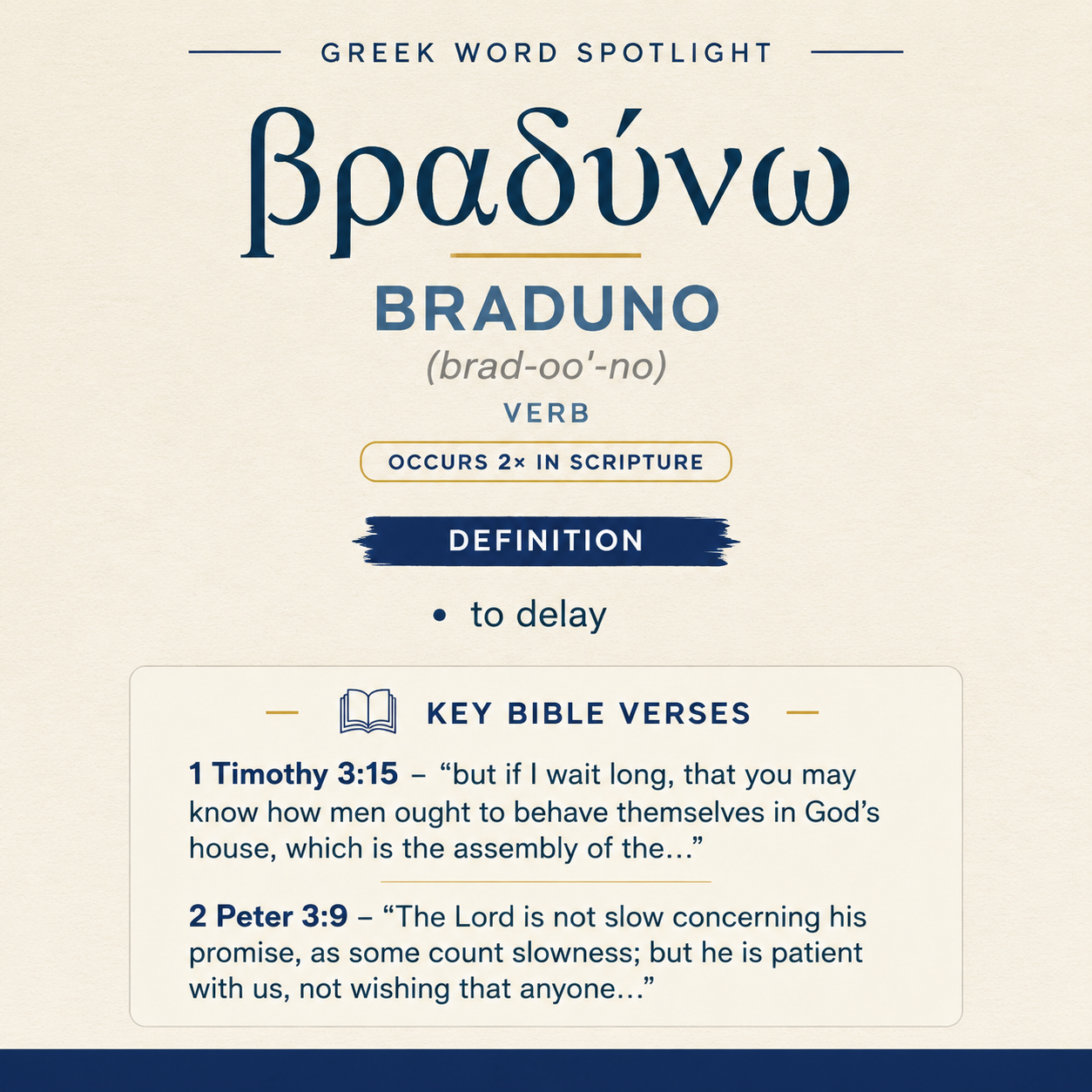
βραδύνω means “to delay” and appears twice in Scripture: 1 Timothy 3:15 and 2 Peter 3:9.
Core Meaning
βραδύνω means “to delay.” It conveys slowness or waiting long in the given contexts.
Learn More →Scripture Occurrences
It occurs in 1 Timothy 3:15 in the phrase “if I wait long.” It occurs in 2 Peter 3:9 in the statement “The Lord is not slow concerning his promise.”
Learn More →Context Notes
In 1 Timothy 3:15, the delay relates to the writer’s prolonged absence. In 2 Peter 3:9, it describes slowness as some count it regarding the Lord’s promise.
Learn More →βραδύνω means “to delay.” It appears in two New Testament contexts: a personal contingency in pastoral instruction and a doctrinal clarification about the Lord’s promise.
Root and Related Words
βραδύνω corresponds to the adjective bradys (βραδύς), “slow” (Strong’s G1021), which provides the descriptive base from which the verbal idea is formed.
Occurrences
1 Timothy 3:15
“but if I wait long, that you may know how men ought to behave themselves in God’s house, which is the assembly of the living God, the pillar and ground of the truth.”
Here βραδύνω frames the letter’s instructions as guidance meant to remain useful even if the writer’s return is postponed. The clause “but if I wait long” sets a conditional delay against the immediate need for order: “that you may know how men ought to behave themselves in God’s house.” The delay envisioned is practical and temporal—time passing before a planned presence—yet its rhetorical function is pastoral: it presses the urgency of knowing proper conduct in “the assembly of the living God,” described with structural metaphors (“pillar and ground of the truth”). In this setting, the verb does not merely describe the writer’s schedule; it accounts for why written instruction is necessary, so that the community’s life is not suspended until the writer arrives.
2 Peter 3:9
“The Lord is not slow concerning his promise, as some count slowness; but he is patient with us, not wishing that anyone should perish, but that all should come to repentance.”
In 2 Peter 3:9 the notion of delay is placed in the arena of interpretation: “as some count slowness.” The statement denies that the Lord’s promise is marked by delay in the way some evaluate events. The verse contrasts that evaluation with a different description of the same interval: “but he is patient with us.” The delay is therefore not treated as mere lateness or inability; it is recharacterized in terms of purpose, aligned with the outcomes expressed in the final clauses: “not wishing that anyone should perish, but that all should come to repentance.” Within this sentence, the word serves as a hinge between two ways of reading time—one that tallies it as slowness, and one that sees it as purposeful restraint connected to repentance.
Sense and Usage
Across these two passages, “to delay” functions in two complementary registers. In 1 Timothy 3:15 it is a contingency attached to human movement and planning: a delayed arrival creates a gap that must be filled by stable instruction so that communal behavior remains ordered. The delay is hypothetical (“if I wait long”), and the focus falls on what should be known and practiced during that interval—conduct appropriate to “God’s house” and the assembly’s role as “pillar and ground of the truth.” The verb thus supports a logic of continuity: when personal oversight is postponed, the community’s obligations are not postponed with it.
In 2 Peter 3:9 “to delay” is not presented as a neutral scheduling matter but as a contested judgment. The sentence explicitly names a way people measure time (“as some count slowness”) and then rejects that measurement as the right lens for the Lord’s promise. The same stretch of time that observers might label as delay is interpreted as patience oriented toward repentance and the avoidance of perishing. The verb therefore participates in an argument about perception: delay is not simply something that happens; it is something that can be miscounted and mischaracterized, depending on what one assumes about the promiser’s intent.
Taken together, these uses show how the idea of delay can carry different weights without changing its core sense. In one scene, delay explains why teaching must be written and communal life maintained; in the other, delay is denied as an adequate explanation for the timing of a promise, because another category—patience with a redemptive aim—is said to better fit the situation. Both passages, however, treat the interval created or perceived by delay as morally and ecclesially consequential: what happens during the waiting matters, whether it is the church’s conduct or the call to repentance.
Imagery
The passages attach delay to settings of waiting and accountability. In 1 Timothy, the image is of a household-like community that must remain properly ordered even when a guiding figure is absent longer than expected. In 2 Peter, the image is of time itself being weighed—some “count slowness,” but the verse insists that the interval should be read as patience directed toward repentance rather than as a failure to keep a promise.
Sources: Lexical data from Strong’s Exhaustive Concordance and the Translators Brief Lexicon of Extended Strongs for Greek (STEPBible, CC BY). Occurrence data from the Translators Amalgamated Greek New Testament (STEPBible, CC BY). Scripture quotations from the World English Bible (public domain).