Understanding the Significance of Bradus in Greek
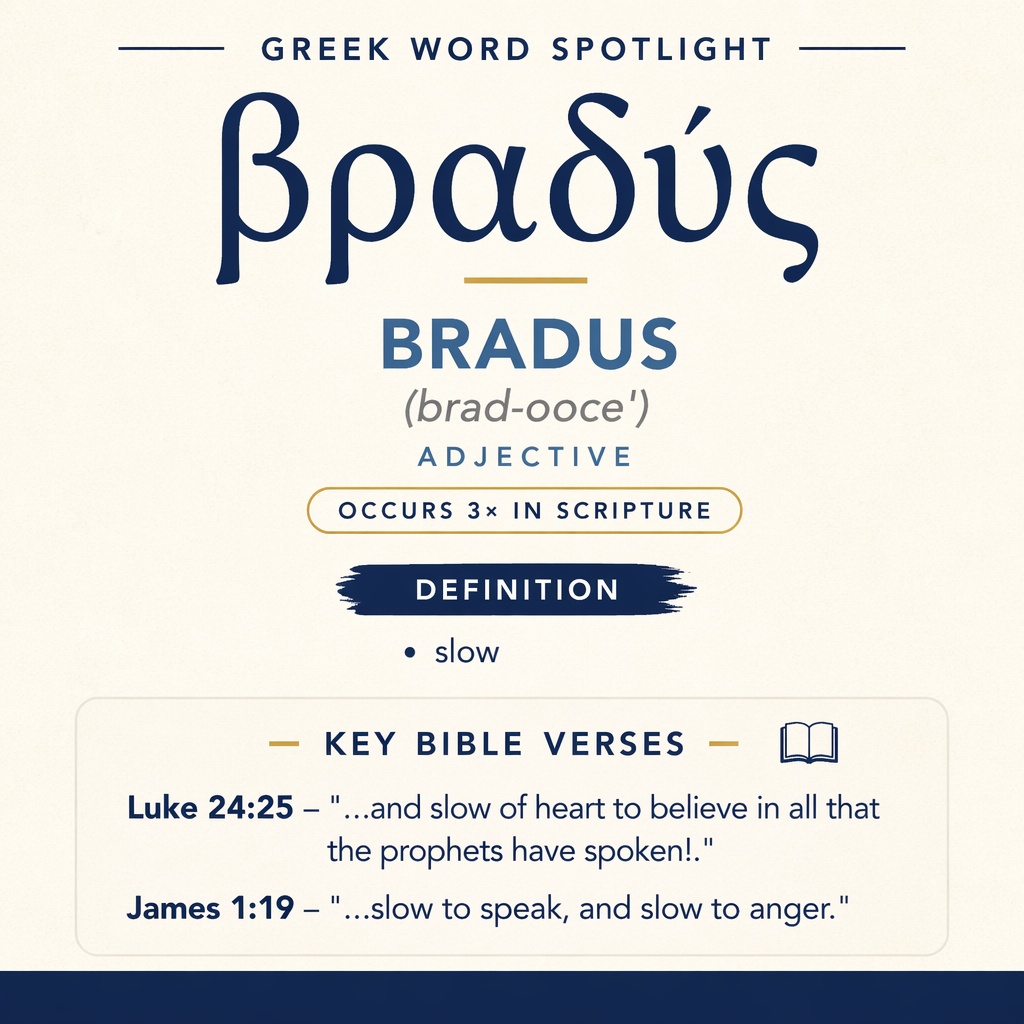
βραδύς means “slow” and appears in Luke 24:25 and James 1:19 (three total occurrences in Scripture).
Scripture Occurrences
It occurs three times in Scripture, including Luke 24:25 and James 1:19.
Learn More →Context Examples
In Luke 24:25 it describes being “slow of heart to believe.” In James 1:19 it pairs with “slow to speak” and “slow to anger.”
Learn More →βραδύς describes what is “slow,” appearing in Jesus’ rebuke of the disciples on the road (Luke 24:25) and in James’s counsel on speech and temper (James 1:19). In both passages it marks a lag, not in motion, but in inward response and outward conduct.
Occurrences
“He said to them, “Foolish men, and slow of heart to believe in all that the prophets have spoken!” (Luke 24:25)
Here βραδύς characterizes the condition of the “heart” in relation to “believe.” The wording sets the slowness in contrast to the breadth and clarity of what is available to be believed: “in all that the prophets have spoken.” The phrase “slow of heart” makes the delay personal and inward; it is not merely that the men lack information, but that their inner readiness to accept what has been spoken is dragging behind. In the rebuke, “Foolish men” and “slow of heart” stand together, so the term contributes to a pointed diagnosis: their response is late and hesitant where a prompt faith is called for by the prophetic witness.

Because the slowness is attached to “to believe,” it functions as a moral and spiritual assessment, not a neutral observation. The sentence frames believing as something that ought to have happened already, since “the prophets have spoken.” βραδύς therefore marks a mismatch between the disciples’ pace of trust and the weight of what has been said: their hearts are not keeping up with the prophetic testimony.
“So, then, my beloved brothers, let every man be swift to hear, slow to speak, and slow to anger;” (James 1:19)
In James, βραδύς is paired twice—“slow to speak, and slow to anger”—and placed beside an opposing quality: “swift to hear.” The term contributes to an ethical rhythm for communication and emotion. “Swift to hear” urges readiness and attentiveness; “slow to speak” urges a measured approach to one’s own words; “slow to anger” urges restraint in the surge of temper. In this triad, slowness is not presented as a defect but as a deliberate posture.
The immediate structure gives βραδύς a practical, behavioral force. Speech and anger often arrive quickly; James calls for a deceleration at precisely those points. In the first pairing, being “slow to speak” implies allowing hearing to run ahead of speaking—letting reception lead expression. In the second, being “slow to anger” suggests a lag between stimulus and emotional eruption, a pause in which anger does not get the first move. βραδύς thus marks a controlled pace: not passivity, but a chosen reluctance to rush into words and wrath.

Sense and Usage
Across these passages, “slow” operates in two distinct evaluations shaped by the surrounding verbs. In Luke 24:25, slowness is censured: a heart that is slow “to believe” is out of step with what ought to be believed, especially when that belief concerns “all that the prophets have spoken.” The term becomes a way to name culpable delay—an inner hesitation that lingers where trust should be responsive. The setting is corrective, and βραδύς carries the sting of that correction.
In James 1:19, slowness is commended: a person who is slow “to speak” and slow “to anger” is acting wisely within relationships. The term’s force is not simply temporal (“later”), but qualitative: speech and anger are slowed down so that hearing can be swift and primary. Here βραδύς is aligned with self-restraint and carefulness. The same basic idea—being slow—shifts in value depending on what is being slowed. A slow heart toward belief is a problem; slow speech and slow anger are virtues.
Both texts, though different in tone, use βραδύς to address responsiveness. Luke targets responsiveness to revelation (“to believe in all that the prophets have spoken”); James targets responsiveness in conversation and conflict (“swift to hear” versus “slow to speak” and “slow to anger”). In each case, the adjective assumes that there is a proper pace for human response: some responses should be quick, others delayed. βραδύς helps establish that moral timing. It signals that the issue is not merely what one does—believe, speak, become angry—but how rapidly one moves into that action.
The collocations sharpen this moral timing. “Slow of heart” binds slowness to the inner person, treating the heart as the seat of readiness and receptivity. “Slow to speak” and “slow to anger” bind slowness to outward expression and emotional reaction, treating speech and anger as forces that benefit from being checked. The adjective thus ranges from diagnosing a lagging inner assent to prescribing a measured outward response, while remaining anchored to the same simple idea of slowness.
Imagery
Luke 24:25 pictures slowness as heaviness within: the heart is portrayed as moving too slowly toward belief, trailing behind what “the prophets have spoken.” James 1:19 pictures slowness as a brake applied at the mouth and at the temper: words and anger are held back so that hearing can go first. Together these scenes attach βραδύς to the felt experience of delay—either the frustrating drag of a hesitant heart, or the purposeful pause that keeps speech and anger from surging ahead.
Sources: Lexical data from Strong’s Exhaustive Concordance and the Translators Brief Lexicon of Extended Strongs for Greek (STEPBible, CC BY). Occurrence data from the Translators Amalgamated Greek New Testament (STEPBible, CC BY). Scripture quotations from the World English Bible (public domain).