
Exploring the Meaning of Blastano in Greek
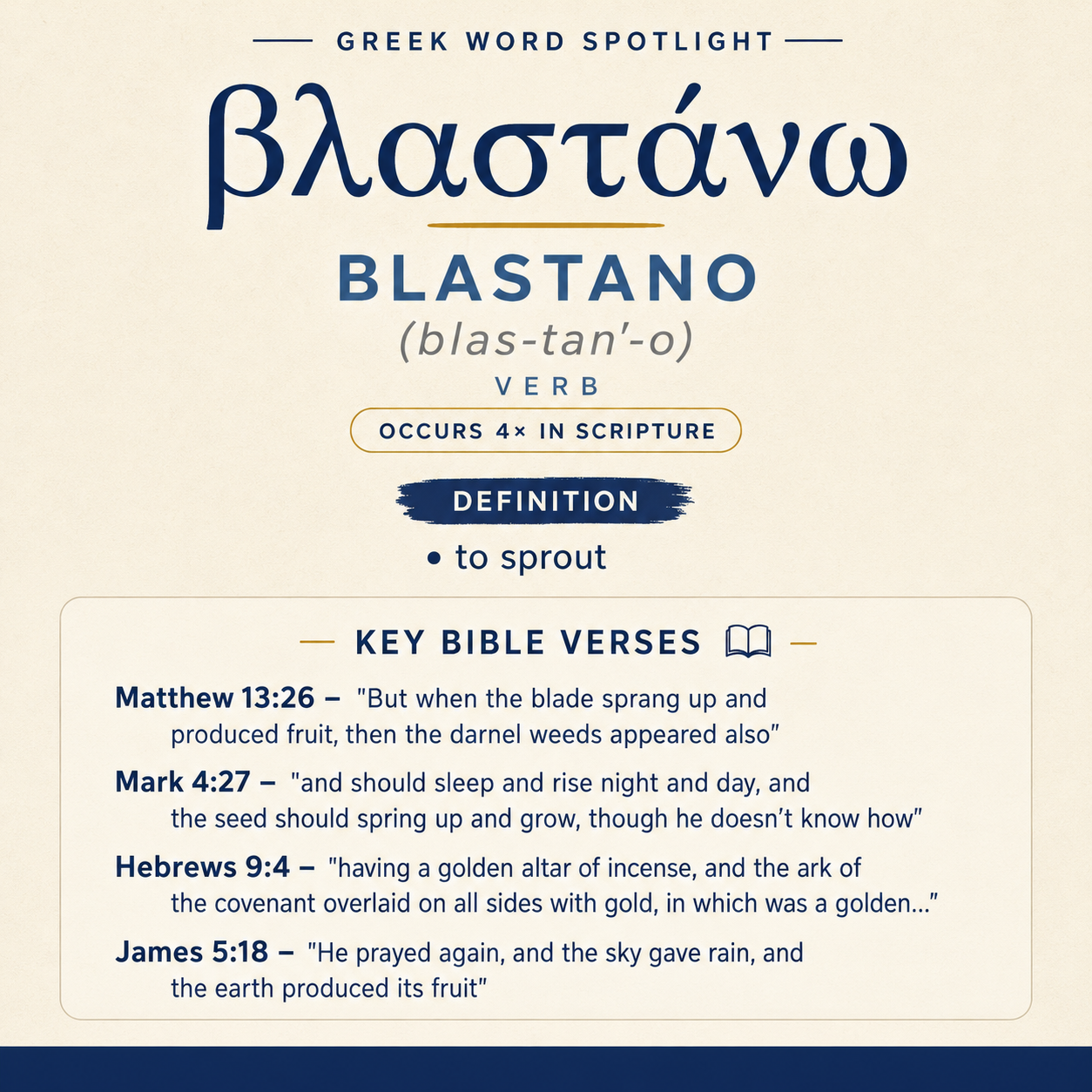
βλαστάνω means “to sprout” and occurs four times in Scripture: Matthew 13:26, Mark 4:27, Hebrews 9:4, and James 5:18.
Core Meaning
βλαστάνω means “to sprout.” It describes growth that comes forth, such as a blade springing up or the earth producing fruit.
Learn More →Gospel Parables
In Matthew 13:26 and Mark 4:27, it is used of seed or a blade springing up and growing. These verses picture growth that becomes visible and fruitful.
Learn More →Other Occurrences
The word also appears in Hebrews 9:4 and James 5:18. In James 5:18, it describes the earth producing its fruit after rain.
Learn More →βλαστάνω describes the action of sprouting. In the New Testament it appears in teaching about seed and harvest, in a description of Aaron’s rod, and in a statement about the earth producing fruit after rain.
Occurrences
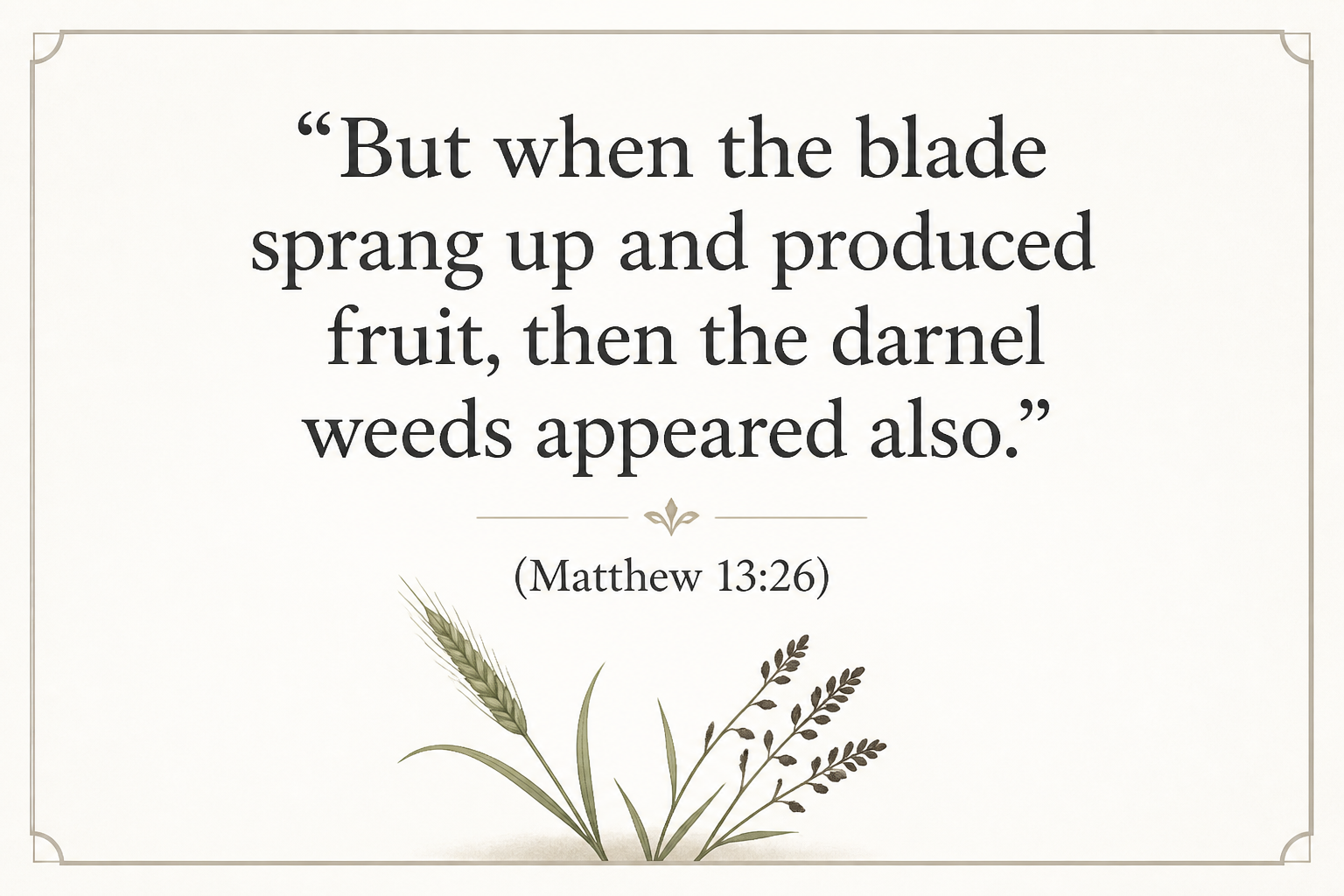
“But when the blade sprang up and produced fruit, then the darnel weeds appeared also.” (Matthew 13:26)
Here the verb is set within a field scene that moves from early growth (“the blade”) to maturity (“produced fruit”). βλαστάνω marks the moment when growth becomes visible and established—when what had been hidden in the ground has now emerged. That emergence triggers recognition: only once the blade has sprouted and the crop is far enough along to bear fruit do “the darnel weeds” become apparent “also.” The sprouting, then, is not merely biological motion; it functions as the turning point in the narrative logic of the verse, the point at which the field’s true mixture is exposed.
“and should sleep and rise night and day, and the seed should spring up and grow, though he doesn’t know how.” (Mark 4:27)
In this saying, βλαστάνω is paired with continued development (“spring up and grow”) and framed by ordinary human rhythms (“sleep and rise night and day”). The sprouting is depicted as an event that proceeds without the farmer’s direct control or even understanding: “though he doesn’t know how.” The verb highlights the seed’s transition from sown potential to visible life; it “should spring up” in a way that is presented as expected and reliable, yet not fully traced to human explanation within the verse. The line’s emphasis falls on the contrast between the man’s routine and the seed’s quiet, ongoing emergence.
“having a golden altar of incense, and the ark of the covenant overlaid on all sides with gold, in which was a golden pot holding the manna, Aaron’s rod that budded, and the tablets of the covenant;” (Hebrews 9:4)
βλαστάνω appears here in a descriptive list of sacred objects associated with the ark of the covenant. Within the catalogue, “Aaron’s rod that budded” stands out as an item characterized by a sprouting action. In this context, the verb’s force lies in its concreteness: a rod—normally an inert piece of wood—is identified by having performed the action of sprouting. The clause does not narrate the event; it names the rod by the result that marked it. Set among objects described by their materials (“golden,” “overlaid on all sides with gold”) and by what they contain or bear (“holding the manna”), the rod’s “budded” quality is a distinctive descriptor grounded in the notion of sprouting.
“He prayed again, and the sky gave rain, and the earth produced its fruit.” (James 5:18)
In this sentence βλαστάνω belongs to a chain of cause and effect moving from prayer to weather to harvest: “He prayed again,” then “the sky gave rain,” and then “the earth produced its fruit.” The verb expresses the earth’s response, the emergence of fruit as the observable outcome following rainfall. The scene is not focused on the seed itself but on the land as the producing agent and on “fruit” as the tangible sign that conditions have changed. βλαστάνω here places sprouting within the broader cycle of provision: rain falls, and the earth brings forth what is needed, described in terms of fruit yielded.

Sense and Usage
Across these four passages, βλαστάνω consistently points to sprouting as the decisive moment when growth becomes outward and discernible. In Matthew 13:26 and Mark 4:27, the setting is agricultural and developmental: the seed’s hidden work reaches the stage where the “blade” or the growing plant stands above ground. The verb helps mark time in the growth process. In Matthew, sprouting belongs to a sequence that includes fruit-bearing, and it becomes the condition under which weeds can be identified alongside the crop. In Mark, sprouting is one element within an ongoing process (“spring up and grow”), and the emphasis is that this emergence proceeds independent of the sower’s comprehension, even while the sower continues his daily cycle.
Hebrews 9:4 uses the sprouting idea in a different register. The setting is not a field but a sacred inventory, and the subject is not seed or earth but “Aaron’s rod.” The verb, attached to an object that would normally be lifeless, conveys sprouting as a defining, remembered characteristic. Without adding narrative detail, the verse shows how a single sprouting event can become the identifying label of an item within a formal list. In that list, many features are static (gold, overlay, contained objects), while “that budded” is dynamic in sense even though it is grammatically a descriptor; βλαστάνω thus carries an implicit notion of life emerging where it would not be expected from the object itself.
James 5:18 frames sprouting as the earth’s productive response to rain. The verb serves the rhetorical flow by placing fruit-bearing on the far side of rainfall: rain is given, and the earth then produces. Whereas Mark emphasizes the sower’s lack of knowledge (“though he doesn’t know how”), James emphasizes the linkage of events (“the sky gave rain, and the earth produced its fruit”). In both, sprouting is treated as real, observable output—something that happens in the world and results in measurable fruitfulness.
Taken together, these uses show βλαστάνω applied to multiple subjects—blade/seed, a rod, and the earth—yet always with the same central idea: the start of visible growth. The word can highlight different aspects of that sprouting depending on context: (1) recognition and separation once growth is evident (Matthew 13:26), (2) the steady, often uncomprehended progress of growth over time (Mark 4:27), (3) an object marked out by having sprouted (Hebrews 9:4), and (4) the land’s fruit-bearing response under suitable conditions (James 5:18). In every case, the verb anchors the text in the tangible moment when life shows itself by coming forth.
Imagery
βλαστάνω brings with it the imagery of emergence: what is below the surface becomes visible, and what is dormant becomes productive. In Matthew 13:26, that emergence affects perception, because sprouting and fruiting are the stage at which “the darnel weeds appeared also.” In Mark 4:27, the image is ordinary yet mysterious—growth proceeds while the farmer “sleep[s] and rise[s] night and day.” Hebrews 9:4 compresses the image into a single remembered feature, “Aaron’s rod that budded,” presenting sprouting as a signature event. James 5:18 rounds out the picture with rain and harvest: the sky gives rain and the earth responds by producing “its fruit.”
Sources: Lexical data from Strong’s Exhaustive Concordance and the Translators Brief Lexicon of Extended Strongs for Greek (STEPBible, CC BY). Occurrence data from the Translators Amalgamated Greek New Testament (STEPBible, CC BY). Scripture quotations from the World English Bible (public domain).




