Understanding the Significance of Bioo in Greek
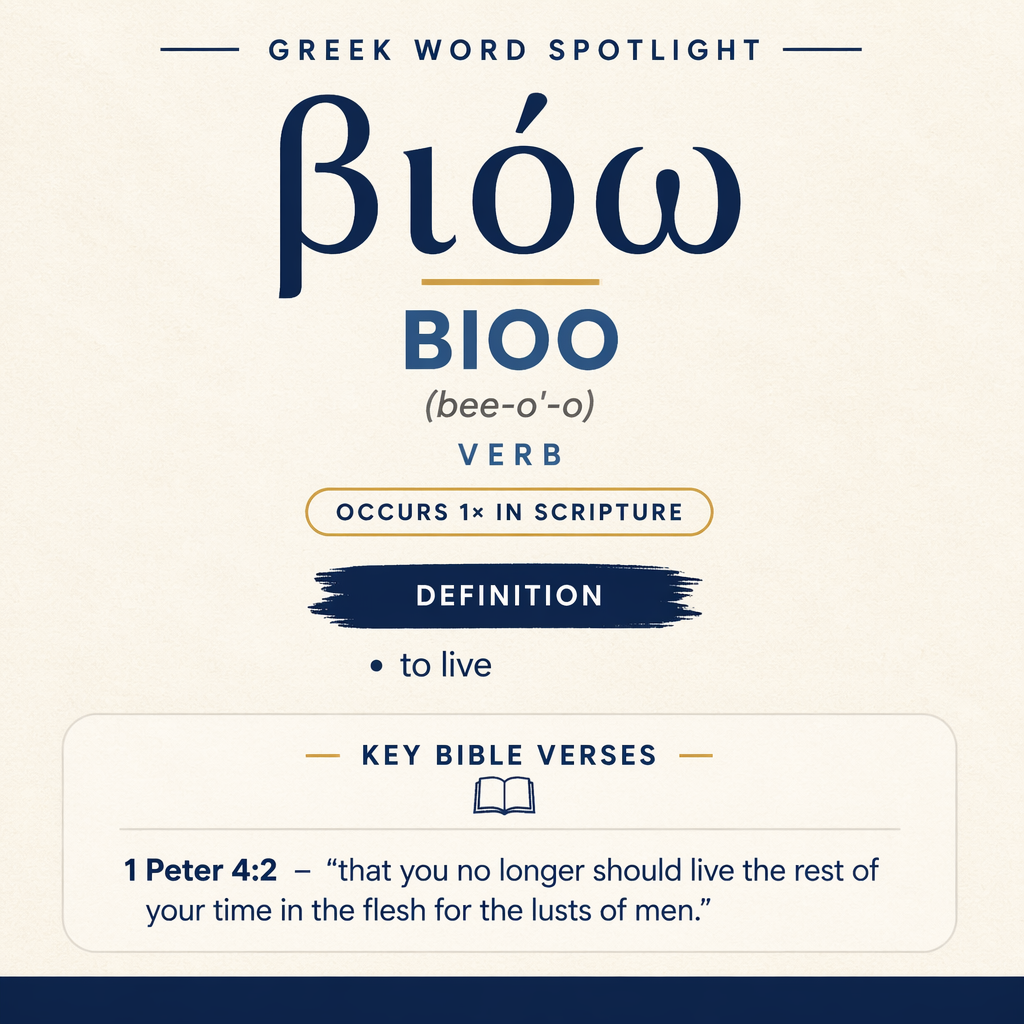
βιόω means “to live” and appears once in Scripture, in 1 Peter 4:2.
Scripture Occurrence
This verb occurs 1 time in Scripture. Its single occurrence is in 1 Peter 4:2.
Learn More →Verse Context
In 1 Peter 4:2 it appears in the phrase, “that you no longer should live the rest of your time in the flesh.”
Learn More →βιόω means “to live.” In the New Testament it appears in 1 Peter 4:2, where it frames how a person is to spend the remainder of earthly time and what purposes are to govern that life.
Root and Related Words
βιόω (Bioo) is connected with the noun βίος (bios), “life” (Strong’s G979), from which it derives.

Occurrences
“that you no longer should live the rest of your time in the flesh for the lusts of men, but for the will of God.” (1 Peter 4:2)
Here βιόω is set within a purposeful contrast: a former manner of living is rejected, and a new aim is embraced. The verb governs “the rest of your time,” placing the focus on the remaining stretch of one’s life as a measurable span that can be directed. In the same line, “in the flesh” locates that span in ordinary embodied existence—life lived under earthly conditions—yet the decisive issue is not the setting but the orientation of that living.
The sentence presents two competing “for” clauses that specify the ends toward which life may be spent. On one side is “for the lusts of men,” a way of living shaped by human desires and impulses. On the other is “for the will of God,” a way of living governed by what God purposes. βιόω therefore contributes more than the bare fact of being alive: it marks lived time as morally and spiritually directed time. The force of “no longer” indicates a turning point, so that living is portrayed as a course capable of reorientation. The verb gathers up conduct, intention, and the practical outworking of desire into the single, comprehensive act of living one’s remaining days.
Sense and Usage
The single attested use of βιόω shows how “to live” can function as a summary verb for an entire pattern of existence. It can take as its object not a thing but a span (“the rest of your time”), treating life as something that is “lived” through and, at the same time, “lived for” something. In 1 Peter 4:2, this verb is immediately qualified by purpose: living is presented as being done “for” one set of ends rather than another. The contrast clarifies that living is not a neutral biological condition but a directed manner of spending time.
Two anchors shape the statement. First, there is continuity: the living occurs “in the flesh,” meaning within the same realm of earthly, bodily life. The verse does not depict an escape from embodied existence; instead, it speaks of how that embodied time is conducted. Second, there is discontinuity: the goals that once animated life are repudiated (“no longer”), and the remainder is claimed for a different governing intention (“but for the will of God”). In this way βιόω carries a sense of lived allegiance, expressing the idea that a life can be characterized by the desires it serves and the authority it recognizes.
The immediate phrasing also portrays life as divisible—there is a “rest” of time—which implies that one’s manner of living can be evaluated in segments: what came before and what follows. βιόω thus naturally supports exhortation, because it can describe life not only as an ongoing state but as a course of action subject to change. Within the verse, the verb stands at the hinge of ethical redirection: living becomes the sphere in which competing motivations—“the lusts of men” versus “the will of God”—are enacted. The word therefore fits contexts where the question is not simply whether someone is alive, but what governs the use of the life that remains.
Imagery
The imagery surrounding βιόω in 1 Peter 4:2 is the imagery of remaining time spent within embodied life, like days that can be allocated toward one purpose or another. The verse pictures life as a path with a decisive break—“no longer”—and a newly chosen destination—“the will of God”—so that living is portrayed as a deliberate direction for the days still ahead.
Sources: Lexical data from Strong’s Exhaustive Concordance and the Translators Brief Lexicon of Extended Strongs for Greek (STEPBible, CC BY). Occurrence data from the Translators Amalgamated Greek New Testament (STEPBible, CC BY). Scripture quotations from the World English Bible (public domain).