Exploring the Meaning of Aspondos in Greek
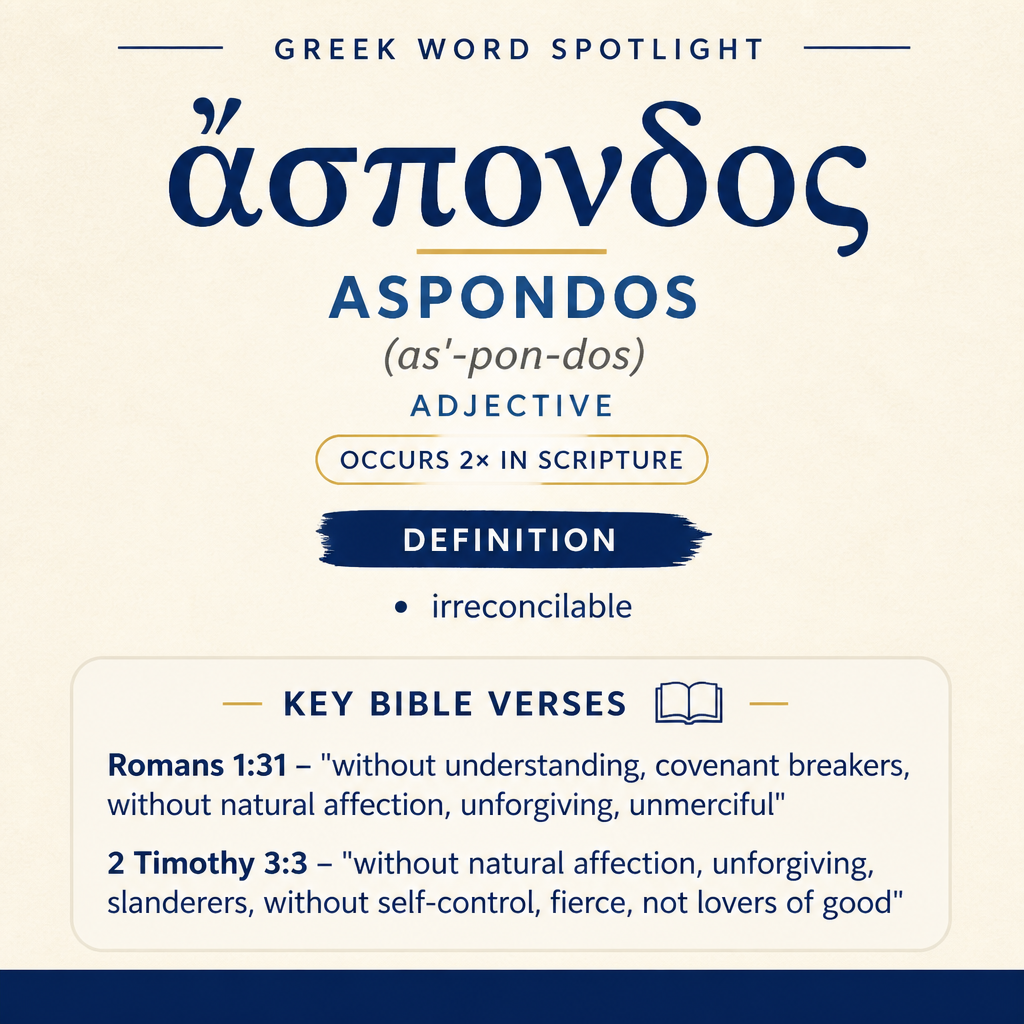
ἄσπονδος means “irreconcilable” and appears twice in Scripture: Romans 1:31 and 2 Timothy 3:3.
Scripture Occurrences
The word occurs 2 times in Scripture: Romans 1:31 and 2 Timothy 3:3.
Learn More →Verse Context
In Romans 1:31 it appears in a list including “covenant breakers” and “unmerciful.” In 2 Timothy 3:3 it appears in a list including “slanderers” and “fierce.”
Learn More →ἄσπονδος means “irreconcilable,” describing a posture in which a person will not be brought into a restored relationship. In the New Testament it appears in two vice lists, where it helps portray moral collapse in human relationships and community life.
Root and Related Words
ἄσπονδος is connected with the letter α (Alpha; transliteration a, α; Strong’s G1), noted as part of its derivation, and with the verb σπένδω (transliteration spendō, σπένδω), “to pour a libation” (Strong’s G4689). In this word, those elements combine to form an adjective that marks a person’s stance toward reconciliation.

Occurrences
“without understanding, covenant breakers, without natural affection, unforgiving, unmerciful;” (Romans 1:31)
Here ἄσπονδος stands among a tightly packed set of descriptions. The surrounding terms paint a picture of relational and moral disintegration: “without understanding,” “covenant breakers,” “without natural affection,” and “unmerciful.” In that stream, “unforgiving” gives ἄσπονδος a clear social location: it is not merely a private emotion but a settled refusal to move from rupture toward restored peace. The sequence also links this irreconcilable stance with broken commitments (“covenant breakers”) and the collapse of family-like loyalties (“without natural affection”), so the word contributes to a portrait in which trust and kinship bonds fail and then harden into an ongoing unwillingness to be reconciled.
“without natural affection, unforgiving, slanderers, without self-control, fierce, not lovers of good,” (2 Timothy 3:3)
In this second list the word again appears as “unforgiving,” placed immediately after “without natural affection.” The cluster that follows—“slanderers, without self-control, fierce, not lovers of good”—describes speech and behavior that attack community stability: words that wound (“slanderers”), impulses unchecked (“without self-control”), aggression (“fierce”), and a settled aversion to what is beneficial (“not lovers of good”). In that moral environment, ἄσπονδος marks the relational end-state: when affection is gone and destructive speech and harshness are present, reconciliation is refused rather than pursued. The term thus helps the list portray not only wrongdoing but an entrenched resistance to repairing what wrongdoing has damaged.
Sense and Usage
Across both passages, ἄσπονδος functions as a relational adjective, describing a person whose posture toward conflict is fixed and hostile to restored peace. Its placement in catalogues of vices is significant: the word is not presented as an isolated fault but as part of a pattern that spreads through human bonds. In Romans 1:31 it is framed by broken obligation (“covenant breakers”) and the failure of familial loyalty (“without natural affection”), suggesting that when bonds of promise and affection have already been violated, irreconcilability becomes a further deepening of the fracture—an insistence that the breach remain a breach.
In 2 Timothy 3:3, the same posture is interwoven with corrupt speech (“slanderers”) and uncontrolled, harsh conduct (“without self-control, fierce”). The effect is to show irreconcilability not as mere passivity—simply “letting things go”—but as an active moral stance that belongs with actions and words that inflame and prolong conflict. The adjective therefore describes a hardened relational character: where affection has failed and destructive habits dominate, the person is set against the repair of relationships. In both lists, ἄσπονδος contributes to the overall depiction of societal life where people do not merely injure one another; they refuse the restoration that would heal injury.
Imagery
The imagery carried by ἄσπονδος in these verses is relational deadlock. Romans 1:31 places it beside the breaking of covenants and the absence of natural affection, while 2 Timothy 3:3 surrounds it with slander and fierceness; together these contexts depict a community atmosphere where ruptures are multiplied and then held in place by an unforgiving, irreconcilable resolve.
Sources: Lexical data from Strong’s Exhaustive Concordance and the Translators Brief Lexicon of Extended Strongs for Greek (STEPBible, CC BY). Occurrence data from the Translators Amalgamated Greek New Testament (STEPBible, CC BY). Scripture quotations from the World English Bible (public domain).