
Exploring the Meaning of Asphalos in Greek
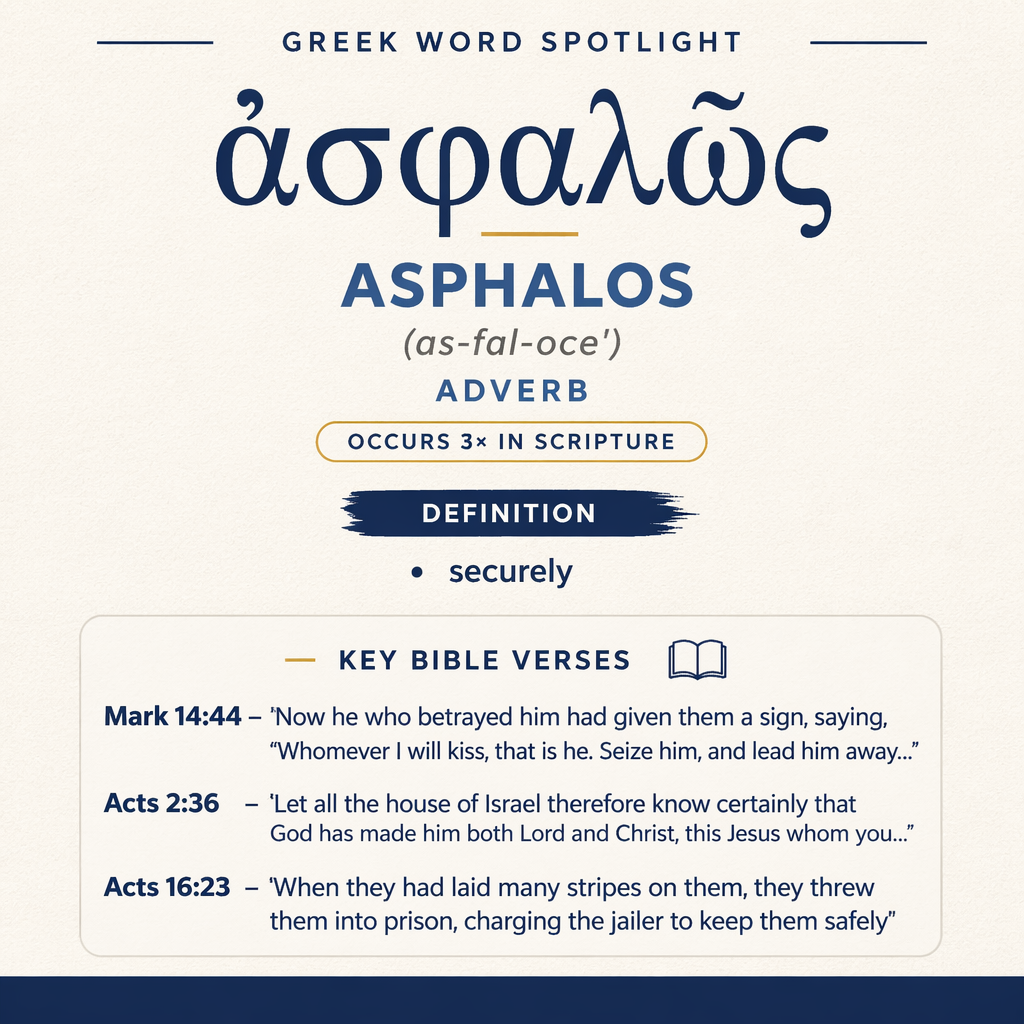
ἀσφαλῶς means “securely” and appears three times in Scripture: Mark 14:44; Acts 2:36; Acts 16:23.
Scripture Occurrences
It occurs 3 times in Scripture: Mark 14:44; Acts 2:36; Acts 16:23.
Learn More →Context Snapshots
In Mark 14:44 it relates to seizing and leading someone away; in Acts 16:23 it concerns keeping prisoners safely. In Acts 2:36 it appears with “know certainly.”
Learn More →ἀσφαλῶς expresses the idea of something being done “securely.” In the New Testament it appears in scenes of arrest and imprisonment, and in a public declaration meant to be held with firm certainty.
Root and Related Words
ἀσφαλῶς corresponds to the adjective asphales (ἀσφαλής), “secure” (Strong’s G804). The adverbial form naturally suits contexts where an action is carried out in a way characterized by security.

Occurrences
Mark 14:44: Now he who betrayed him had given them a sign, saying, “Whomever I will kiss, that is he. Seize him, and lead him away safely.”
Here ἀσφαλῶς modifies the instruction given to the arresting party: after the identifying kiss, they are to “seize” and then “lead him away” in a manner marked by security. The word shapes the betrayer’s plan as more than identification; it anticipates resistance, escape, or interference and therefore presses for a controlled outcome. Within the single sentence, it stands at the end of a sequence (“kiss … seize … lead away”), highlighting the desired end state of the arrest: custody maintained without loss of control.
Acts 2:36: “Let all the house of Israel therefore know certainly that God has made him both Lord and Christ, this Jesus whom you crucified.”
In this proclamation, ἀσφαλῶς bears on knowing: “know certainly.” The statement is not framed as tentative or merely probable; it is presented as knowledge that is to be held securely by “all the house of Israel.” The content of what is to be known is specific and weighty—“that God has made him both Lord and Christ, this Jesus whom you crucified.” In this setting, the adverb supports the rhetorical force of the appeal: the hearers are urged toward settled conviction regarding what God has done, even as the sentence directly confronts them with their own involvement (“whom you crucified”).
Acts 16:23: When they had laid many stripes on them, they threw them into prison, charging the jailer to keep them safely,
In Philippi, ἀσφαλῶς describes how the jailer is ordered to guard the prisoners: he must keep them “safely.” The surrounding details intensify the word’s practical sense. The prisoners have received “many stripes,” then are “threw[n] … into prison,” and the jailer is given a formal charge. In that chain of actions, ἀσφαλῶς expresses the authorities’ aim that confinement be secure—custody that holds, not a loose detention. The adverb also fits the administrative tone of the line: the jailer is not merely told to watch them, but to keep them in a condition of secure keeping.
Sense and Usage
Across these three passages, “securely” functions in two closely connected directions: the security of custody and the security of conviction. Mark 14:44 and Acts 16:23 apply the term to the handling of persons under restraint—first in an arrest (“Seize him … lead him away safely”), then in incarceration (“charging the jailer to keep them safely”). In both, the adverb highlights the controlling concern of the actors involved: they are not content simply to begin the process (seizing, imprisoning); they want the outcome safeguarded so that the person remains firmly in their power.
Acts 2:36 moves the same notion of security into the realm of knowledge: “know certainly.” The scene is public address rather than physical restraint, yet the adverb still describes an intended stability. The speaker calls for knowledge that is fixed and dependable, not easily shaken. The verse’s structure also shows how such certainty is directed toward a particular claim (“God has made him both Lord and Christ”) about a particular person (“this Jesus”) in a morally charged frame (“whom you crucified”). ἀσφαλῶς, then, serves the communicative goal of establishing the statement as something to be held with secure assurance.
Put together, these uses show the adverb’s practical flexibility. It can describe securing a person in transit and confinement, and it can describe securing a conclusion in the mind of a community. In each setting it adds an emphasis on firmness: a desired condition that is protected against loss—whether loss of custody through escape or loss of certainty through doubt.
Imagery
The passages give ἀσφαλῶς a concrete feel even when it modifies knowing. In Mark, it sits in the tense moment of a planned arrest, where a kiss becomes a signal and “safely” points to control after the seizure. In Acts 16, it belongs to the hard imagery of punishment and imprisonment—“many stripes,” then being thrown into prison, then a charge to keep them securely. Acts 2 uses courtroom-like firmness in the sphere of proclamation: a crowd addressed as “all the house of Israel” is urged to hold a conclusion with secure certainty about Jesus. Together these scenes tie the word to outcomes that are meant to stand fast under pressure.
Sources: Lexical data from Strong’s Exhaustive Concordance and the Translators Brief Lexicon of Extended Strongs for Greek (STEPBible, CC BY). Occurrence data from the Translators Amalgamated Greek New Testament (STEPBible, CC BY). Scripture quotations from the World English Bible (public domain).





