Exploring the Meaning of Asphales in Greek
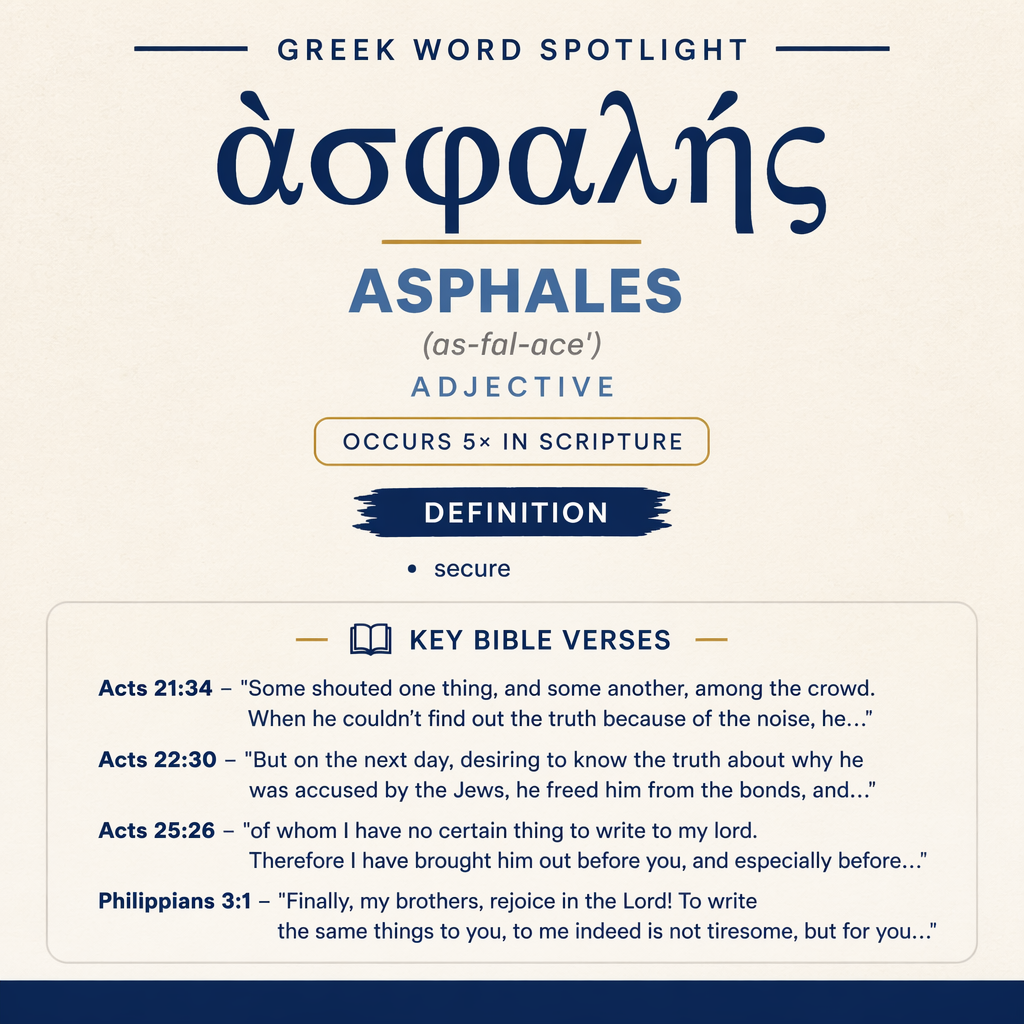
ἀσφαλής means “secure” and appears five times in Scripture: Acts 21:34; 22:30; 25:26; Philippians 3:1; Hebrews 6:19.
Scripture Occurrences
It occurs 5 times in Scripture. The references are Acts 21:34; Acts 22:30; Acts 25:26; Philippians 3:1; Hebrews 6:19.
Learn More →Context Snapshot
In Acts, it appears in settings focused on finding the truth and having “no certain thing” to write. In Hebrews 6:19 it describes hope as “sure and steadfast.”
Learn More →ἀσφαλής expresses the idea of what is secure, whether in establishing reliable facts, providing a protected condition, or describing something firmly held. In the New Testament it appears in narrative settings where officials seek dependable clarity, and in exhortation and metaphor where the reader’s position is described as secure.
Root and Related Words
Strong’s associates ἀσφαλής (Asphales) with the letter-name Ἄλφα (Alpha, α; Strong’s G1), glossed “Alpha.”

Occurrences
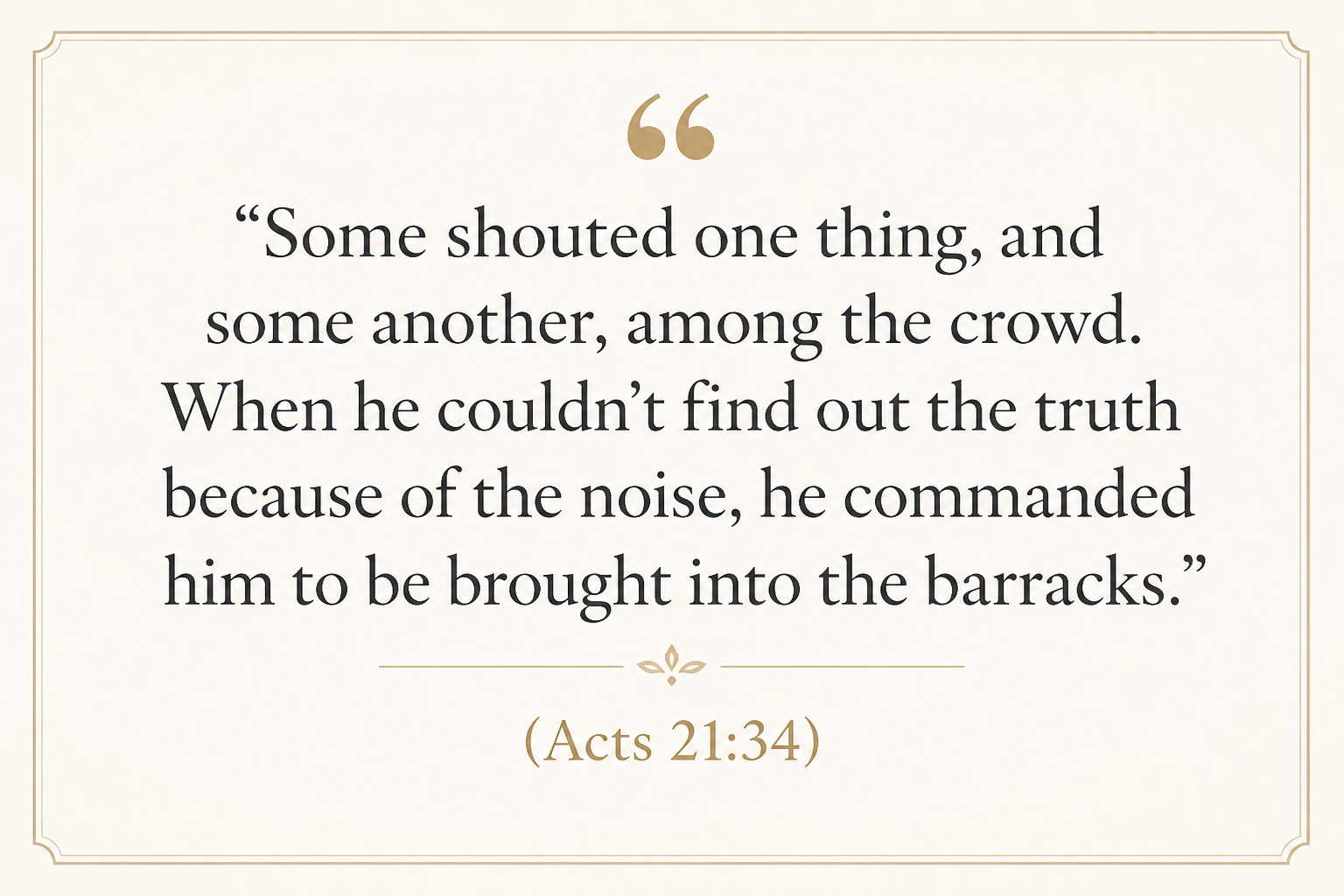
“Some shouted one thing, and some another, among the crowd. When he couldn’t find out the truth because of the noise, he commanded him to be brought into the barracks.” (Acts 21:34)
The scene is dominated by confusion—conflicting shouts and overwhelming noise. In that setting, what is secure is precisely what is missing: the commander “couldn’t find out the truth,” so he removes Paul to the barracks, a controlled space where the situation can be stabilized. The move from a turbulent crowd to a guarded facility highlights the practical need for security when facts cannot be established in public disorder.
“But on the next day, desiring to know the truth about why he was accused by the Jews, he freed him from the bonds, and commanded the chief priests and all the council to come together, and brought Paul down and set him before them.” (Acts 22:30)
This episode continues the concern for a secure grasp of the case: the commander is “desiring to know the truth” about the accusation. He shifts from bonds and immediate custody to a formal convening of “the chief priests and all the council,” placing Paul before an authoritative gathering. Security here is tied to an orderly process—moving from uncertainty and restraint to a setting designed to yield firm understanding of the charge.
“of whom I have no certain thing to write to my lord. Therefore I have brought him out before you, and especially before you, King Agrippa, that, after examination, I may have something to write.” (Acts 25:26)
Here ἀσφαλής is tied explicitly to what can be stated with confidence. The speaker acknowledges “no certain thing to write,” so he arranges an “examination” before King Agrippa with the goal of producing a reportable account. The word’s force lies in the administrative problem: official correspondence requires what is secure enough to commit to writing, and the hearing is presented as the means of turning ambiguity into a dependable statement.
“Finally, my brothers, rejoice in the Lord! To write the same things to you, to me indeed is not tiresome, but for you it is safe.” (Philippians 3:1)
In this exhortation, security is applied to the readers rather than to information in a case file. Repetition (“to write the same things”) is defended not as a burden but as a safeguard: it is “safe” for them. The statement portrays security as a protective effect of reinforcement—reiterated instruction functions as a stable support for a community’s well-being as they are called to “rejoice in the Lord.”
“This hope we have as an anchor of the soul, a hope both sure and steadfast and entering into that which is within the veil;” (Hebrews 6:19)
The metaphor intensifies the term’s imagery: hope is described as “an anchor of the soul,” and that hope is “sure and steadfast.” The adjective contributes the sense of something secure enough to hold fast under strain, like an anchor that keeps from drifting. The phrase “entering into that which is within the veil” extends the picture by locating this secure hope beyond ordinary visibility, yet presented as firmly effective for the soul’s stability.
Sense and Usage
Across these passages, ἀσφαλής gathers around two connected arenas where security matters: (1) the reliability of a conclusion, and (2) the protected steadiness of a person’s condition. In Acts, the term’s range is felt in judicial and military-administrative contexts. The crowd’s chaos (Acts 21:34) and the commander’s desire “to know the truth” (Acts 22:30) frame security as the opposite of disorderly uncertainty; the movement into barracks or formal council underscores that secure understanding is sought through controlled setting and procedure. In Acts 25:26, the need becomes sharply documentary—an official cannot responsibly write to his lord without “certain” content—so security is bound to what can be set down as dependable after “examination.”
In the letters, the same idea is applied to the hearers’ stability. Philippians 3:1 treats security as pastoral protection: repetition is not merely tolerated but valued because it provides a safe condition for the recipients. Hebrews 6:19 uses physical imagery to portray inner firmness; security becomes the soul’s anchored state, described with paired adjectives (“sure and steadfast”) and a directional phrase (“entering into that which is within the veil”) that presents the anchor-point as beyond the immediate scene yet effectively securing the person. Taken together, these uses show ἀσφαλής operating wherever what matters is being held in a secure way—whether a conclusion that can be responsibly written, or a community and conscience kept steady.
Imagery
The passages offer two dominant pictures for security. One is institutional: the shift from noisy crowd to barracks, from bonds to council, and from uncertainty to examination (Acts 21:34; Acts 22:30; Acts 25:26). The other is experiential: repeated instruction that guards a church, and hope portrayed as an anchor that holds the soul firm (Philippians 3:1; Hebrews 6:19). In both, ἀσφαλής marks the movement from what is unstable—noise, accusation, lack of certainty—to what can be relied on and safely held.
Sources: Lexical data from Strong’s Exhaustive Concordance and the Translators Brief Lexicon of Extended Strongs for Greek (STEPBible, CC BY). Occurrence data from the Translators Amalgamated Greek New Testament (STEPBible, CC BY). Scripture quotations from the World English Bible (public domain).