
Exploring the Meaning of Arithmos in Greek
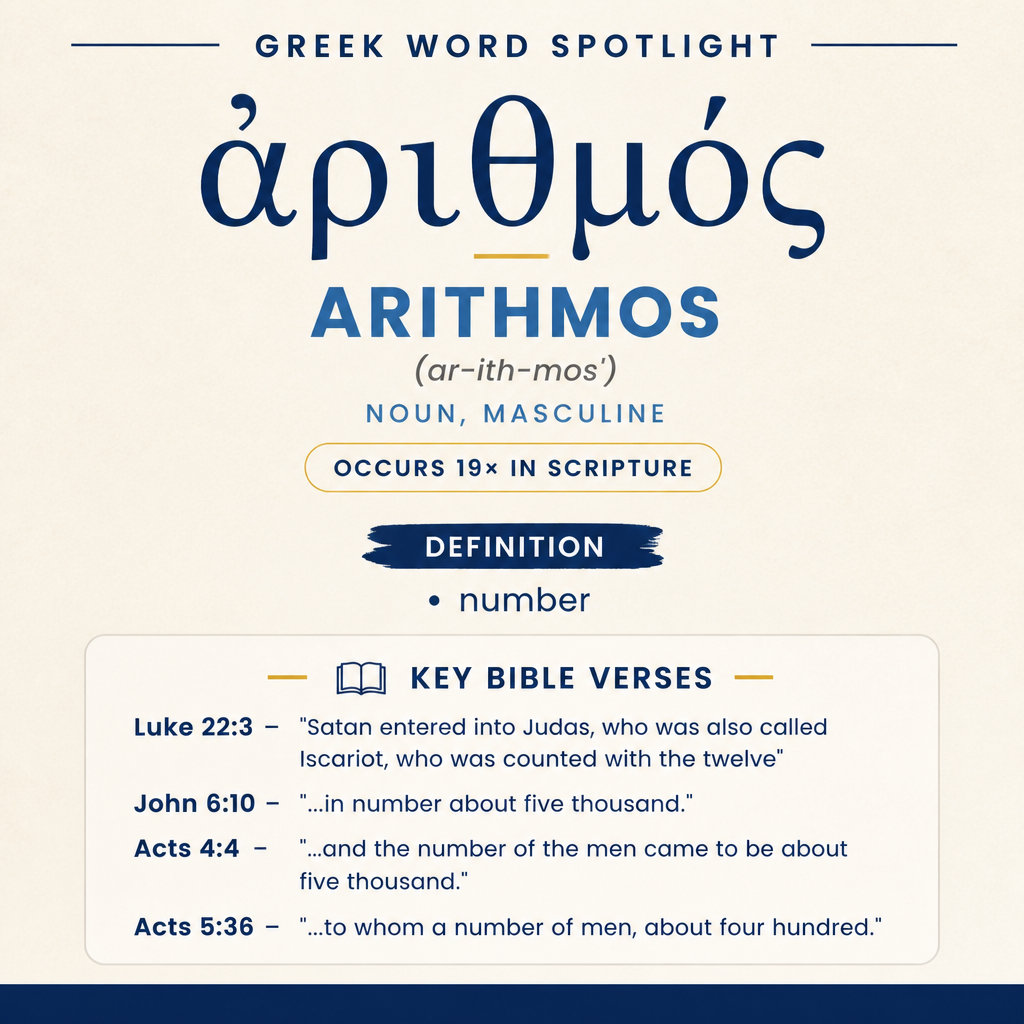
ἀριθμός (Arithmos) means “number” and occurs 19 times in Scripture, including Luke 22:3, John 6:10, Acts 4:4, and Romans 9:27.
Core Meaning
ἀριθμός is defined as “number.” In the listed passages, it refers to counted persons or quantities.
Learn More →Acts References
Acts uses ἀριθμός for counted groups: about five thousand men (Acts 4:4) and about four hundred men (Acts 5:36). It also describes growing numbers of disciples and believers (Acts 6:7; 11:21; 16:5).
Learn More →Gospel & Romans
In John 6:10, men sat down “in number” about five thousand. Romans 9:27 speaks of “the number of the children of Israel.”
Learn More →ἀριθμός refers to “number,” a way of speaking about quantity as something that can be counted, totaled, or stated. In the passages where it appears here, it ranges from small, approximate tallies to vast, awe-filled totals, and it can also function as a defining identifier tied to a name.
Occurrences
Luke 22:3 — “Satan entered into Judas, who was also called Iscariot, who was counted with the twelve.”
Here ἀριθμός lies behind the idea of being “counted with the twelve.” The emphasis is not on a numeral spoken aloud but on inclusion in a recognized total: Judas belongs to a defined group whose size is fixed and known. The statement uses counting language to mark membership and status within that set.
John 6:10 — “Jesus said, “Have the people sit down.” Now there was much grass in that place. So the men sat down, in number about five thousand.”
In this scene the word frames an observable crowd as a countable quantity. “In number about five thousand” presents a large total while still allowing approximation (“about”), showing that ἀριθμός can express a real-world estimate rather than a precise census. It helps the reader feel the scale of what is happening on the “much grass” where the men sit.
Acts 4:4 — “But many of those who heard the word believed, and the number of the men came to be about five thousand.”
Again ἀριθμός marks growth in a measurable way: belief results in a “number” that “came to be about five thousand.” The counting concept turns an otherwise general claim (“many… believed”) into a report of magnitude. The phrase “came to be” suggests a transition into a new total—an increase that can be stated as a count.
Acts 5:36 — “For before these days Theudas rose up, making himself out to be somebody; to whom a number of men, about four hundred, joined themselves. He was slain; and all, as many as obeyed him, were dispersed, and came to nothing.”
Here ἀριθμός is attached to a following estimate, “about four hundred,” describing the size of a movement around Theudas. The word sets the group within the realm of the countable, and the ensuing narrative (“He was slain… were dispersed”) contrasts that measurable gathering with its collapse. Even “all, as many as obeyed him” continues the counting theme, describing the adherents in terms of quantity.
Acts 6:7 — “The word of God increased and the number of the disciples greatly multiplied in Jerusalem. A great company of the priests were obedient to the faith.”
In this summary of expansion, ἀριθμός names what can be multiplied: “the number of the disciples greatly multiplied.” The focus is not merely on individual additions but on the overall total as something that grows. The verse pairs this with another large-quantity expression (“A great company of the priests”), keeping attention on scale within Jerusalem.
Acts 11:21 — “The hand of the Lord was with them, and a great number believed and turned to the Lord.”
Here ἀριθμός appears with an adjective of magnitude: “a great number.” The word provides a counting frame for the response (“believed and turned”), presenting the outcome as a substantial total. Rather than highlighting a specific figure, it highlights the weight of the response by treating it as a large quantity.
Acts 16:5 — “So the assemblies were strengthened in the faith, and increased in number daily.”
In this travel-summary style statement, ἀριθμός functions almost like a metric of communal health: the assemblies “increased in number daily.” The word depicts growth as an ongoing accumulation that could, in principle, be tracked day by day as a rising total.
Romans 9:27 — “Isaiah cries concerning Israel, “If the number of the children of Israel are as the sand of the sea, it is the remnant who will be saved;”
Here ἀριθμός is used in a comparison: “the number… as the sand of the sea.” The point is not an exact count but an unimaginably large quantity. Yet the counting word still matters: it frames even this vast multitude as a “number” in contrast with “the remnant,” a smaller subset singled out within the larger total.
Revelation 5:11 — “I saw, and I heard something like a voice of many angels around the throne, the living creatures, and the elders. The number of them was ten thousands of ten thousands, and thousands of thousands;”
In this heavenly vision, ἀριθμός supplies the form for a soaring, piled-up expression of magnitude. “The number of them” introduces an enumerated total that is expressed through repeated large units (“ten thousands of ten thousands, and thousands of thousands”), conveying an overwhelming multitude around the throne. The counting term anchors the awe: the crowd is presented as a total that can be spoken of as a number, even when it strains ordinary calculation.
Revelation 7:4 — “I heard the number of those who were sealed, one hundred forty-four thousand, sealed out of every tribe of the children of Israel:”
Here ἀριθμός introduces a specific, stated total: “the number of those who were sealed, one hundred forty-four thousand.” The word sets up the figure as a definitive count, and the verse ties that total to identity and origin (“out of every tribe of the children of Israel”). The emphasis falls on a declared quantity that defines the sealed group.
Revelation 9:16 — “The number of the armies of the horsemen was two hundred million. I heard the number of them.”
This verse doubles the word: it first states “The number… was two hundred million,” then repeats, “I heard the number of them.” ἀριθμός here is both the content of the report (an immense total) and something received by hearing—an announced figure within the vision. The repetition underlines the certainty and impact of the counted magnitude.
Revelation 13:17 — “and that no one would be able to buy or to sell, unless he has that mark, which is the name of the beast or the number of his name.”
Here ἀριθμός shifts from crowds and totals to identification: “the name of the beast or the number of his name.” The word still retains its basic sense, but it functions as a label tied to the beast’s “name,” something that can serve as a recognized numeric designation within the commerce-restricting system described. “Number” stands alongside “name” as an identifying marker.

Sense and Usage
Across these passages, ἀριθμός consistently treats quantity as something that can be expressed as a count or total, whether or not the figure is exact. In several narrative reports (John 6:10; Acts 4:4; Acts 5:36), it introduces approximate tallies (“about five thousand,” “about four hundred”), showing that “number” can carry the sense of countable quantity even when precision is not the point. In other summary statements (Acts 6:7; Acts 16:5), it serves as a way to speak about growth: not merely that more people are present, but that an overall total increases and can be described as multiplying or increasing.
In Romans 9:27, the term stretches toward the immeasurable by comparing Israel’s “number” to “the sand of the sea.” The word keeps the focus on sheer magnitude while setting up an internal contrast between a vast total and “the remnant.” Revelation uses ἀριθμός in two related ways: to articulate the overwhelming scale of heavenly or martial multitudes (Revelation 5:11; 9:16) and to present a declared, defining count for a marked group (Revelation 7:4). Finally, Revelation 13:17 shows “number” functioning alongside “name” as an identifier. Taken together, these uses show that ἀριθμός can describe quantity as measurement, as growth, as immense scale, and as a numeric designation tied to identity—all still within the simple notion of “number.”
Imagery
The word often carries the feel of a spoken report: totals are heard, stated, and recognized. It can evoke the quiet concreteness of people seated on grass “in number about five thousand” (John 6:10), the public reckoning of a movement’s size and its dispersal (Acts 5:36), and the compressed sweep of growth “daily” (Acts 16:5). In Revelation, “number” becomes part of the sensory force of the visions: a voice-like multitude with a declared total (Revelation 5:11), a counted company of the sealed (Revelation 7:4), and the thunderous scale of armies whose figure is twice “heard” (Revelation 9:16). Even when attached to “the number of his name” (Revelation 13:17), the term retains its concrete edge: quantity that can be designated, recognized, and required.
Sources: Lexical data from Strong’s Exhaustive Concordance and the Translators Brief Lexicon of Extended Strongs for Greek (STEPBible, CC BY). Occurrence data from the Translators Amalgamated Greek New Testament (STEPBible, CC BY). Scripture quotations from the World English Bible (public domain).




