
Understanding the Meaning of Arithmeo in Greek
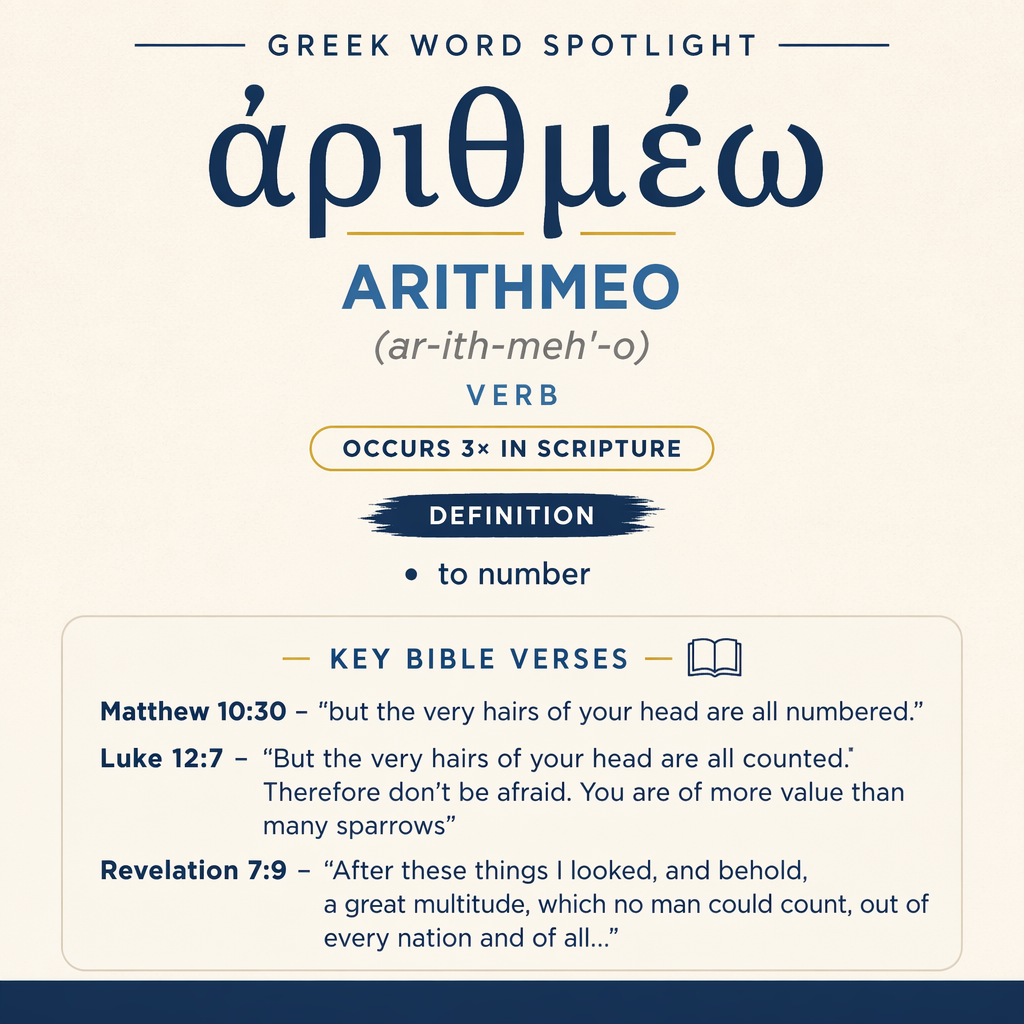
ἀριθμέω means “to number” and appears three times in Scripture: Matthew 10:30, Luke 12:7, and Revelation 7:9.
Gospel Usage
In Matthew 10:30, it describes the hairs of your head as all numbered. In Luke 12:7, the hairs of your head are all counted.
Learn More →Revelation Usage
In Revelation 7:9, it describes a great multitude which no man could count. The multitude is out of every nation.
Learn More →ἀριθμέω means “to number.” In the New Testament it appears in sayings about God’s detailed care for individuals and in a vision where the size of a gathered multitude surpasses human ability to number it.
Root and Related Words
ἀριθμέω corresponds to the noun arithmos (ἀριθμός), “number” (Strong’s G706), expressing the verbal idea of assigning or reckoning a number.

Occurrences
Matthew 10:30 — “but the very hairs of your head are all numbered.”
Here ἀριθμέω is applied to something ordinarily too small and too numerous to keep track of: “the very hairs of your head.” The statement treats numbering not as a rough estimate but as complete reckoning—“are all numbered.” Within the scene, the force lies in the contrast between what people usually ignore (individual hairs) and what is nevertheless included within a full accounting. The verb frames care and knowledge in terms of exact enumeration: what can be numbered has been numbered already, down to the smallest details connected with a person.
Luke 12:7 — “But the very hairs of your head are all counted. Therefore don’t be afraid. You are of more value than many sparrows.”
In Luke’s wording, ἀριθμέω again reaches into the minute particulars of embodied life: “the very hairs of your head.” The line is immediately followed by an inference drawn from that counting: “Therefore don’t be afraid.” The verb thus functions as the premise for reassurance. Because the hairs are “all counted,” fear is answered with the idea of thorough, attentive reckoning; nothing about the individual is outside that count. The closing comparison—“You are of more value than many sparrows”—anchors the counting in personal worth. The act of counting is not detached bookkeeping; it belongs to a larger argument that the one whose care can include numbering hairs also appraises the person as valuable.
Revelation 7:9 — “After these things I looked, and behold, a great multitude, which no man could count, out of every nation and of all tribes, peoples, and languages, standing before the throne and before the Lamb, dressed in white robes, with palm branches in their hands.”
In this vision scene, ἀριθμέω is placed under a negation: the multitude is one “which no man could count.” The verb therefore highlights not divine precision but human limitation. Even though the crowd is visible—John can “look” and “behold” it—its size exceeds human capacity to number. The inability to count is tied to the crowd’s breadth: it is “out of every nation and of all tribes, peoples, and languages.” The picture is not of a vague mass but of a gathered assembly whose diversity is emphasized while its total remains beyond human reckoning. By using the language of counting, the passage gives a concrete way to express immensity: the multitude is so large that numbering it is not merely difficult but impossible for “man.”
Sense and Usage
Across these passages, “to number” operates in two complementary directions. In Matthew and Luke, the verb is used of something extraordinarily fine-grained: “the very hairs of your head,” presented as already fully numbered. The effect is to connect numbering with exhaustive attention to particulars. The hair-count is not offered as trivia; it provides a measurable image of complete oversight—an accounting that reaches what people cannot or do not normally account for.
In Revelation, the same verbal idea is turned outward to a collective scale: a “great multitude” that overwhelms human numbering. The scene keeps the notion of enumeration in view—counting is the natural human way to put a total on what is seen—but insists on its failure: “no man could count.” The verb thus serves as a boundary marker for human ability, especially when confronted with a scene that combines vast size with worldwide scope (“every nation… all tribes, peoples, and languages”).
Together, these uses show how numbering can function rhetorically in opposite ways while retaining the same core idea. Numbering the hairs conveys completeness at the smallest scale; being unable to number the multitude conveys excess at the largest scale. The verb provides a shared measuring-stick—enumeration—so that both meticulous detail and overwhelming magnitude can be spoken of in a single conceptual register. In the sayings, numbering is the ground for confidence (“Therefore don’t be afraid”); in the vision, the impossibility of numbering is part of the astonishment and grandeur of what is seen (“behold, a great multitude”).
Imagery
The passages attach ἀριθμέω to two vivid images: the hidden, everyday detail of “the very hairs of your head,” and the public, visible spectacle of “a great multitude… standing before the throne and before the Lamb.” In both, numbering serves as a way of speaking about scope—either the scope of attention that reaches into what is smallest, or the scope of a gathered crowd so large that it defeats human counting.
Sources: Lexical data from Strong’s Exhaustive Concordance and the Translators Brief Lexicon of Extended Strongs for Greek (STEPBible, CC BY). Occurrence data from the Translators Amalgamated Greek New Testament (STEPBible, CC BY). Scripture quotations from the World English Bible (public domain).




