
Understanding the Meaning of Apotomia in Greek
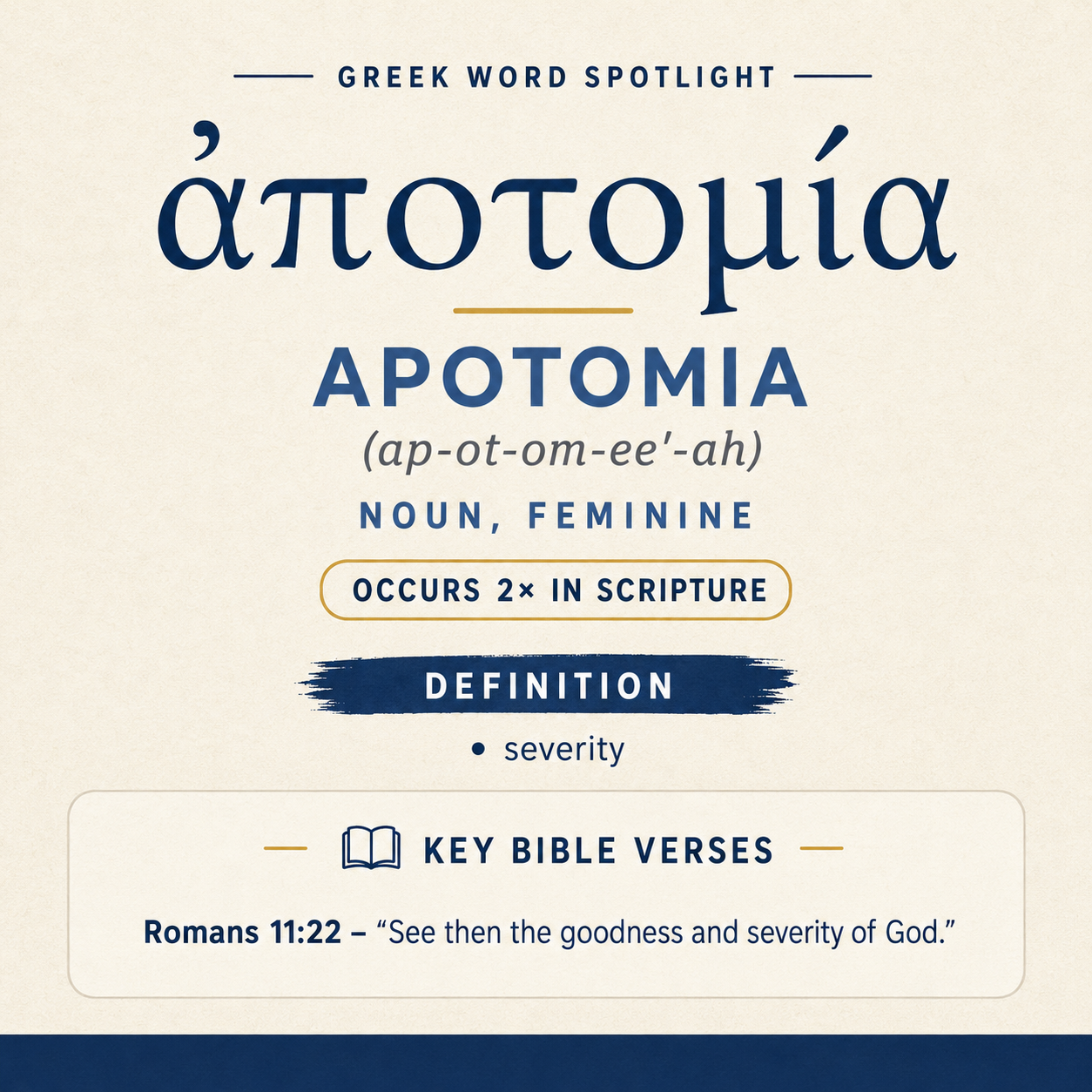
ἀποτομία means “severity” and occurs twice in Scripture, including Romans 11:22.
Romans 11:22
Romans 11:22 pairs “the goodness and severity of God.” The verse applies “severity” toward those who fell.
Learn More →ἀποτομία expresses “severity” and is used to describe a decisive aspect of God’s dealings. It appears in Romans 11:22, where it is set in direct contrast with God’s goodness.
Root and Related Words
ἀποτομία is related to the adverb Apotomōs (ἀποτόμως), “severely” (Strong’s G664). The relationship points to a shared idea of severity expressed in different grammatical forms.
Occurrences
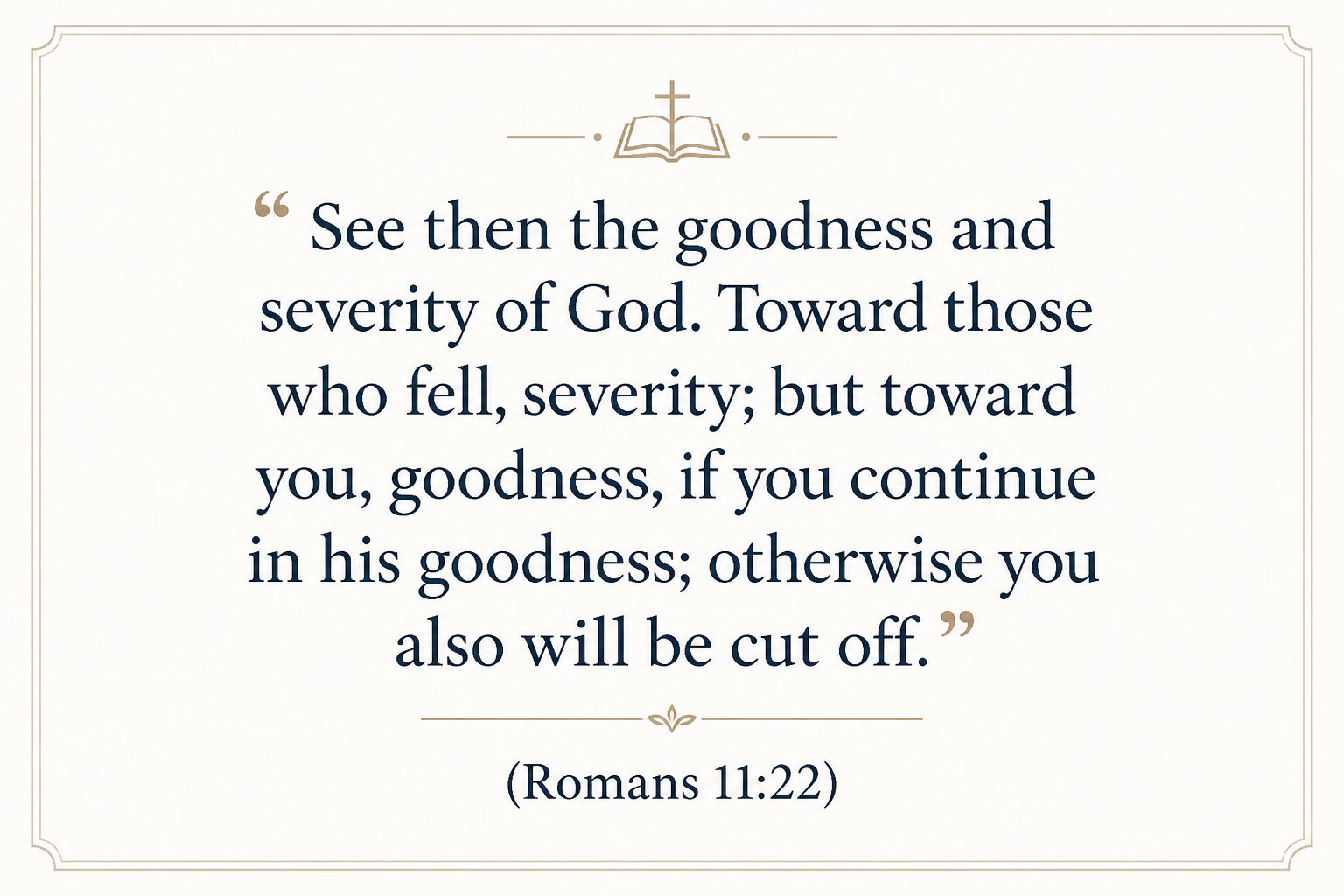
“See then the goodness and severity of God. Toward those who fell, severity; but toward you, goodness, if you continue in his goodness; otherwise you also will be cut off.” (Romans 11:22)
Here ἀποτομία names “severity” as one side of a twofold portrayal: “the goodness and severity of God.” The verse does not treat severity as an abstract quality detached from action; it is tied to outcomes within the sentence’s structure. The line “Toward those who fell, severity” presents severity as God’s posture toward a particular group defined by their condition (“those who fell”). The next clause mirrors the first: “but toward you, goodness,” with a condition attached—“if you continue in his goodness.” In this setting, ἀποτομία functions as a sobering counterweight to “goodness,” framing divine dealings in terms that include both favor and the sternness that meets falling away.
The final warning, “otherwise you also will be cut off,” supplies the immediate practical edge of the contrast. Severity is not merely a descriptive label; it stands over against goodness as a real prospect that can be encountered. The verse’s rhetorical movement—“See then…”—presses the reader to reckon with severity as something that can be observed in how God responds, not merely inferred as a theological category.
Sense and Usage
Within Romans 11:22, ἀποτομία (“severity”) is used in a carefully balanced contrast with “goodness.” The verse repeats both terms, first as paired attributes (“the goodness and severity of God”), then as targeted orientations (“Toward those who fell, severity; but toward you, goodness”), and finally with an explicit conditional warning (“if you continue… otherwise you also will be cut off”). This layering gives the word a defined role: severity is the name for God’s stern side in the contrast, particularly as it pertains to those characterized as having “fell,” and as the implied alternative outcome if continuation in goodness does not occur.
The way the verse is written keeps severity from being treated as arbitrary. It appears within a moral and relational framework: there are “those who fell,” there is a “you” addressed, and there is the call to “continue in his goodness.” Severity, then, functions as a term that marks the seriousness of turning from the posture that corresponds to goodness. Even without adding any additional details beyond the verse itself, the sentence structure communicates that severity is not independent of the conditional logic set out in the exhortation and warning. It is the term that names what stands on the other side of continuing—what is encountered “toward those who fell,” and what is threatened in the clause “otherwise you also will be cut off.”
Because the verse places ἀποτομία alongside “goodness” and then restates both in relation to different subjects, the usage highlights severity as something that is not vague or sentimentalized. It is weighty, pointed, and connected to consequence. The word’s force in context is sharpened by its parallelism: the reader is made to see a deliberate contrast and to hold both realities together in a single view of God’s dealings.
Imagery and Emphasis
The closing warning, “otherwise you also will be cut off,” supplies a concrete, memorable way for the verse to press the contrast between goodness and severity. In this frame, ἀποτομία carries the feel of a hard edge: severity is not only an attribute named, but an emphasis that supports the seriousness of the conditional appeal—continuing in goodness rather than facing the outcome the warning describes.
Sources: Lexical data from Strong’s Exhaustive Concordance and the Translators Brief Lexicon of Extended Strongs for Greek (STEPBible, CC BY). Occurrence data from the Translators Amalgamated Greek New Testament (STEPBible, CC BY). Scripture quotations from the World English Bible (public domain).





