Exploring the Meaning of Apotolmao in Greek
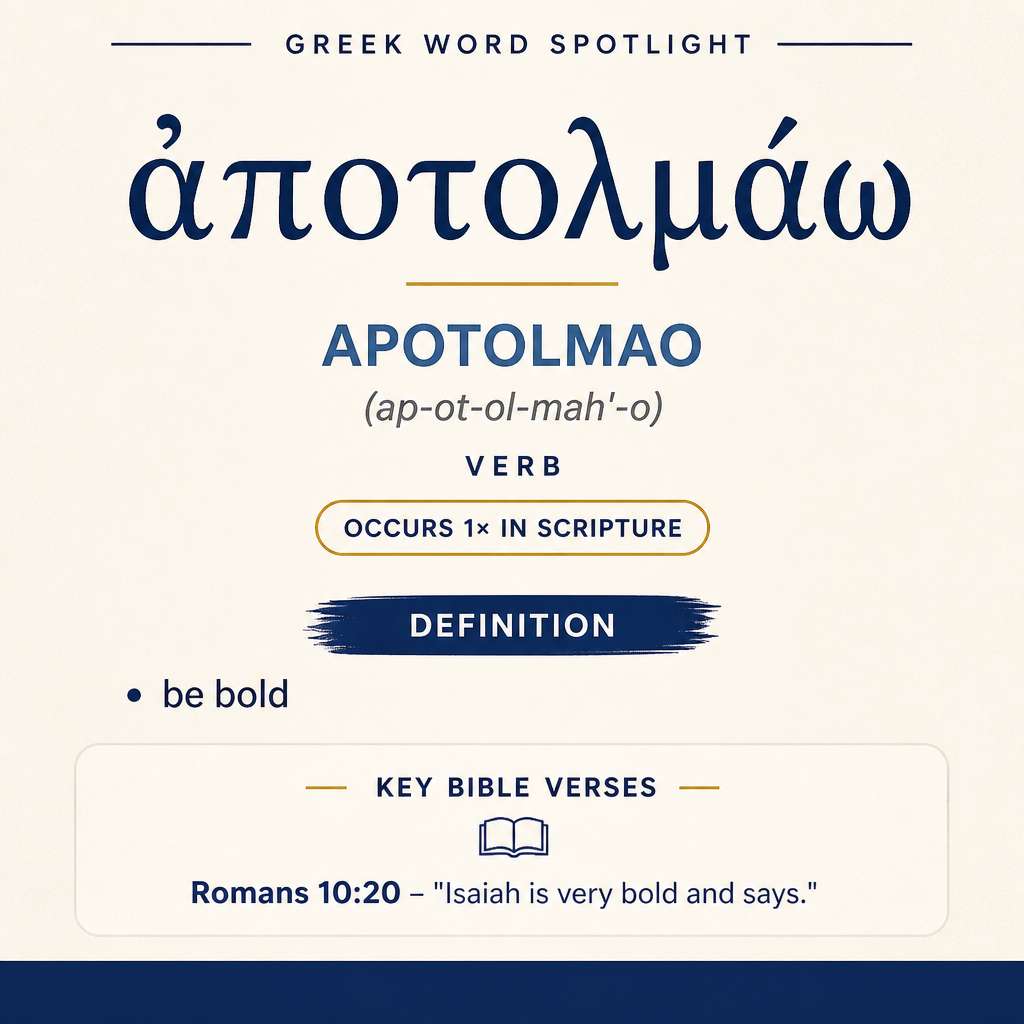
ἀποτολμάω means “be bold” and appears once in Scripture, in Romans 10:20.
Scripture Occurrence
It occurs 1 time in Scripture. The single occurrence is Romans 10:20.
Learn More →Verse Context
In Romans 10:20, Isaiah is described as very bold and then speaks. The verse includes: “I was found by those who didn’t seek me.”
Learn More →ἀποτολμάω expresses being bold, and it appears in Paul’s citation of Isaiah in Romans 10:20. In that setting the term frames a prophetic statement as unusually forthright.
Root and Related Words
ἀποτολμάω (Apotolmao) derives from τολμάω (tolmao), “be bold” (Strong’s G5111), and ἀπό (apo), “away from” (Strong’s G575). The compound form marks the verb as built on the idea of boldness, with the added force contributed by the prefixed element.

Occurrences
“Isaiah is very bold and says, “I was found by those who didn’t seek me. I was revealed to those who didn’t ask for me.”” (Romans 10:20)
Here ἀποτολμάω describes the manner in which Isaiah speaks: he is “very bold.” The term does not introduce a new topic; it colors the speech-act itself, emphasizing the daring quality of what follows. The quoted lines present two parallel claims—“I was found” and “I was revealed”—each paired with a description of people who did not initiate the search (“those who didn’t seek me,” “those who didn’t ask for me”). In that immediate context, the boldness is tied to the startling reversal embedded in the statements: the finding and revealing occur to those who were not pursuing or requesting. By labeling Isaiah as “very bold,” the verb functions as Paul’s way of characterizing the prophetic utterance as frank and unrestrained in how it portrays the situation.

The placement of the verb is also rhetorically important. It stands before the quotation and acts like a verbal stage-direction: Isaiah does not merely “say” these words; he speaks them with conspicuous boldness. That framing influences how the reader hears the quotation—less as a cautious inference and more as a direct declaration. In other words, ἀποτολμάω helps interpret the tone of Isaiah’s voice in Paul’s presentation: the prophet’s speech is depicted as openly assertive as it announces being “found” and “revealed” to unexpected people.
Sense and Usage
The sense “be bold” in this passage is not abstracted from the quotation; it is anchored to the act of speaking. Romans 10:20 pairs the characterization “very bold” with the ordinary reporting verb “says,” creating a two-part description: Isaiah speaks, and he speaks boldly. The boldness is therefore an attribute of public utterance—how a message is delivered—and not a separate content item alongside the message. It highlights the confidence and directness with which a speaker can voice a claim that might otherwise be treated cautiously.
Within the quoted statement itself, the content supplies the reason that boldness is an apt descriptor: the people in view are defined by what they did not do (“didn’t seek,” “didn’t ask”), yet they are the ones to whom the finding and revealing happen (“I was found,” “I was revealed”). The boldness, as Romans frames it, belongs to stating such a reversal plainly. The term thus serves to underline a kind of outspoken candor: the prophet’s claim is presented as straightforwardly announced, not softened by qualification in Paul’s retelling.
Because the verse explicitly intensifies the description (“very bold”), the usage shows boldness as something that can be expressed in degree. The wording encourages the reader to hear a heightened level of forthrightness, as though the speech crosses a threshold from ordinary assertion into striking openness. In this single New Testament use, ἀποτολμάω functions as a vivid rhetorical marker that prepares the reader for a strong, direct declaration and signals the confidence with which it is put forward.
Imagery
The imagery carried by this use is the scene of a prophet speaking out plainly. Romans 10:20 portrays Isaiah’s words as spoken with conspicuous boldness, and the quotation itself evokes a sudden disclosure—being “found” and “revealed”—coming to people who were not seeking or asking. The term contributes the sense of an unhesitating public announcement that matches the unexpected turn described in the lines that follow.
Sources: Lexical data from Strong’s Exhaustive Concordance and the Translators Brief Lexicon of Extended Strongs for Greek (STEPBible, CC BY). Occurrence data from the Translators Amalgamated Greek New Testament (STEPBible, CC BY). Scripture quotations from the World English Bible (public domain).