
Exploring the Meaning of Apotheke in Greek
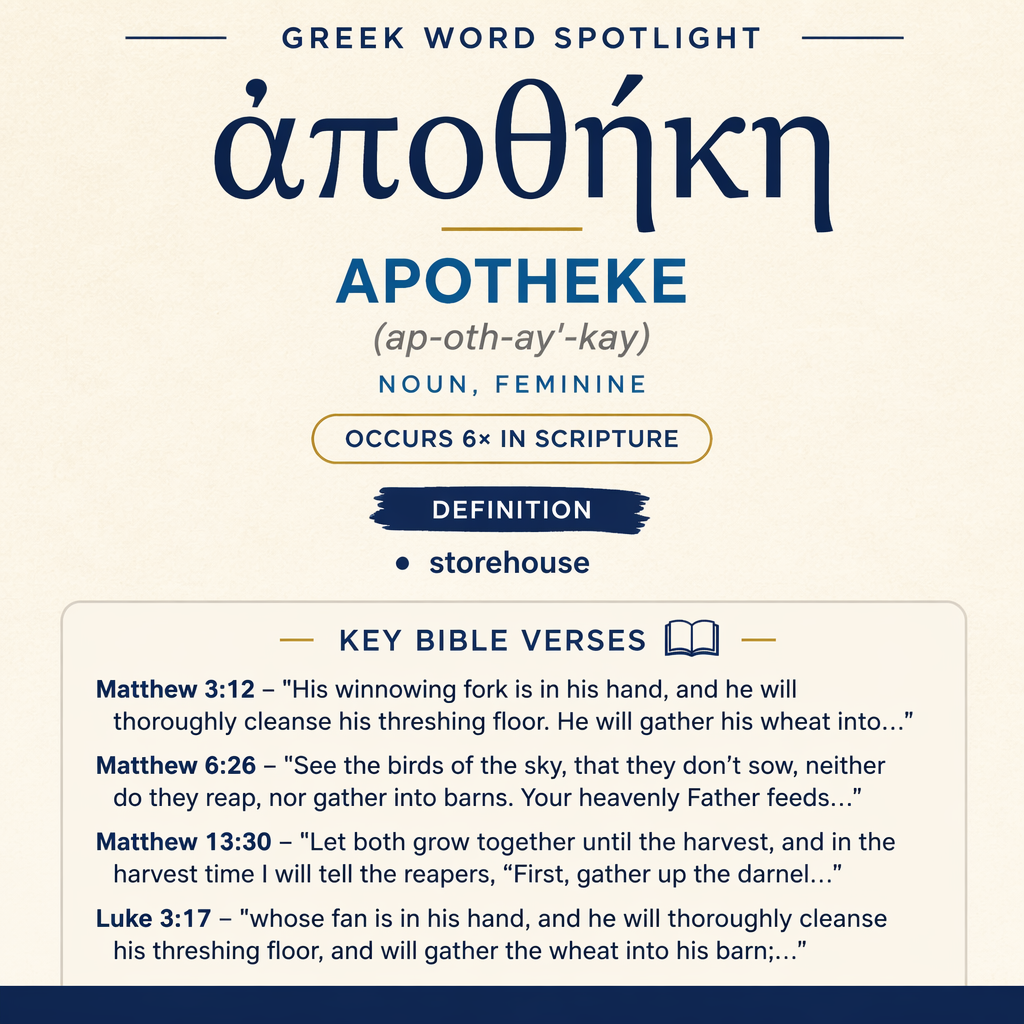
ἀποθήκη means “storehouse” and appears 6 times in Scripture: Matthew 3:12; 6:26; 13:30; Luke 3:17; 12:18; 12:24.
Core Meaning
ἀποθήκη is defined as a “storehouse.” In the listed passages it refers to places where grain or harvest is gathered and kept.
Learn More →Gospel Occurrences
It occurs only in Matthew and Luke among the references provided. The six occurrences are Matthew 3:12; 6:26; 13:30 and Luke 3:17; 12:18; 12:24.
Learn More →Usage in Context
Matthew 3:12 and Luke 3:17 speak of gathering wheat into a barn. Luke 12:18 mentions storing grain in bigger barns, while Luke 12:24 notes having no warehouse or barn.
Learn More →ἀποθήκη refers to a “storehouse” and appears in scenes that picture stored grain, the security of barns, and the separation of wheat from chaff. In these passages it anchors the imagery of gathering, keeping, and provisioning in settings that range from harvest to everyday observation of birds.
Root and Related Words
ἀποθήκη is connected with the verb apotithēmi (ἀποτίθημι), “to put aside” (Strong’s G659). That relationship suits contexts where goods are gathered and set aside for keeping.
Occurrences
“His winnowing fork is in his hand, and he will thoroughly cleanse his threshing floor. He will gather his wheat into the barn, but the chaff he will burn up with unquenchable fire.”” (Matthew 3:12)
Here ἀποθήκη names the destination of the “wheat” after the threshing floor is “thoroughly” cleansed. The storehouse stands for the protected place where what is valuable is gathered, in sharp contrast to “the chaff” assigned to “unquenchable fire.” The word therefore participates in an either/or scene: one outcome is gathered into a secure place; the other is destroyed.

“See the birds of the sky, that they don’t sow, neither do they reap, nor gather into barns. Your heavenly Father feeds them. Aren’t you of much more value than they?” (Matthew 6:26)
In this observation about “the birds of the sky,” ἀποθήκη is something birds do not use: they “don’t sow,” “don’t reap,” and do not “gather into barns.” The storehouse functions as the human strategy of collecting and holding provisions. By setting that strategy beside the statement “Your heavenly Father feeds them,” the verse uses the lack of barns as evidence that feeding can occur without stored reserves.
“Let both grow together until the harvest, and in the harvest time I will tell the reapers, “First, gather up the darnel weeds, and bind them in bundles to burn them; but gather the wheat into my barn.” ’ ”” (Matthew 13:30)
In the harvest instruction, ἀποθήκη is again the place where “the wheat” is gathered, but now it is explicitly “my barn,” belonging to the speaker who directs the reapers. The word is set within a sequence of actions: growth “until the harvest,” then sorting, then two distinct destinations—bundles “to burn,” and wheat “into my barn.” The storehouse is thus the endpoint for what is kept after an intentional separation.
“whose fan is in his hand, and he will thoroughly cleanse his threshing floor, and will gather the wheat into his barn; but he will burn up the chaff with unquenchable fire.”” (Luke 3:17)
This repeats the threshing-floor picture: the one holding the “fan” cleanses the floor and gathers “the wheat into his barn.” ἀποθήκη marks the place of collected grain after a process of cleansing. As in Matthew 3:12, the storehouse is part of a twofold result that contrasts the gathered wheat with chaff that “he will burn up with unquenchable fire.”
“He said, ‘This is what I will do. I will pull down my barns, build bigger ones, and there I will store all my grain and my goods.” (Luke 12:18)
In this plan for expansion, ἀποθήκη appears in the plural (“barns”) and is the focus of a construction project: “pull down,” “build bigger ones.” The “there” in “there I will store all my grain and my goods” links the storehouse directly to the act of accumulation and safekeeping. The word contributes the concrete idea of a place that can be enlarged to match the desire to store “all” one possesses.
“Consider the ravens: they don’t sow, they don’t reap, they have no warehouse or barn, and God feeds them. How much more valuable are you than birds!” (Luke 12:24)
Here ἀποθήκη is paired with “warehouse,” presenting storage space in two related forms of human provision. Ravens “have no warehouse or barn,” yet “God feeds them.” The storehouse again functions as the emblem of stored resources and planned supply, but it is invoked to highlight that life and feeding occur even where there is no stockpiled reserve.
Sense and Usage
Across these six occurrences, ἀποθήκη consistently denotes a physical place where goods—especially agricultural produce—are gathered and kept. Two passages frame it within threshing-floor imagery (Matthew 3:12; Luke 3:17): wheat is collected into a barn after cleansing, while chaff is burned. In these settings, the storehouse is not merely a building; it is the settled destination that follows separation, the place where what remains is kept together and preserved.
Another harvest context (Matthew 13:30) uses the storehouse as the endpoint of sorting at “the harvest time.” The command “gather the wheat into my barn” places ἀποθήκη on the side of what is retained after reapers perform discriminating work. The word thus naturally carries the idea of gathered finality: what enters the storehouse has been selected and is now placed where it belongs.
In contrast, Matthew 6:26 and Luke 12:24 use the absence of storehouses among birds as a striking counter-image. Birds do not operate with sowing, reaping, or storage; yet feeding still happens. In these sayings, ἀποθήκη stands for the normal human pattern of provisioning—work yields grain, grain is collected, barns hold it for future use. The text does not deny the reality of barns; it uses them as a vivid marker of how food security is often imagined, and then juxtaposes that imagination with the claim that God feeds creatures that lack such structures.
Luke 12:18 brings the word into direct association with personal wealth and future planning: “my barns” become larger so that “all my grain and my goods” can be stored. Here ἀποθήκη is the expandable container of accumulation. The sense is still concrete and architectural, but the usage emphasizes scale (“bigger ones”) and comprehensiveness (“all”), showing how a storehouse can represent the drive to secure and concentrate possessions in one managed place.
Imagery
The passages cluster around two pictures: harvest storage and birdlife without storage. In the threshing-floor and harvest scenes, ἀποθήκη evokes a barn filled with gathered wheat after cleansing and sorting (Matthew 3:12; Matthew 13:30; Luke 3:17). In the sayings about birds, it evokes the notable lack of barns and warehouses among creatures that are still fed (Matthew 6:26; Luke 12:24). In the plan to build bigger barns, it evokes storage as a deliberate project of enlarging capacity for grain and goods (Luke 12:18).
Sources: Lexical data from Strong’s Exhaustive Concordance and the Translators Brief Lexicon of Extended Strongs for Greek (STEPBible, CC BY). Occurrence data from the Translators Amalgamated Greek New Testament (STEPBible, CC BY). Scripture quotations from the World English Bible (public domain).




