
Understanding the Significance of Apolausis in Greek
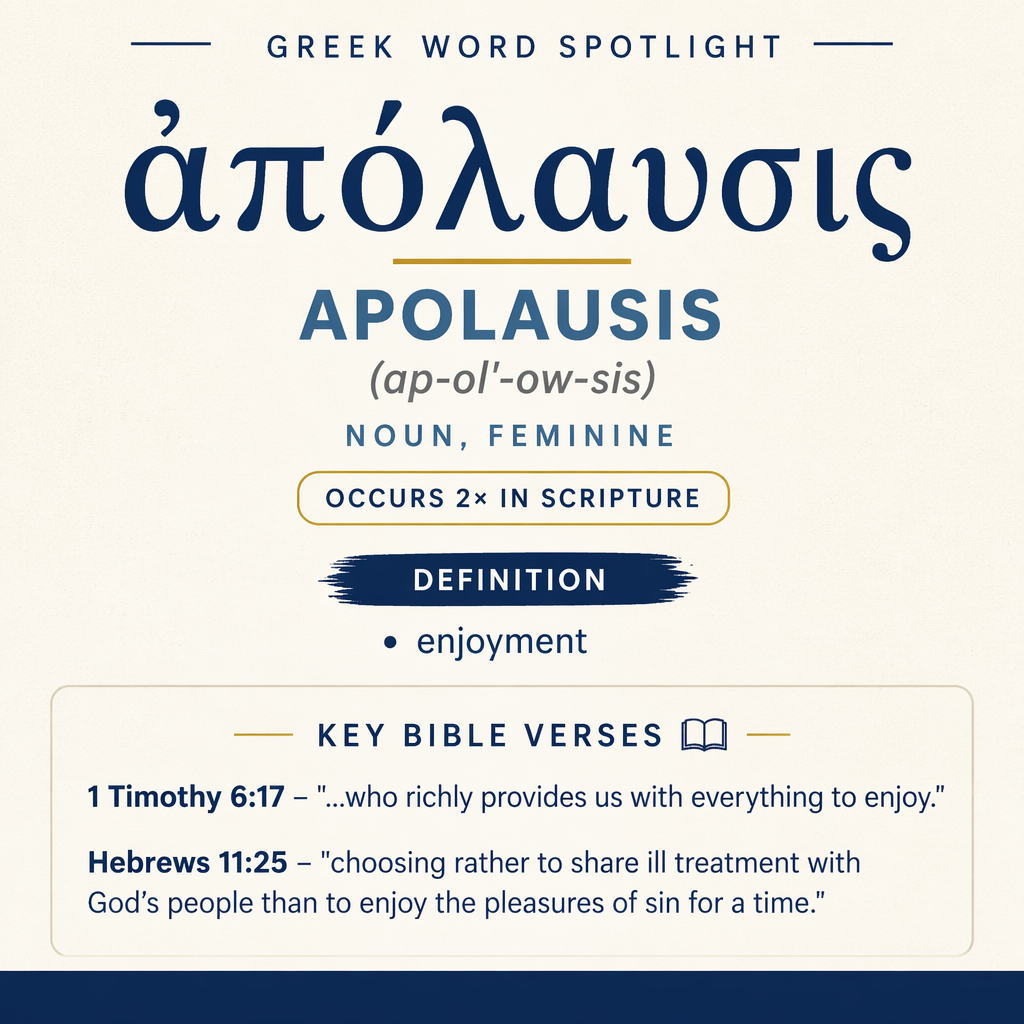
ἀπόλαυσις means “enjoyment” and occurs twice in Scripture: 1 Timothy 6:17 and Hebrews 11:25.
Scripture Occurrences
The word appears 2 times in Scripture. Its occurrences are in 1 Timothy 6:17 and Hebrews 11:25.
Learn More →Verse Contexts
In 1 Timothy 6:17 it appears in a charge to the rich not to set hope on uncertainty. In Hebrews 11:25 it refers to enjoying sin’s pleasures for a time.
Learn More →ἀπόλαυσις speaks of “enjoyment” in the New Testament, appearing in two contexts that weigh what a person takes pleasure in and where that capacity for enjoyment is anchored. One passage places enjoyment within God’s generous provision; the other contrasts enjoyment with the cost of faithful solidarity with God’s people.
Root and Related Words
ἀπόλαυσις is connected (as a derived form) with the preposition ἀπό (apo), meaning “away from” (Strong’s G575). The prepositional element suggests a form built with ἀπό as a component, as reflected in its traditional listing under related words.

Occurrences
“Charge those who are rich in this present world that they not be arrogant, nor have their hope set on the uncertainty of riches, but on the living God, who richly provides us with everything to enjoy;” (1 Timothy 6:17)
Here ἀπόλαυσις functions within a direct pastoral charge aimed at “those who are rich in this present world.” The verse sets up a sequence of re-aiming: not arrogance, not hope fixed on unstable wealth, but hope fixed “on the living God.” Against that backdrop, enjoyment is not framed as a self-originating entitlement tied to status or possessions; it is placed within the clause describing God’s action: God “richly provides us with everything to enjoy.” In this sentence, enjoyment is the intended human reception of what God gives. The wording “richly provides” matches the theme of abundance, yet the abundance is explicitly located in God’s giving rather than in riches themselves. ἀπόλαυσις therefore contributes the idea that God’s provision is meant to be genuinely received as enjoyment, even while the surrounding admonition guards against the spiritual posture that wealth can produce (arrogance, misplaced hope). The term stands at the end of the verse as the practical endpoint of provision: God gives, and the recipients enjoy what is given.
“choosing rather to share ill treatment with God’s people than to enjoy the pleasures of sin for a time,” (Hebrews 11:25)
In Hebrews 11:25, ἀπόλαυσις belongs to a starkly comparative construction: one path is “to share ill treatment with God’s people,” the other is “to enjoy the pleasures of sin for a time.” The verse places enjoyment on the side of “the pleasures of sin,” and it adds a boundary—“for a time”—which constrains the duration of that enjoyment. Within the sentence, ἀπόλαυσις is not denied as an experience; rather, it is acknowledged as something that can be chosen and felt, but it is attached to an object (“the pleasures of sin”) and a limit (“for a time”) that mark it as a temporary attraction. The verb-like framing (“to enjoy”) underscores a deliberate orientation: enjoyment is presented as one of two competing outcomes of choice. The rhetorical force arises from the contrast: the verse pictures a conscious preference for suffering with God’s people over a time-bound enjoyment connected with sin. ἀπόλαυσις thus contributes the experiential pull of the alternative being refused; it is part of the description of what makes the rejected option appealing, even though it is not the chosen route.
Sense and Usage
Across these two occurrences, “enjoyment” is treated as a real human experience, but its moral and spiritual weight is shaped by what it is tied to. In 1 Timothy 6:17, enjoyment sits within a theology of provision: God is named “the living God,” and the enjoyment in view is the reception of what this God “richly provides.” Enjoyment here is not a rival to trust; it is the intended fruit of trust properly directed. The verse does not make enjoyment the foundation of hope; instead, hope is redirected away from the “uncertainty of riches” and toward God, while enjoyment appears as what God’s giving is for. In that setting, ἀπόλαυσις is compatible with a humble stance: it follows commands that resist arrogance and resist anchoring one’s future on wealth.
In Hebrews 11:25, enjoyment is bound to “the pleasures of sin” and explicitly marked by temporariness. The same basic idea—enjoyment—now functions as a competing lure within an ethical decision. This contrast does not redefine enjoyment; it reframes its significance by setting it alongside “ill treatment with God’s people.” Enjoyment is one pole of a choice, suffering is the other. By adding “for a time,” the verse supplies a narrative constraint: the enjoyment offered by sin is real yet bounded, not open-ended. In this usage, ἀπόλαυσις helps articulate why the rejected path might be attractive at the level of experience, making the choice of hardship more pointed and costly.
Taken together, the two passages show that ἀπόλαυσις can describe enjoyment in a way that is not automatically praised or condemned by the word itself; its evaluation depends on its object and context. In one case, enjoyment is the proper reception of God’s rich provision; in the other, enjoyment is linked to sinful pleasures and set against solidarity with God’s people. The two uses therefore place enjoyment on both sides of moral discernment: it can be an intended outcome of divine generosity, and it can be a short-lived enticement that must be refused. The word’s limited New Testament distribution intensifies this effect: each occurrence is strategically placed in exhortation and in exemplary choice, showing enjoyment as something that can either accompany rightly ordered trust or compete with faithfulness when attached to sin’s pleasures.
Imagery
The imagery of ἀπόλαυσις in these verses is concrete and experiential. In 1 Timothy 6:17 it evokes the ordinary, thankful reception of “everything” God gives, with enjoyment pictured as the human side of divine provision. In Hebrews 11:25 it evokes the felt attractiveness of “pleasures,” but with the shadow of brevity—“for a time”—so that enjoyment is pictured as a limited season set in tension with the enduring weight of identifying with God’s people in suffering.
Sources: Lexical data from Strong’s Exhaustive Concordance and the Translators Brief Lexicon of Extended Strongs for Greek (STEPBible, CC BY). Occurrence data from the Translators Amalgamated Greek New Testament (STEPBible, CC BY). Scripture quotations from the World English Bible (public domain).




