
Exploring the Significance of Apollonia in Greek
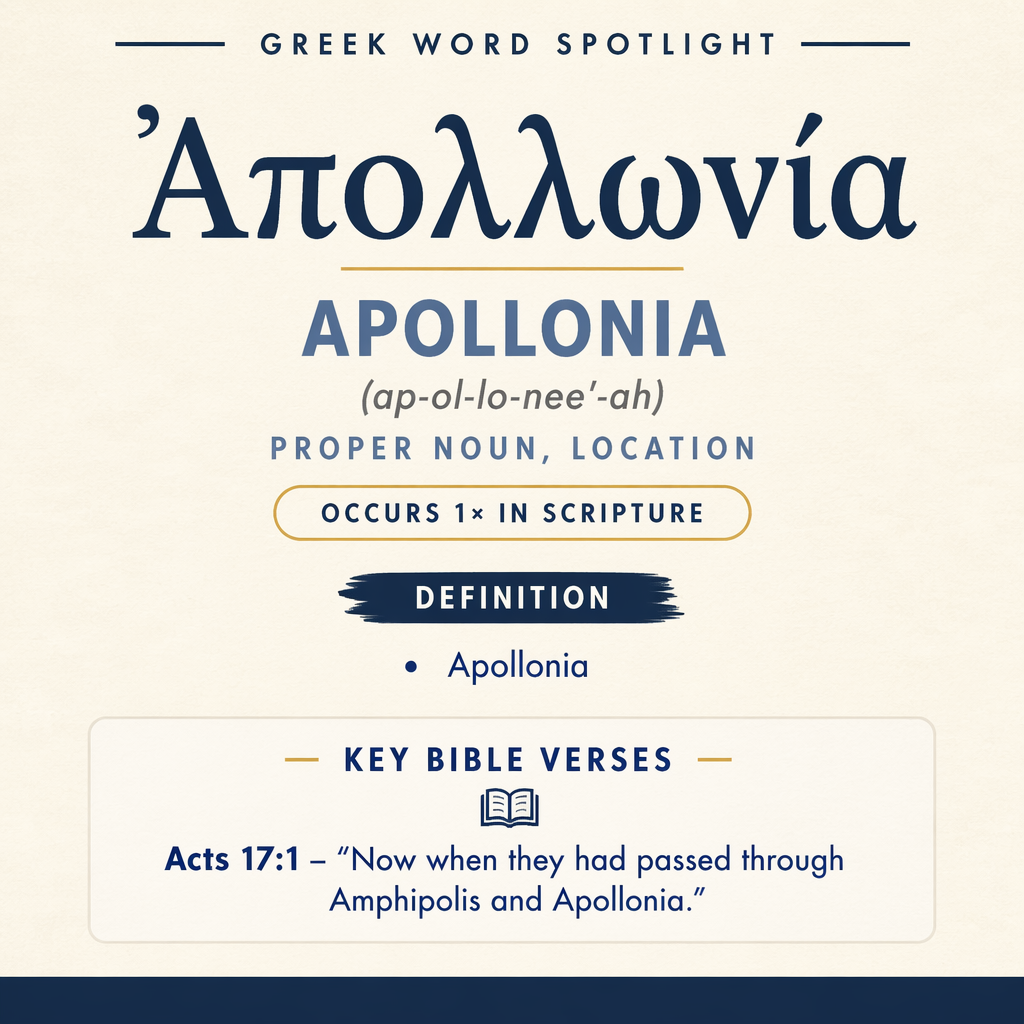
Ἀπολλωνία (Apollonia) means “Apollonia” and appears in Acts 17:1 as a place passed through on the way to Thessalonica.
Verse Context
Acts 17:1 says they passed through Amphipolis and Apollonia and came to Thessalonica. Thessalonica is noted as having a Jewish synagogue.
Learn More →Apollonia is a place-name, appearing once in the New Testament in a travel notice that traces a route through Macedonia. In its lone occurrence it functions as a waypoint on the way to a larger destination where public ministry will follow.
Occurrences
“Now when they had passed through Amphipolis and Apollonia, they came to Thessalonica, where there was a Jewish synagogue.” (Acts 17:1)
In Acts 17:1 Apollonia is named as one stage in a sequence of movements: “passed through Amphipolis and Apollonia” and then “came to Thessalonica.” The sentence is tightly focused on travel, and the placement of Apollonia between two other named locations marks it as part of an established road itinerary. By linking the two verbs (“had passed through …” / “they came to …”), the verse portrays Apollonia not as the endpoint of the journey but as a point traversed en route to Thessalonica.
The structure of the line also shows how Apollonia contributes to narrative pacing. Two locations are grouped together under the same action (“passed through”), and then the narrative settles on Thessalonica with an added note: “where there was a Jewish synagogue.” That added clause shifts from geography to the social and religious setting that will matter for what follows, while Apollonia remains part of the movement that brings the travelers to that setting. In other words, Apollonia is presented as real and specific—worthy of naming—yet its narrative role here is to anchor the reader’s sense of distance, direction, and progression toward a place characterized in the same breath by a synagogue.
The mention of multiple cities in a single verse creates a map-like effect. Apollonia helps the reader track the path as one of successive towns rather than a single leap from one famous place to another. Because Acts 17:1 identifies Thessalonica by what it contains (“a Jewish synagogue”), the earlier names, including Apollonia, also work by contrast: they are given without description, which keeps the emphasis on the act of passing through rather than on a stay, a speech, or a notable event. The word therefore functions as a narrative coordinate, situating the travelers between departure and arrival.

Sense and Usage
As a proper noun designating a location, Apollonia serves a referential purpose: it points to a particular place along a traveled route. In Acts 17:1 it appears in a straightforward list of destinations, which is characteristic of place-names in journey summaries: the name’s job is not to describe what happened there but to locate the travelers’ movement in the real world of cities and roads. The sense is thus carried by its placement within a chain of geographic markers rather than by any descriptive adjectives or explanatory phrases attached to it.
Within the verse’s syntax, Apollonia is coordinated with Amphipolis (“through Amphipolis and Apollonia”), showing that the narrative treats the two similarly: both are places passed through. Thessalonica is treated differently (“they came to Thessalonica”), and the difference is reinforced by the explanatory clause about the synagogue. This contrast clarifies how Acts 17:1 uses the place-name: it is not introduced to highlight a destination of ministry in this line, but to demonstrate continuity of travel and the deliberate movement toward a setting where engagement with a Jewish community is possible.
The single occurrence also shows how a place-name can carry meaning through narrative economy. By simply naming Apollonia, the text provides enough specificity to make the journey concrete without interrupting the flow with extra details. The reader is given an itinerary that is both believable and traceable within the story: the travelers do not drift; they move purposefully through successive towns until they reach a city singled out for its synagogue. In this way Apollonia contributes to the depiction of intentional travel: the mission advances by passing through known places and arriving at strategic ones.
Because Acts 17:1 places Apollonia inside a triad of locations, the name also participates in a pattern of sequential narration. The verse begins with “Now,” signaling a new stage, and then immediately narrates movement through named points. Apollonia’s presence in that sequence helps the verse accomplish its primary narrative function: transitioning the story from one region and moment to the next with minimal delay. The place-name is therefore an element of narrative geography, functioning to connect scenes and to orient the reader spatially as the storyline progresses toward Thessalonica.
Imagery
Though Apollonia is presented without description, its placement among other named towns evokes the ordinary visibility of travel—roads, stops, and the passing by of settlements on the way to a major city. In Acts 17:1 the imagery is that of steady movement through recognizable waypoints until the travelers reach a destination marked out by a communal gathering place, “a Jewish synagogue.” Apollonia contributes to that sense of a journey with stages: not only arrival, but the miles and towns between.
Sources: Lexical data from Strong’s Exhaustive Concordance and the Translators Brief Lexicon of Extended Strongs for Greek (STEPBible, CC BY). Occurrence data from the Translators Amalgamated Greek New Testament (STEPBible, CC BY). Scripture quotations from the World English Bible (public domain).




