
Unveiling the Meaning of Apoleicho in Greek
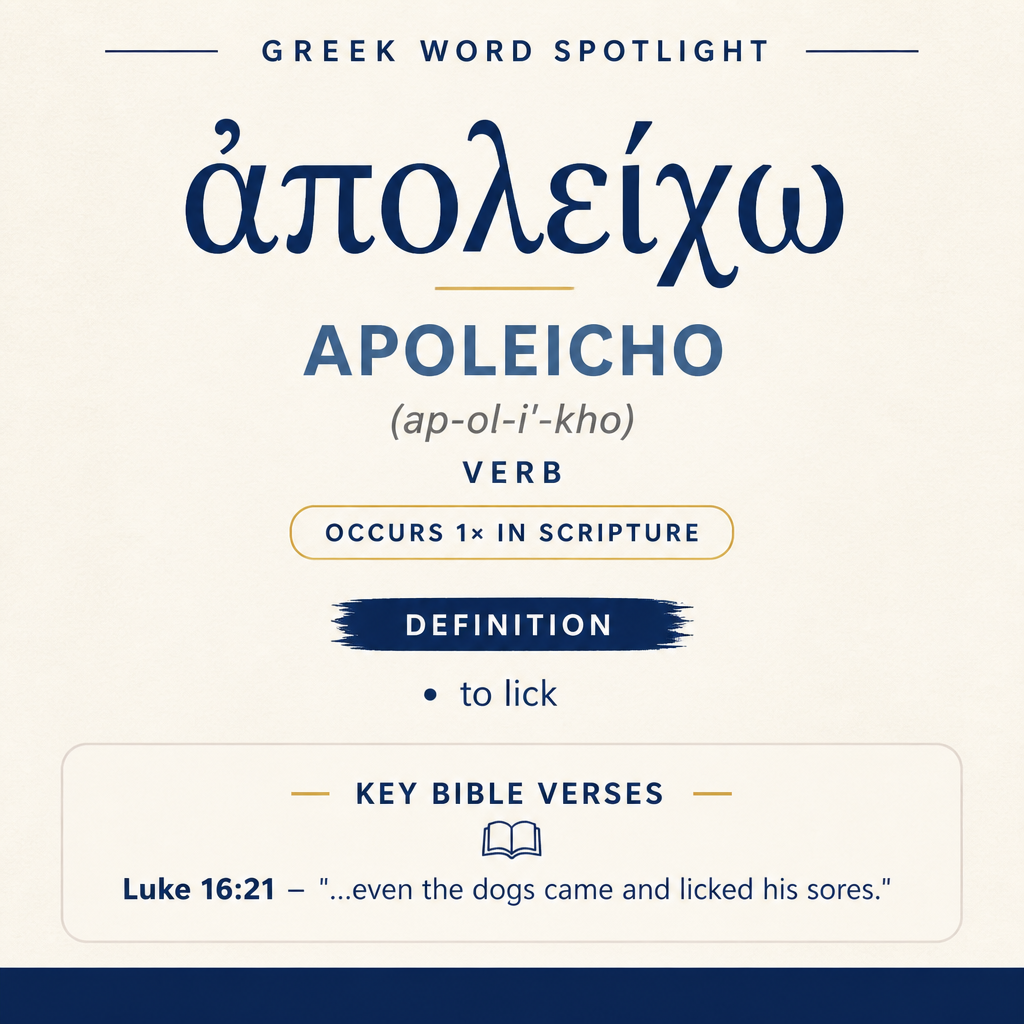
ἀπολείχω means “to lick” and appears once in Scripture, in Luke 16:21.
ἀπολείχω expresses the action “to lick” and appears in the description of Lazarus’s suffering in Jesus’ account of a poor man and a rich man. In its single New Testament occurrence, the verb helps render the scene with physical immediacy and bodily detail.
Root and Related Words
ἀπολείχω is presented as deriving from apo (ἀπό), “away from.”

Occurrences
Luke 16:21 — “and desiring to be fed with the crumbs that fell from the rich man’s table. Yes, even the dogs came and licked his sores.”
Here the verb belongs to a tightly drawn picture of deprivation: Lazarus is portrayed as longing “to be fed with the crumbs that fell from the rich man’s table,” a line that places him outside the rich man’s sphere of abundance and reduces his hope to what drops beyond the table. Into that same space come “the dogs,” and their movement is described simply—“came”—followed by the action ἀπολείχω: they “licked his sores.” The verb brings the narrative from social distance and hunger into close bodily contact. Lazarus is not only hungry; he is wounded (“sores”), and the licking is directed to those wounds.
The placement of the action after “Yes, even” heightens the force of the detail. The dogs’ licking is introduced as an emphatic addition to the preceding picture of need, as though the account piles one concrete circumstance upon another. Within the quoted line, the dogs’ action is not presented as a medical treatment or a spoken response; it is simply an animal action performed on the surface of Lazarus’s body. The verb therefore functions as a vivid narrative stroke: it makes the reader “see” the scene at ground level—Lazarus lying in misery, dogs approaching, and their tongues contacting his sores.
Because the verb is attached to “dogs,” it carries the naturalness of animal behavior rather than the deliberateness that might be implied if a human agent were the subject. The action is not mediated by tools or by speech; it is immediate and physical. The text does not pause to explain motives or outcomes; the verb stands as a concrete act that intensifies the portrayal of Lazarus’s condition and the environment around him.
Sense and Usage
In this occurrence, “to lick” is used in a literal, bodily sense: an animate subject makes contact with something using the tongue. The object of the licking—“his sores”—adds specificity. The word does not operate here as a general metaphor for tasting or sampling; it is anchored to the skin-level reality of wounds. That anchoring gives the narrative a tactile dimension that complements the other concrete nouns in the verse: “crumbs,” “table,” “dogs,” and “sores.” Together they form an earthy tableau of need and exposure, and ἀπολείχω supplies one of the most intimate points of contact within it.
The verb also participates in a contrast implicit in the verse. Lazarus desires food from “the rich man’s table,” but instead of receiving nourishment from that human household, he experiences an animal’s attention to his wounds. The action of licking does not address his hunger for “crumbs,” yet it draws attention to his suffering in another register—the condition of his body. The text thereby places the licking alongside his desire for crumbs, not as an alternative meal but as a further detail of his plight: even as he yearns for food, his sores are being licked by dogs who approach him where he lies.
Within the sentence, the verb’s force is strengthened by its simple coordination: “came and licked.” The two verbs present a brief sequence—approach followed by contact—without elaboration. This economy makes the action feel unadorned and matter-of-fact, which in turn makes the scene more stark. The narrative does not romanticize Lazarus’s state; it reports the dogs’ licking plainly, as one more observable fact of his daily reality at the margins.
The related element apo (ἀπό), “away from,” can be read as a directional nuance that fits the broader spatial logic of the verse: Lazarus is positioned away from the rich man’s table, living off what falls beyond it, and his experience is described in terms of what happens in that outside space. Whatever the precise force of the derivation, the action of licking is portrayed as taking place on Lazarus’s body in a setting defined by exclusion from the table’s abundance.
Imagery
The image created by ἀπολείχω in Luke 16:21 is unavoidably sensory: dogs close enough to touch a sufferer’s sores with their tongues. Alongside the crumbs that “fell” and the table from which Lazarus is excluded, the licking fixes the scene at the lowest level—on the ground, at the edge of another man’s plenty, where hunger and open wounds are part of the same picture.
Sources: Lexical data from Strong’s Exhaustive Concordance and the Translators Brief Lexicon of Extended Strongs for Greek (STEPBible, CC BY). Occurrence data from the Translators Amalgamated Greek New Testament (STEPBible, CC BY). Scripture quotations from the World English Bible (public domain).




