
Understanding the Meaning of Apokrupto in Greek
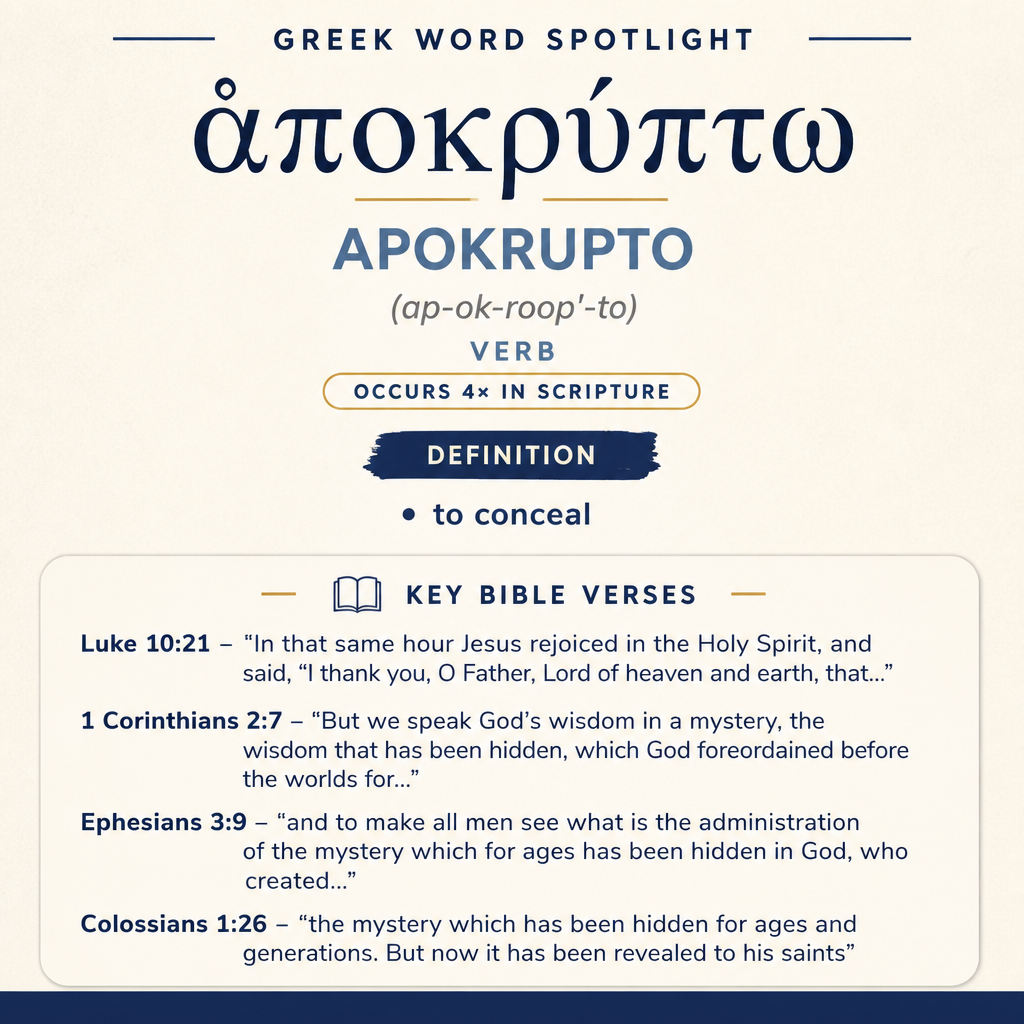
ἀποκρύπτω means “to conceal” and appears four times in Scripture: Luke 10:21; 1 Corinthians 2:7; Ephesians 3:9; Colossians 1:26.
Scripture Occurrences
It occurs 4 times in Scripture: Luke 10:21; 1 Corinthians 2:7; Ephesians 3:9; Colossians 1:26.
Learn More →Context Highlights
In 1 Corinthians 2:7, Ephesians 3:9, and Colossians 1:26, it describes wisdom or a mystery that has been hidden.
Learn More →Apokrupto means “to conceal.” It appears in Jesus’ prayer of praise (Luke 10:21) and in three Pauline statements about God’s wisdom as a “mystery” that was hidden and then revealed (1 Corinthians 2:7; Ephesians 3:9; Colossians 1:26).
Root and Related Words
Apokrupto is formed with apo (ἀπό), “away from,” joined to krypto (κρύπτω), “to hide.”

Occurrences
“In that same hour Jesus rejoiced in the Holy Spirit, and said, “I thank you, O Father, Lord of heaven and earth, that you have hidden these things from the wise and understanding, and revealed them to little children. Yes, Father, for so it was well-pleasing in your sight.”” (Luke 10:21)
Here apokrupto marks a deliberate divine action: the Father has “hidden these things” from a particular class—“the wise and understanding”—while at the same time “revealed them to little children.” The verb sits inside a sharp contrast of concealment and revelation, so its contribution is to underline that access to “these things” is not distributed according to human status or intellectual reputation. In the scene’s emotional tone—Jesus “rejoiced in the Holy Spirit”—concealment is not presented as a failure of communication but as part of what Jesus openly thanks the Father for, “well-pleasing in your sight.”
“But we speak God’s wisdom in a mystery, the wisdom that has been hidden, which God foreordained before the worlds for our glory,” (1 Corinthians 2:7)
In this sentence apokrupto is tied to “God’s wisdom in a mystery.” The concealment is described as a settled condition of that wisdom: it “has been hidden.” The surrounding clauses anchor the hiddenness in God’s purpose—“which God foreordained before the worlds for our glory”—so the verb contributes the idea that God’s wisdom did not lie open to ordinary discovery. Paul’s wording holds together two facts in one breath: he and his co-speakers “speak” this wisdom, and yet it is wisdom that stood in a concealed state until God’s own timing and intention brought it into proclamation.
“and to make all men see what is the administration of the mystery which for ages has been hidden in God, who created all things through Jesus Christ,” (Ephesians 3:9)
Apokrupto again modifies “the mystery,” but here the line of thought moves from concealment to visibility: Paul speaks of making “all men see” something whose prior location is described as “hidden in God.” The concealment has a temporal frame (“for ages”) and a relational frame (“in God”), which gives the verb a strong theological weight in this context: what is concealed is not merely withheld information but something kept within God’s own counsel until the moment when it becomes an object of public seeing. The verb thus supports the transition from God-centered hiddenness to humanly witnessed disclosure, fitting Paul’s aim “to make all men see” the “administration” connected with the mystery.
“the mystery which has been hidden for ages and generations. But now it has been revealed to his saints,” (Colossians 1:26)
This occurrence places concealment and revelation in direct sequence across two short sentences. Apokrupto characterizes “the mystery” as something “hidden for ages and generations,” emphasizing extended duration and continuity of concealment across time and peoples. Then the contrastive “But now” signals a turning point: what was concealed is no longer so, for it “has been revealed to his saints.” In this setting the verb’s force is to heighten the significance of the “now” moment; revelation is meaningful precisely because the mystery previously stood behind a long veil of concealment.
Sense and Usage
Across these four passages, apokrupto consistently describes concealment as a purposeful state connected with God’s activity and God’s timing. In Luke 10:21 the subject of the hiding is directly addressed—“you have hidden”—and the concealment functions within a relational reversal: the “wise and understanding” are not the ones to whom the things are made plain, while “little children” are. In the three Pauline texts, the verb most naturally fits a description of the “mystery” as having existed under concealment before becoming something spoken about and shown.
The contexts also show that concealment does not stand alone as the final word. Each passage either explicitly pairs concealment with revelation (“hidden… and revealed,” “has been hidden… But now it has been revealed”) or sets concealment alongside the act of making known (“we speak God’s wisdom,” “to make all men see”). Apokrupto therefore works as part of a broader communicative movement: something is genuinely concealed, yet not left permanently inaccessible. The word serves to mark the prior condition—kept from certain people or kept through long ages—so that the disclosed state can be understood as an act of divine initiative rather than human achievement.
Finally, the objects of concealment in these verses are consistently “these things,” “God’s wisdom,” and “the mystery.” The verb does not point to the concealment of ordinary facts, but to realities that shape understanding of God’s work and purpose. That focus helps explain why the surrounding phrases stress God’s pleasure (Luke), God’s foreordination (1 Corinthians), God as the locus of concealment (Ephesians), and the decisive “now” of disclosure to “his saints” (Colossians). In each case, apokrupto contributes the sense that what is being addressed is not simply unknown, but kept concealed until the fitting disclosure.
Imagery
The repeated pairing of hiddenness with revelation gives apokrupto a vivid implied imagery: something kept out of sight and then brought into view. Luke 10:21 frames that shift in personal terms—some are excluded from sight while “little children” receive it—whereas the epistles frame it across time—“for ages,” “for ages and generations”—and then place emphasis on the moment when concealment yields to being spoken, seen, and revealed.
Sources: Lexical data from Strong’s Exhaustive Concordance and the Translators Brief Lexicon of Extended Strongs for Greek (STEPBible, CC BY). Occurrence data from the Translators Amalgamated Greek New Testament (STEPBible, CC BY). Scripture quotations from the World English Bible (public domain).




