
Exploring the Meaning of Krupto in Greek
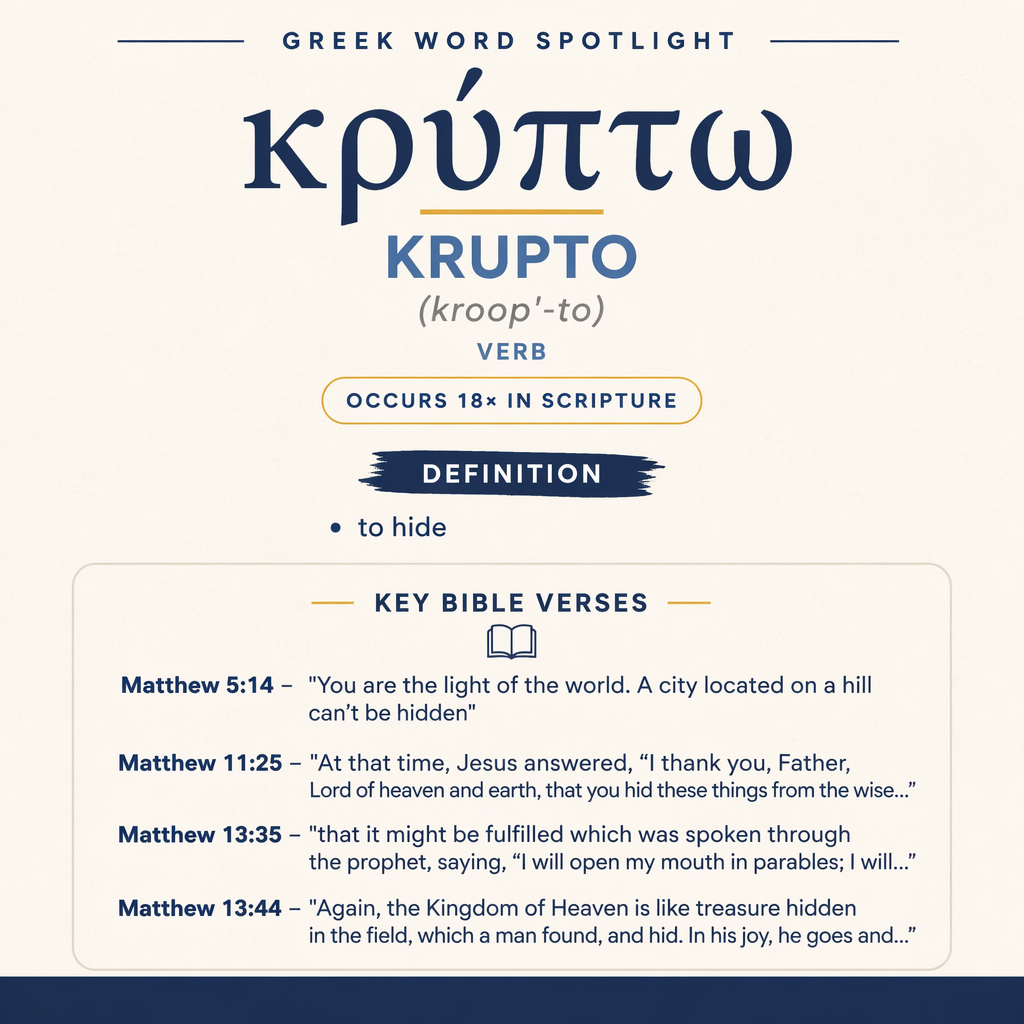
κρύπτω (Krupto) means “to hide” and occurs 18 times in Scripture, including Matthew 5:14 and Luke 19:42.
Core Meaning
κρύπτω means “to hide.” In Matthew 5:14, a city on a hill “can’t be hidden.”
Learn More →Gospel Examples
In Matthew 25:18 and 25:25, a servant hid his lord’s money in the earth. In Matthew 13:44, treasure is hidden in a field.
Learn More →Hidden Understanding
In Matthew 11:25, Jesus thanks the Father for hiding things from the wise. Luke 18:34 says a saying was hidden from the disciples.
Learn More →κρύπτω expresses the action of hiding, whether something is concealed from sight, kept out of someone’s understanding, or withheld from public view. In the passages below it ranges from everyday concealment (money in the ground, treasure in a field) to concealment in teaching, perception, and personal movement.
Occurrences
Matthew 5:14 — “You are the light of the world. A city located on a hill can’t be hidden.”
Here κρύπτω frames an impossibility: the elevated placement of “a city located on a hill” prevents it from being concealed. The saying relies on the plain visibility of a hilltop settlement; hiding is presented as contrary to the situation described.
Matthew 11:25 — “At that time, Jesus answered, “I thank you, Father, Lord of heaven and earth, that you hid these things from the wise and understanding, and revealed them to infants.”
Hiding is attributed to the Father’s action with respect to “these things.” The contrast is built into the sentence: what is hidden from “the wise and understanding” is “revealed…to infants.” κρύπτω therefore describes a selective concealment tied to who is able to receive what is disclosed.
Matthew 13:35 — “that it might be fulfilled which was spoken through the prophet, saying, “I will open my mouth in parables; I will utter things hidden from the foundation of the world.””
κρύπτω describes the prior status of what is now being “utter[ed]” in parables: the content had been hidden “from the foundation of the world.” The line juxtaposes speaking openly (“open my mouth”) with the unveiling of what had long been kept concealed.
Matthew 13:44 — ““Again, the Kingdom of Heaven is like treasure hidden in the field, which a man found, and hid. In his joy, he goes and sells all that he has, and buys that field.”
This occurrence uses hiding in two linked ways: the treasure is already “hidden in the field,” then the finder “hid” it again. κρύπτω supplies the practical detail that explains the man’s later action—selling all to buy the field—by keeping the treasure concealed until rightful possession of the field is secured.
Matthew 25:18 — “But he who received the one talent went away and dug in the earth, and hid his lord’s money.”
In the parable’s financial setting, κρύπτω is a deliberate measure for safeguarding: the servant “dug in the earth” with the purpose of hiding “his lord’s money.” The verb ties concealment to inactivity; instead of putting the money to work, he places it out of sight.
Matthew 25:25 — “I was afraid, and went away and hid your talent in the earth. Behold, you have what is yours.’”
The servant explains his earlier choice in his own words: fear led him to hide the talent. κρύπτω becomes part of a self-justification—he returns what belongs to the master unchanged (“you have what is yours”) because it was concealed rather than risked.
Luke 18:34 — “They understood none of these things. This saying was hidden from them, and they didn’t understand the things that were said.”
Hiding here concerns comprehension rather than location. The disciples’ lack of understanding is stated twice, and κρύπτω sits between the two statements: “This saying was hidden from them,” resulting in not understanding “the things that were said.” The verb captures the experience of a message being present yet inaccessible.
Luke 19:42 — “saying, “If you, even you, had known today the things which belong to your peace! But now, they are hidden from your eyes.”
κρύπτω is used for what should have been recognized: “the things which belong to your peace.” The shift from “had known today” to “now” marks a change of opportunity, and “hidden from your eyes” portrays concealment as an obstacle to seeing what matters at the moment.
John 8:59 — “Therefore they took up stones to throw at him, but Jesus was hidden, and went out of the temple, having gone through the middle of them, and so passed by.”
In an imminent threat of violence, κρύπτω describes Jesus’ concealed state as he exits. The narrative connects concealment with successful departure: he “went out of the temple” and “passed by” despite the hostile crowd, with hiding functioning as the means by which the danger is evaded.
John 12:36 — “While you have the light, believe in the light, that you may become children of light.” Jesus said these things, and he departed and hid himself from them.
After an exhortation about “light,” κρύπτω narrates a withdrawal: Jesus “departed and hid himself from them.” The movement is relational as well as spatial—he removes himself from the people addressed—so that hiding marks a transition from public speech to absence.
John 19:38 — “After these things, Joseph of Arimathaea, being a disciple of Jesus, but secretly for fear of the Jews, asked of Pilate that he might take away Jesus’ body. Pilate gave him permission. He came therefore and took away his body.”
Although κρύπτω does not describe a physical object here, the scene turns on concealed allegiance: Joseph is “a disciple of Jesus, but secretly for fear of the Jews.” The idea of hiding appears in the manner of his discipleship—kept from open exposure—while he still acts decisively by requesting the body and taking it away.
Colossians 3:3 — “For you died, and your life is hidden with Christ in God.”
κρύπτω is used for a state rather than an action: “your life is hidden with Christ in God.” The sentence ties concealment to identity and security; the believer’s “life” is described as not outwardly accessible, because it is located “with Christ in God.”

Sense and Usage
Across these passages κρύπτω consistently names concealment, but it operates in several domains. In physical settings it can describe visibility and location: a hilltop city that cannot be concealed (Matthew 5:14), treasure kept out of sight in a field (Matthew 13:44), money buried in the earth (Matthew 25:18, 25), and a person concealed amid danger or withdrawal (John 8:59; John 12:36). These contexts share concrete markers—hill, field, earth, temple, departure—that make hiding a matter of where something is placed or how someone moves.
In cognitive and revelatory settings the same verb reaches beyond geography. Matthew 11:25 and Luke 18:34 speak of truths and sayings that are hidden from certain people; concealment is experienced as inability to grasp what is present in teaching. Luke 19:42 intensifies the perceptual dimension by using “eyes,” blending the language of sight with recognition; hiddenness blocks knowing “the things which belong to your peace.” Matthew 13:35 situates hiddenness in time: what is spoken now had been concealed “from the foundation of the world,” so the verb helps portray a shift from long-concealed to spoken disclosure.
The occurrences also show that hiding can be either purposeful or descriptive. The servant in Matthew 25 acts intentionally—he “dug in the earth, and hid his lord’s money”—and later defends the same choice. The finder in Matthew 13:44 hides treasure again as a strategic act in the story’s logic. By contrast, Luke 18:34 uses a passive description (“was hidden from them”) to characterize the disciples’ situation; the focus falls on their lack of understanding rather than on an actor’s technique. John 8:59 and John 12:36 portray Jesus as actively concealed or concealing himself in relation to hostility and to the crowd, while John 19:38 portrays Joseph’s discipleship as kept from public exposure because of fear, showing how hiddenness can attach to identity and association in a tense social setting.
Finally, Colossians 3:3 places κρύπτω in a theological claim about life “with Christ in God.” The concealment there is not presented as temporary evasive action, but as a defining condition of the believer’s life in relation to Christ and God. In the overall set, κρύπτω thus covers concealment of places and objects, concealment of persons, concealment of understanding, and concealment of life—each time preserving the core idea of being kept from plain view or immediate access.
Imagery
The imagery clusters around what is visible versus what is withheld. A “city located on a hill” represents what cannot be kept out of sight (Matthew 5:14), while a buried talent and a field with hidden treasure picture concealment under the ground (Matthew 25:18, 25; Matthew 13:44). Against these earthy images stand scenes of hiddenness in speech and perception—parables that utter what had been concealed (Matthew 13:35), sayings that remain inaccessible (Luke 18:34), and peace-related realities hidden from eyes (Luke 19:42). John’s narratives add motion: concealment enables safe passage out of danger (John 8:59) and marks a deliberate withdrawal after speaking (John 12:36). The range of scenes makes κρύπτω a flexible verb for hiding across space, knowledge, and relationship.
Sources: Lexical data from Strong’s Exhaustive Concordance and the Translators Brief Lexicon of Extended Strongs for Greek (STEPBible, CC BY). Occurrence data from the Translators Amalgamated Greek New Testament (STEPBible, CC BY). Scripture quotations from the World English Bible (public domain).




