
Exploring the Meaning of Apokrisis in Greek
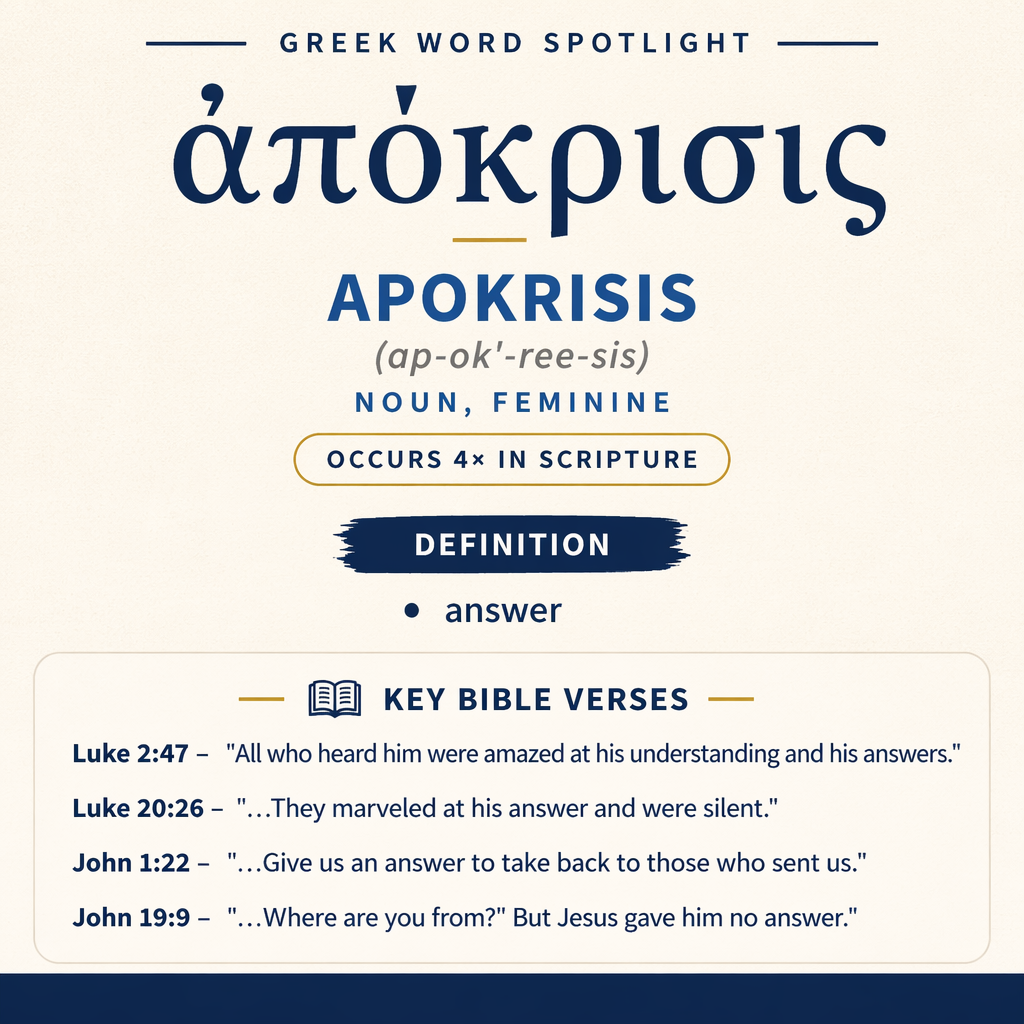
ἀπόκρισις means “answer” and occurs 4 times in Scripture: Luke 2:47; Luke 20:26; John 1:22; John 19:9.
Core Meaning
ἀπόκρισις means “answer.” In the listed passages, it refers to spoken responses or the lack of one.
Learn More →Gospel Occurrences
The word appears in Luke 2:47 and Luke 20:26, and in John 1:22 and John 19:9. Each occurrence is in a Gospel narrative or dialogue.
Learn More →Contextual Snapshots
Luke highlights amazement and silence in response to an ἀπόκρισις (Luke 2:47; 20:26). John includes both a request for an answer and Jesus giving no answer (John 1:22; 19:9).
Learn More →ἀπόκρισις means “answer” and appears in scenes where a spoken reply is expected, evaluated, requested, or withheld. In the Gospels it is tied to moments of public listening, interrogation, and the pressure of giving a response under scrutiny.
Root and Related Words
ἀπόκρισις is related to the verb apokrinomai (ἀποκρίνω), “to answer” (Strong’s G611).

Occurrences
“All who heard him were amazed at his understanding and his answers.” (Luke 2:47)
Here ἀπόκρισις is plural (“answers”) and stands alongside “understanding” as the two things that impress the listeners. The setting is auditory and public: “All who heard him” react to what they perceive in the exchange. The word points to the concrete outputs of speech—responses that show comprehension. Within the sentence, “answers” are not mere acknowledgments; they are the audible evidence that evokes amazement. The stress falls on what the hearers can assess in real time: the quality of the replies.

“They weren’t able to trap him in his words before the people. They marveled at his answer and were silent.” (Luke 20:26)
In this confrontation, ἀπόκρισις is singular (“his answer”) and functions as the turning point of the attempted trap. The verse frames the exchange as a contest over speech: opponents try to “trap him in his words,” and the presence of “before the people” underscores public stakes. The “answer” is effective enough to reverse the attackers’ momentum: instead of catching him, they “marveled” and then “were silent.” In this scene the word carries the sense of a reply that closes down further attack, not by force but by what it accomplishes in the listeners—leaving adversaries without a follow-up.
“They said therefore to him, “Who are you? Give us an answer to take back to those who sent us. What do you say about yourself?”” (John 1:22)
Here ἀπόκρισις is demanded explicitly: “Give us an answer.” The request is framed as a matter of delegated responsibility—an “answer” is needed “to take back to those who sent us.” The word is thus linked to accountability and reporting: a response is not only for the speaker and immediate hearers, but for a wider chain of inquiry. The interrogators press with layered questions (“Who are you?” … “What do you say about yourself?”), showing that ἀπόκρισις is expected to be sufficiently definite to travel, to be repeated, and to satisfy those not present.
“He entered into the Praetorium again, and said to Jesus, “Where are you from?” But Jesus gave him no answer.” (John 19:9)
In this scene ἀπόκρισις is negated: “no answer.” The question is direct (“Where are you from?”), asked in a setting marked by official space (“the Praetorium”). The word highlights the absence of the expected exchange: the authority figure speaks, but the reply does not come. By naming what is missing—an “answer”—the verse draws attention to silence as a deliberate posture within interrogation. The lack of ἀπόκρισις is itself meaningful in context: it leaves the question hanging and keeps the questioner without the response he seeks.
Sense and Usage
Across these passages ἀπόκρισις consistently belongs to the sphere of verbal response in moments where words are weighed. In Luke 2:47 it appears as repeated replies that display “understanding,” making the “answers” observable proof of insight to “all who heard.” In Luke 20:26 it is a single, decisive reply within a public attempt at entrapment; the “answer” is measured by its effect on opponents, moving them from strategy (“trap him”) to astonishment (“marveled”) and then to speechlessness (“were silent”).
John 1:22 shows the same basic idea of a reply but places it in an administrative frame: an “answer” is something that can be carried back to superiors, a statement that represents the speaker to those absent. The word is at home in questioning that seeks a clear account—an answer that functions as reportable content. John 19:9 displays the opposite edge of the same concept: the expected reply is withheld, and the narrative names this absence as “no answer,” emphasizing the broken symmetry of question-and-response.
In all four uses, ἀπόκρισις is not presented as an abstract idea but as a concrete unit of speech within relational pressure: listeners amazed, opponents frustrated, envoys tasked with returning a report, and an official question left unmet. The word therefore marks the point at which questioning meets response—or fails to meet it—and the surrounding reactions (amazement, marveling, silence, insistence on receiving something to bring back) show how much weight a spoken answer can carry in public and judicial-like settings.
Imagery in Context
The passages give ἀπόκρισις a consistent conversational imagery: voices in a listening crowd (Luke 2:47), a contested exchange “before the people” where a reply ends the challengers’ speech (Luke 20:26), messengers pressing for a response they can physically “take back” (John 1:22), and an interior official space where a question meets silence (John 19:9). Together they portray “answer” as something heard, evaluated, transported, and sometimes refused—an ordinary word for reply that nevertheless stands at decisive moments of scrutiny.
Sources: Lexical data from Strong’s Exhaustive Concordance and the Translators Brief Lexicon of Extended Strongs for Greek (STEPBible, CC BY). Occurrence data from the Translators Amalgamated Greek New Testament (STEPBible, CC BY). Scripture quotations from the World English Bible (public domain).




