Understanding the Biblical Meaning of Apodeixis in Greek
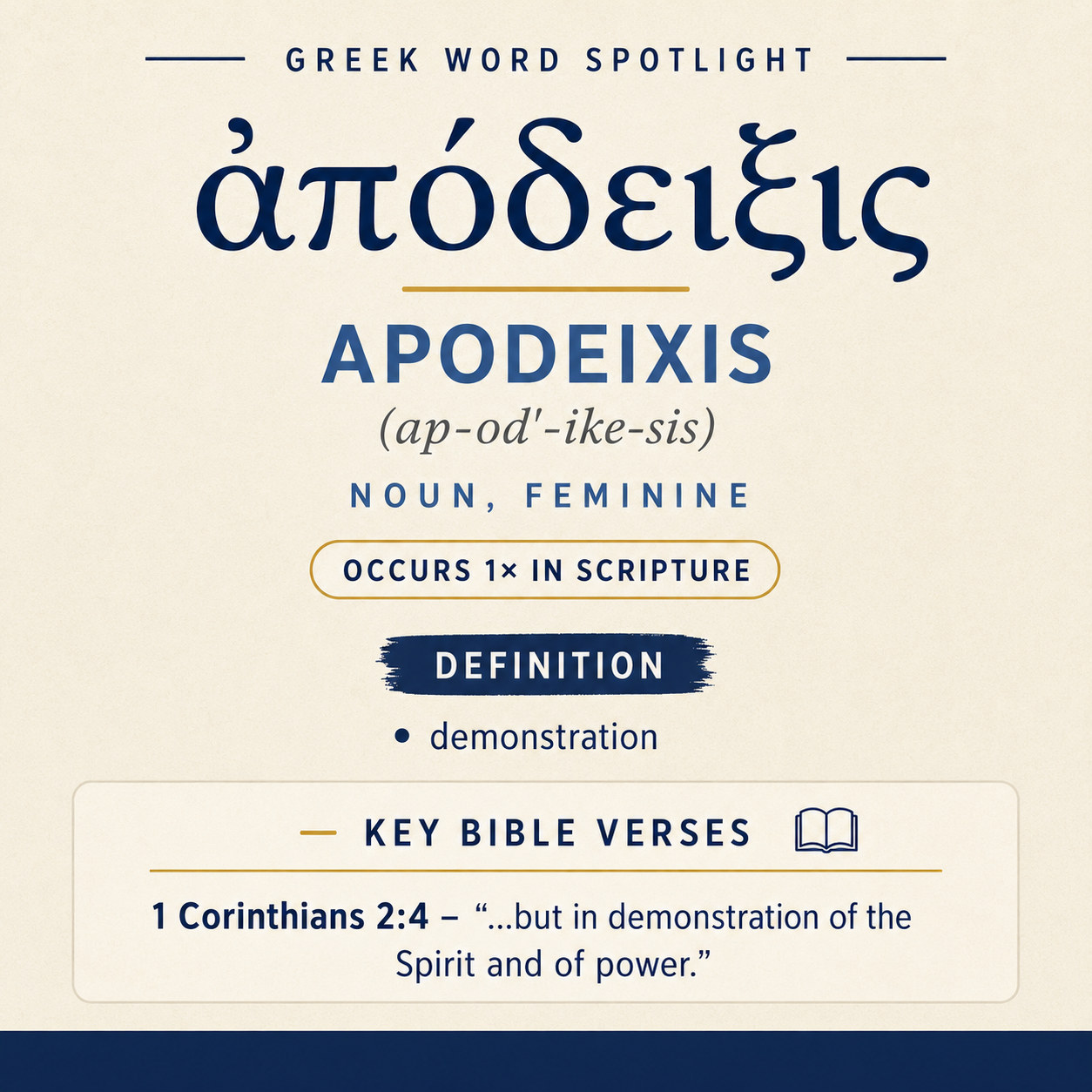
ἀπόδειξις means “demonstration” and appears once in Scripture, in 1 Corinthians 2:4.
Biblical Occurrence
It occurs one time in Scripture. That occurrence is in 1 Corinthians 2:4.
Learn More →Verse Context
In 1 Corinthians 2:4, it describes preaching not in persuasive human wisdom. It is “in demonstration of the Spirit and of power.”
Learn More →ἀπόδειξις means “demonstration,” and it appears in the New Testament in Paul’s description of how his message came to the Corinthians. In that context it names the kind of persuasive force that marked his speech and preaching.
Root and Related Words
ἀπόδειξις derives from the verb apodeiknymi (ἀποδείκνυμι), “to display.” The noun therefore belongs to a word-family that speaks in terms of making something evident by setting it forth.

Occurrences
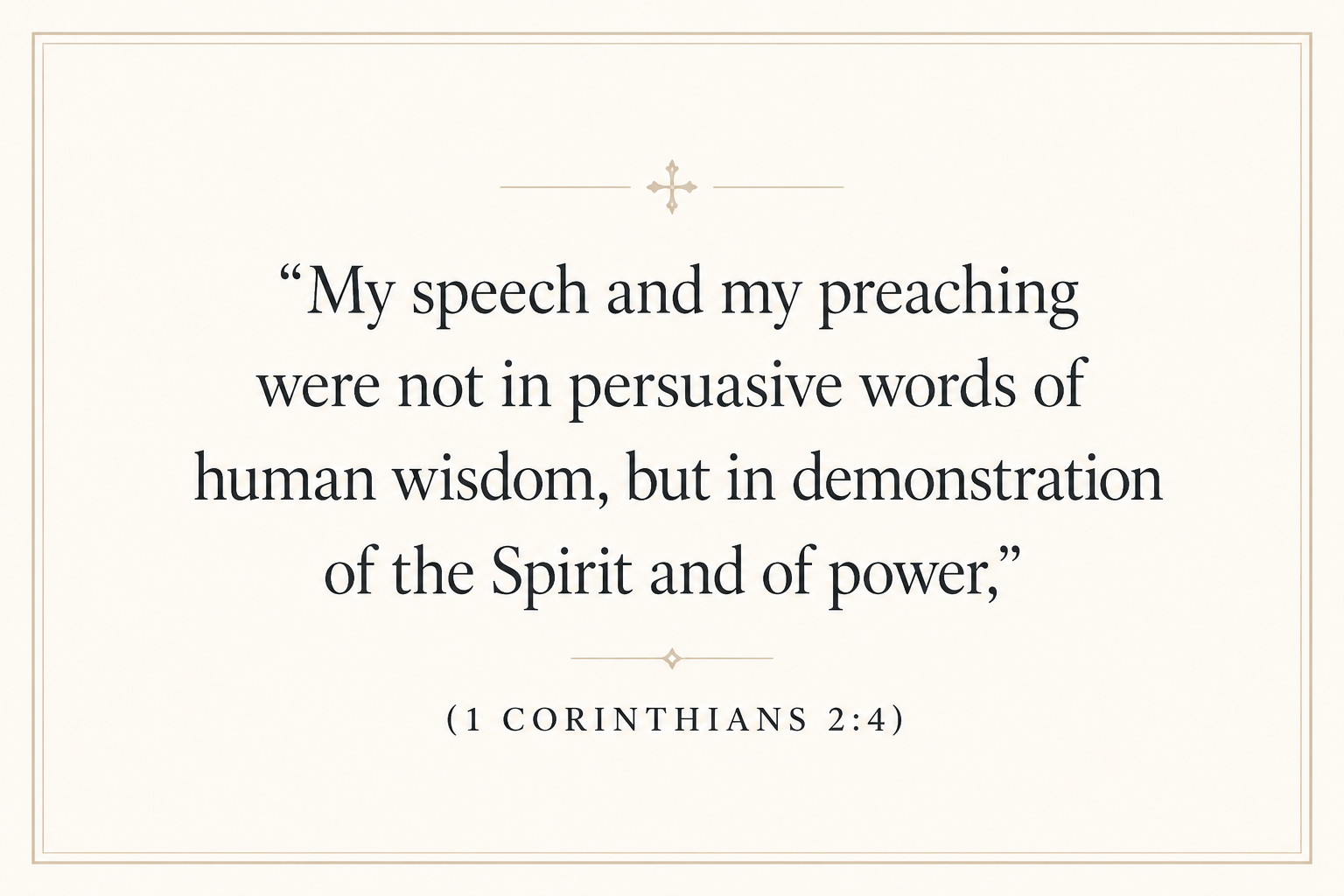
“My speech and my preaching were not in persuasive words of human wisdom, but in demonstration of the Spirit and of power,” (1 Corinthians 2:4)
Here ἀπόδειξις stands in deliberate contrast with “persuasive words of human wisdom.” Paul frames two different ways a message can carry weight: one through carefully chosen rhetoric aimed at human persuasion, the other through “demonstration of the Spirit and of power.” The noun functions as the hinge of that contrast. It names what his speech was characterized by, over against what it was not characterized by.
The grammar of the line also shows what kind of “demonstration” is in view. The phrase “of the Spirit and of power” specifies the sphere and source in which this demonstration takes place; it is not described as a demonstration of argument, technique, or learning, but one tied to “the Spirit” and to “power.” Thus, in the immediate scene of the verse, ἀπόδειξις is presented as an alternative mode of validation for preaching: rather than depending on language that persuades by human wisdom, the preaching is accompanied by an evidencing that belongs to the Spirit and is marked by power.
Within the single sentence, Paul links “my speech” and “my preaching” together and then treats them as one unified activity that may be evaluated by its manner (“not in… but in…”). ἀπόδειξις therefore does not point to something private or internal, but to what attended his outward communication. The force of the contrast is rhetorical, but the content of the contrast is also practical: the effectiveness or credibility of his message is located in a demonstration characterized by Spirit and power rather than in the craft of “persuasive words.”
Sense and Usage
As “demonstration,” ἀπόδειξις refers to an evidencing that makes something plain. In 1 Corinthians 2:4, that evidencing is not presented as a detached display for its own sake, but as the manner in which Paul’s spoken ministry came to the Corinthians. The verse places the term in the realm of proclamation (“speech” and “preaching”), where listeners might normally expect credibility to be carried by humanly impressive “words” and “wisdom.” Against that expectation, ἀπόδειξις names a different kind of persuasive force—one defined by what it is associated with: “the Spirit” and “power.”
The presence of the contrast (“not… but…”) helps clarify how the term functions without adding new categories beyond the verse. Paul is not merely denying that his preaching included any human wisdom at all; he is denying that its persuasive character rested “in” such words. The prepositional framing emphasizes the medium or basis: the speech is not located in one kind of rhetorical ground but in another kind of ground. ἀπόδειξις, then, expresses a basis of confidence for what is preached, describing the way the message is validated or made evident in the act of proclamation.
The immediate collocation with “Spirit” and “power” also shapes the term’s texture. “Demonstration” could, in many settings, suggest a careful presentation or a proof offered to the mind. In this verse, however, it is paired with words that point to divine agency and effective force. Paul’s phrasing keeps the noun from being reduced to an intellectual performance; it belongs to the kind of showing forth that is attributed to the Spirit and marked by power. That is precisely why it can be set against “persuasive words of human wisdom”: it is a demonstration of a different order, operating in a different register of credibility.
Because ἀπόδειξις occurs here with first-person references (“My speech and my preaching”), it also carries a personal dimension: Paul is describing his own method and the character of his own ministry among the Corinthians. Yet the noun remains focused on what accompanies the message, not on Paul’s personality. The verse portrays an event of proclamation in which something is made evident—something that can be described as “demonstration”—and that event is attributed to the Spirit’s activity and expressed as power.
The related verb apodeiknymi (ἀποδείκνυμι), “to display,” fits the way the noun works in this context. Even without expanding beyond the single verse, the idea of “display” helps explain why Paul can speak of a “demonstration” as the antithesis of persuasive wording: a display does not rely on verbal ingenuity to create an impression; it presents something in such a way that it is shown. In 1 Corinthians 2:4, the “display” is not described visually, but it is described as something real and effective in the arena of speech and preaching, with the Spirit and power as its defining associations.
Imagery
In 1 Corinthians 2:4, ἀπόδειξις carries the imagery of something being set out in the open rather than merely argued for. Paul’s contrast between “persuasive words” and “demonstration of the Spirit and of power” evokes the difference between a message supported by human rhetorical skill and a message accompanied by a manifest showing that belongs to the Spirit and is marked by power.
Sources: Lexical data from Strong’s Exhaustive Concordance and the Translators Brief Lexicon of Extended Strongs for Greek (STEPBible, CC BY). Occurrence data from the Translators Amalgamated Greek New Testament (STEPBible, CC BY). Scripture quotations from the World English Bible (public domain).