Exploring the Meaning of Aphelotes in Greek
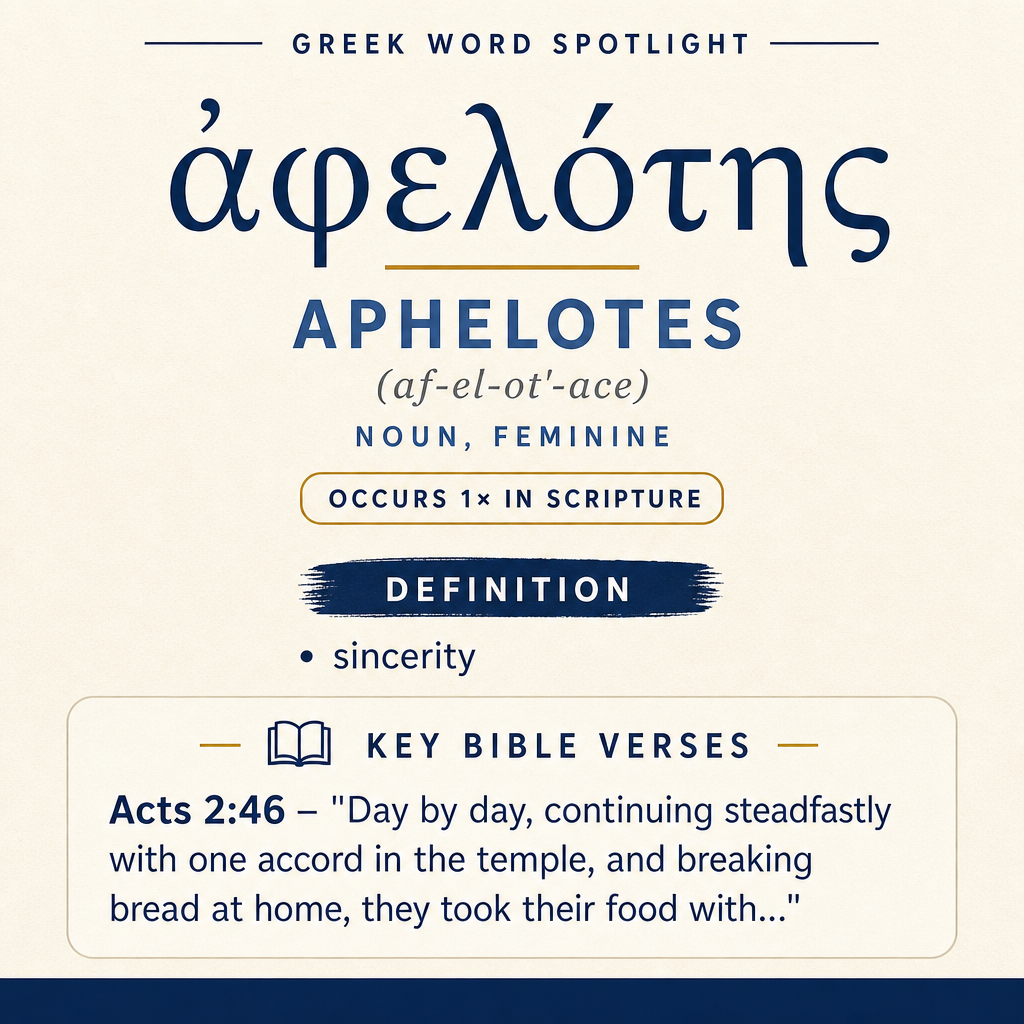
ἀφελότης (Aphelotes) means “sincerity” and appears once in Scripture, in Acts 2:46.
Acts Context
In Acts 2:46, it describes how they took their food while continuing steadfastly with one accord.
Learn More →ἀφελότης expresses “sincerity,” and it appears in the description of the earliest believers’ shared life in Acts 2:46. In that setting it characterizes the inner quality of their communal meals and worship as they live openly and wholeheartedly together.
Root and Related Words
ἀφελότης is linked, per Strong’s, to Alpha, transliterated A (α, Ἀλφα; Strong’s G1), “Alpha.”

Occurrences
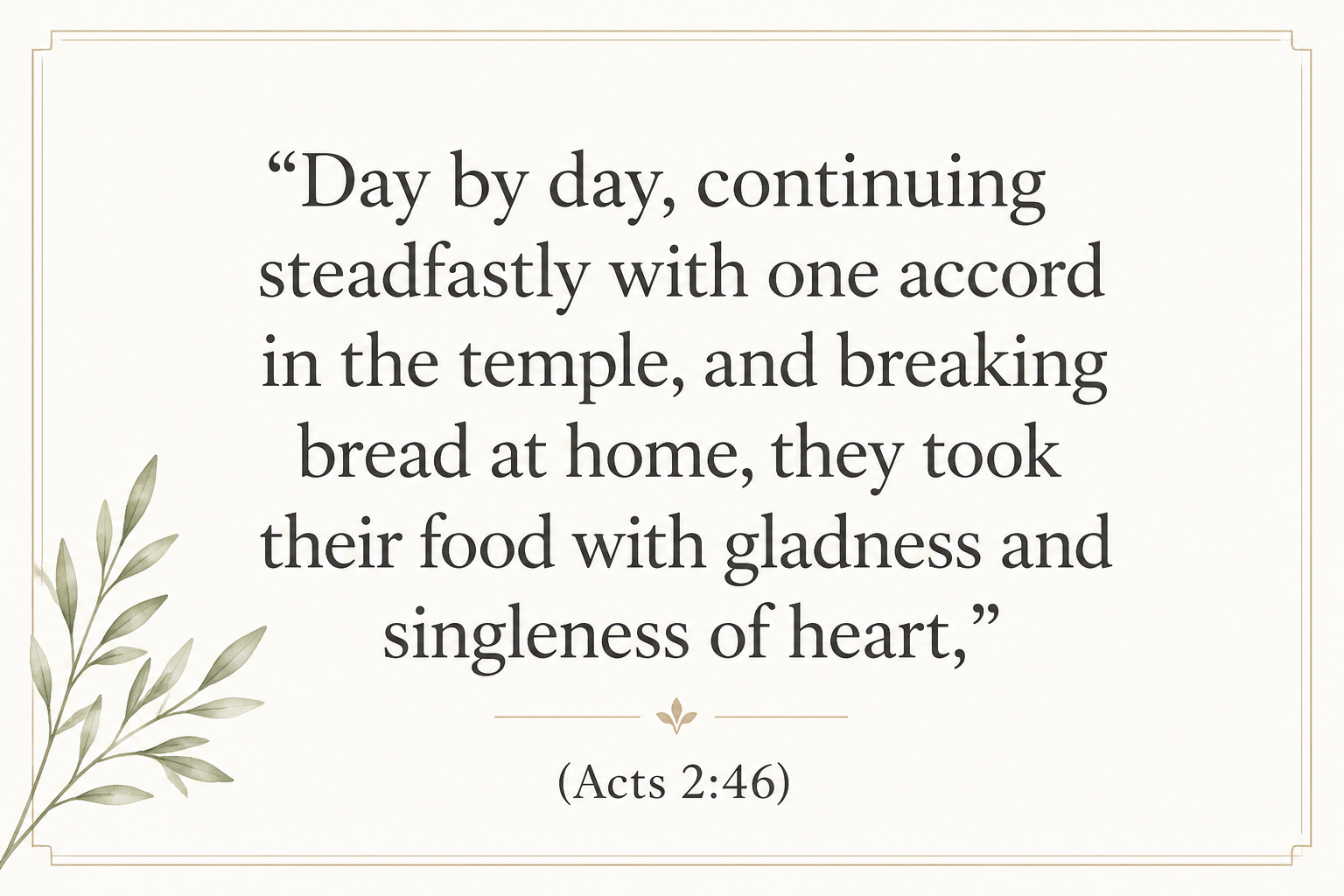
“Day by day, continuing steadfastly with one accord in the temple, and breaking bread at home, they took their food with gladness and singleness of heart,” (Acts 2:46)
In Acts 2:46, ἀφελότης stands in a cluster of phrases that portray a steady, shared rhythm: “Day by day,” “continuing steadfastly,” “with one accord,” “in the temple,” and “breaking bread at home.” Within that sequence, the word is tied specifically to the manner in which they “took their food”—their table fellowship is marked by “gladness” and by “singleness of heart.” The scene alternates between public devotion (“in the temple”) and domestic hospitality (“at home”), and ἀφελότης belongs to the private, daily act of eating together as much as to the public unity of worship. It names an inward integrity that fits the outward simplicity of the action: not an occasional gesture, but a repeated practice carried out with an undivided disposition.
The verse frames this quality as communal rather than merely individual. The subjects act together (“they took their food”), and the sincerity described is not isolated virtue but the tone of a whole group’s life. It accompanies “gladness,” so it is not presented as grim austerity; instead it sits beside joy as a defining feature of their shared meals. It also accompanies “one accord,” suggesting that their unity is not only organizational—meeting in the same places and doing the same things—but also heartfelt, expressed in a congruence between what they do together and what they are together. In this single occurrence, ἀφελότης functions like a window into motive: it points to the genuineness within the routine acts of gathering, eating, and persisting day after day.
Sense and Usage
The definition “sincerity” is given concrete form in Acts 2:46 through the phrase “singleness of heart.” The sense is not abstracted into a slogan; it is embodied in ordinary practices—meeting, eating, and continuing “day by day.” Sincerity here is shown as a quality that can characterize a group’s shared life. It belongs to the heart, yet it is observable in how the community behaves: they do not merely “break bread at home,” but do so in a way that matches the gladness and unity the verse highlights. The word therefore lends moral texture to the narrative: the early community’s steadfastness is not depicted as mere persistence, and their one-accord togetherness is not portrayed as superficial agreement. Their repeated actions are carried out with a genuine, undivided interior posture.
The pairing with “gladness” also shapes the color of the sincerity described. The verse does not separate heartfelt genuineness from shared joy; it places them side by side as companion qualities. In the logic of the sentence, sincerity is part of what makes their daily meals distinct: they “took their food” not only with positive emotion (“gladness”) but with an inner straightforwardness (“singleness of heart”). The word thus contributes a note of clarity and openness to the community’s fellowship. The meals are not portrayed as calculated displays, and the unity is not depicted as forced; rather, the scene presents a life together where the inner disposition and the outward practice correspond.
Because ἀφελότης occurs in the flow of an ongoing, habitual pattern (“Day by day”), its sincerity is not a momentary impulse but a stable feature of their life. The verse situates this stability within two venues—temple and home—so the same basic posture accompanies them across public worship and private hospitality. Sincerity is therefore portrayed as portable and consistent: it is the same “singleness of heart” whether they are in a public sacred space or at a household table. In this way the word helps define the character of early communal devotion, showing that their shared faith is carried by a genuine interior unity expressed in daily, tangible practices.
Imagery
Although ἀφελότης names an inward quality, Acts 2:46 gives it a vivid setting: people gathered “at home,” eating together, in a steady daily rhythm. The word’s imagery is therefore domestic and communal—sincerity pictured not as a private feeling hidden away, but as something that can be recognized in the atmosphere of a shared meal marked by gladness and an undivided heart.
Sources: Lexical data from Strong’s Exhaustive Concordance and the Translators Brief Lexicon of Extended Strongs for Greek (STEPBible, CC BY). Occurrence data from the Translators Amalgamated Greek New Testament (STEPBible, CC BY). Scripture quotations from the World English Bible (public domain).