Exploring the Meaning of Apheidia in Greek
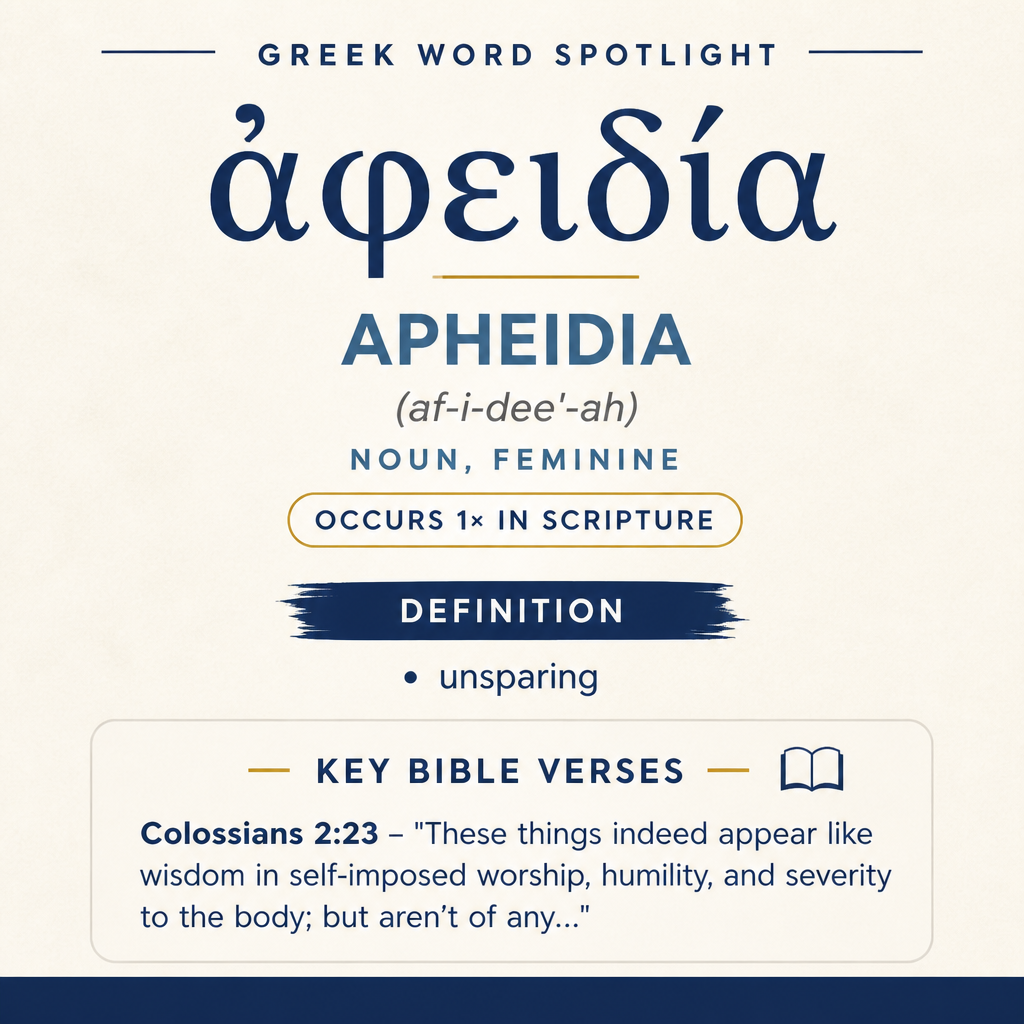
ἀφειδία means “unsparing” and appears once in Scripture, in Colossians 2:23.
Verse Context
In Colossians 2:23, it is used alongside self-imposed worship, humility, and severity to the body.
Learn More →ἀφειδία means “unsparing” and appears once in the New Testament, in Paul’s warning about practices that only seem wise in Colossians 2:23. In that setting it belongs to a cluster of terms describing a religious program marked by strictness toward the body.
Root and Related Words
ἀφειδία is connected with the verb pheidomai (φείδομαι), “to spare” (Strong’s G5339). Strong’s also traces it to Alpha (A, α, Ἀλφα), “Alpha” (Strong’s G1).

Occurrences
“These things indeed appear like wisdom in self-imposed worship, humility, and severity to the body; but aren’t of any value against the indulgence of the flesh.” (Colossians 2:23)
In Colossians 2:23, ἀφειδία functions inside a short list of features that give certain “things” a persuasive surface: they “appear like wisdom” because they present themselves as rigorous religion. The verse groups “self-imposed worship,” “humility,” and “severity to the body” as the kinds of traits that can make a program look spiritually serious. Within that cluster, ἀφειδία expresses an “unsparing” posture—an approach that does not hold back in its treatment of the body, matching the phrase “severity to the body.” It is the language of strictness that can be felt, measured, and displayed: a discipline that looks intense because it is not gentle or restrained.

Yet the same sentence undercuts the persuasive appearance. Paul contrasts what “appear[s] like wisdom” with what actually matters: these things “aren’t of any value against the indulgence of the flesh.” The word ἀφειδία therefore sits in an ironic frame. It belongs to the outward package that can impress—practices that look like wisdom because they involve chosen acts of devotion (“self-imposed worship”), a posture of lowliness (“humility”), and an “unsparing” severity directed toward the body. But Paul’s verdict is practical: despite that unsparing severity, the program has no real power “against the indulgence of the flesh.” In the logic of the verse, ἀφειδία strengthens the description of harsh discipline precisely so that the conclusion lands with more force: even unsparing treatment of the body does not necessarily restrain fleshly indulgence.
Sense and Usage
The single New Testament use shows ἀφειδία operating as a descriptor of rigorous practice. “Unsparing” here is not an abstract quality floating free of context; it is attached to a specific direction (“to the body”) and paired with other markers of visible religiosity. The word helps portray a kind of devotion that gains credibility through self-chosen intensity: the severity feels like evidence of seriousness, and the unsparing character of that severity is what makes it persuasive.
At the same time, Colossians 2:23 places ἀφειδία on the “appearance” side of a sharp contrast. The verse distinguishes what looks like wisdom from what has “value against the indulgence of the flesh.” In that contrast, ἀφειδία contributes to a critique of surface-level spiritual strategies. The harsher the regimen sounds—self-imposed worship, humility, and unsparing severity—the more it can “appear like wisdom.” But the verdict does not concede effectiveness. The word’s force is therefore double-edged in this verse: it heightens the description of strictness, and that very heightening intensifies the disappointment of the concluding evaluation.
Because ἀφειδία is paired with “severity to the body,” its “unsparing” sense is expressed as a tangible stance toward embodied life. It evokes discipline that does not excuse, does not relax, and does not “spare” the body from imposed demands. Yet Paul’s sentence does not evaluate the intensity by its harshness; it evaluates it by its fruit—whether it actually counters “indulgence of the flesh.” In this way, ἀφειδία serves Paul’s rhetorical purpose: it names the most severe version of bodily strictness, so that the statement “aren’t of any value” cannot be dismissed as referring only to mild or half-hearted practices.
Imagery
The imagery implied by ἀφειδία in Colossians 2:23 is the feel of strict bodily discipline: practices that “appear like wisdom” because they look costly, demanding, and hard on the body. The verse frames that unsparing severity as a visible badge—yet one that, in Paul’s assessment, fails to address “the indulgence of the flesh,” leaving the reader with a contrast between harsh appearance and real moral power.
Sources: Lexical data from Strong’s Exhaustive Concordance and the Translators Brief Lexicon of Extended Strongs for Greek (STEPBible, CC BY). Occurrence data from the Translators Amalgamated Greek New Testament (STEPBible, CC BY). Scripture quotations from the World English Bible (public domain).