
Exploring the Meaning of Apallotrioo in Greek
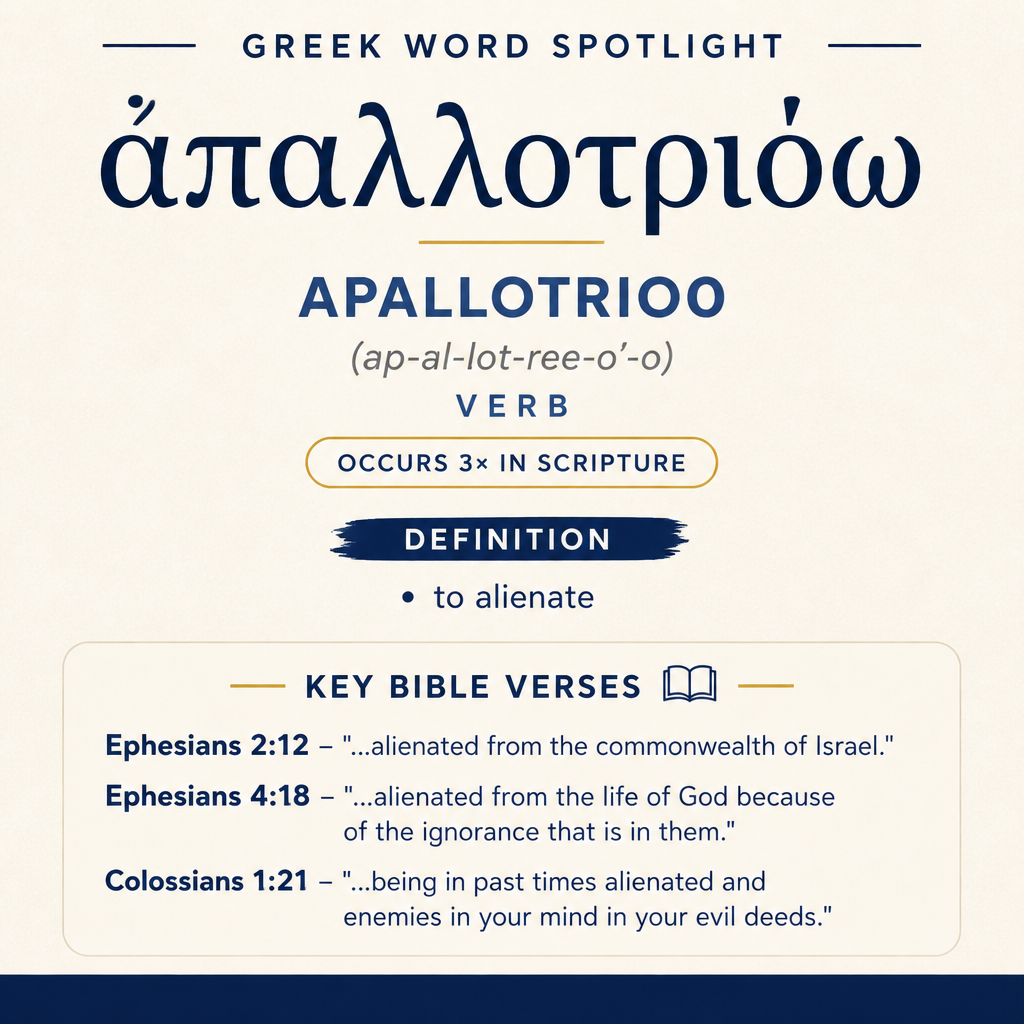
ἀπαλλοτριόω means “to alienate” and appears three times: Ephesians 2:12; Ephesians 4:18; Colossians 1:21.
Where It Appears
This verb occurs three times in Scripture: Ephesians 2:12; Ephesians 4:18; Colossians 1:21.
Learn More →Context In Verses
It describes being alienated from the commonwealth of Israel (Eph 2:12), from the life of God (Eph 4:18), and formerly alienated and enemies in mind (Col 1:21).
Learn More →ἀπαλλοτριόω means “to alienate.” In the New Testament it appears in Ephesians 2:12, Ephesians 4:18, and Colossians 1:21, each time describing a condition of separation that shapes how the surrounding clauses are heard.
Root and Related Words
ἀπαλλοτριόω is connected with ἀλλότριος (allotrios), “another’s” (Strong’s G245), and with ἀπό (apo), “away from” (Strong’s G575). Together these related terms color the verb with the idea of being set at a remove from what properly belongs to another sphere.

Occurrences
Ephesians 2:12 — “that you were at that time separate from Christ, alienated from the commonwealth of Israel, and strangers from the covenants of the promise, having no hope and without God in the world.”
Here ἀπαλλοτριόω stands within a chain of descriptions that pile up to portray a former situation of exclusion. “Separate from Christ” is followed by “alienated from the commonwealth of Israel,” and then by “strangers from the covenants of the promise.” The verb marks not a passing emotion but a relational and communal distance: the people addressed are pictured as outside a defined “commonwealth,” positioned as outsiders to “covenants,” and left with the bleak results that follow—“having no hope and without God in the world.” In this setting, “alienated” functions as a key term for belonging: it depicts life lived at the boundary, cut off from participation in what is named (a commonwealth) and from access to what is promised (covenants of promise). The effect of the sentence depends on that separation; the later phrases (“no hope…without God”) read as consequences that fit an alienated status.
Ephesians 4:18 — “being darkened in their understanding, alienated from the life of God because of the ignorance that is in them, because of the hardening of their hearts.”
In Ephesians 4:18 the verb is applied not to civic standing but to “the life of God.” The clause “being darkened in their understanding” prepares for an alienation that reaches beyond external association: alienation is tied to understanding, ignorance, and the heart. The text gives a causal account—“because of the ignorance that is in them, because of the hardening of their hearts”—so “alienated” describes a condition that corresponds to interior dullness and resistance. The phrase “from the life of God” frames what is lost: not merely knowledge about God, but a kind of life characterized as God’s. Within the sentence, alienation is coordinated with a darkened understanding: the mind and the life it should participate in are treated as connected, so alienation describes a severe break in participation, reinforced by the two “because” clauses that locate the break within ignorance and hardened hearts.
Colossians 1:21 — “You, being in past times alienated and enemies in your mind in your evil deeds,”
Colossians 1:21 places ἀπαλλοτριόω in a direct address, “You,” and locates the alienation in “past times.” The verse couples “alienated” with “enemies in your mind,” bringing the state of separation into the realm of hostility and thought. The phrase “in your evil deeds” anchors that mental enmity in a life pattern that expresses itself in actions; the verse does not treat alienation as an abstract label but as a description intertwined with inward posture (“enemies in your mind”) and outward practice (“your evil deeds”). In this context, “alienated” helps depict a former identity: the readers are portrayed as once positioned against, rather than aligned with, the sphere implied by the letter’s broader address to God and Christ. The compact wording allows “alienated” to carry much of the weight for that prior estrangement, setting the stage for the contrast implied by the phrase “in past times.”
Sense and Usage
Across these passages, “to alienate” consistently describes a state of separation that has recognizable effects. In Ephesians 2:12, alienation is social and covenantal: it is “from the commonwealth of Israel,” paired with being “strangers from the covenants of the promise.” The word contributes the notion of being outside a defined community and outside its promise-structures, with the resulting absence of hope and a life “without God in the world.” In Ephesians 4:18, alienation is expressed as spiritual participation lost—“from the life of God”—and the text explains how that separation coheres with ignorance and hardened hearts. In Colossians 1:21, alienation is relational and mental: it is joined to being “enemies in your mind,” and it is shown as morally expressed “in your evil deeds.”
These uses together show the verb’s flexibility in what it can take as its object—“commonwealth,” “life,” and an implied relational stance that can be described as enmity—while keeping the same core idea of being set apart from what would otherwise be a place of belonging or participation. The surrounding vocabulary in each instance helps define the lived shape of alienation. Where the text speaks of “strangers” and “covenants,” alienation reads as exclusion from a people and its promised commitments. Where it speaks of darkened understanding and ignorance, alienation reads as a severed connection to God’s life that corresponds to an inward condition. Where it speaks of enemies in the mind and evil deeds, alienation reads as a posture and practice that opposes rather than shares in the life oriented toward God. In each case, the verb contributes a strong relational diagnosis: the separation is not merely spatial but involves identity and participation, whether in communal standing, divine life, or the mind’s stance toward God.
Imagery
The imagery carried by ἀπαλλοτριόω in these texts is the imagery of distance and exclusion. Ephesians 2:12 evokes boundaries around a “commonwealth” and the status of being “strangers,” as though standing outside a city’s life and outside the household where promises are kept. Ephesians 4:18 intensifies the picture by linking alienation with darkness in understanding, as if separation from “the life of God” is accompanied by an inner dimming and hardening. Colossians 1:21 adds the picture of estrangement becoming active opposition—“enemies in your mind”—so alienation can be felt as both distance and conflict, expressed in “evil deeds.”
Sources: Lexical data from Strong’s Exhaustive Concordance and the Translators Brief Lexicon of Extended Strongs for Greek (STEPBible, CC BY). Occurrence data from the Translators Amalgamated Greek New Testament (STEPBible, CC BY). Scripture quotations from the World English Bible (public domain).




