
Understanding the Meaning of Allotrios in Greek
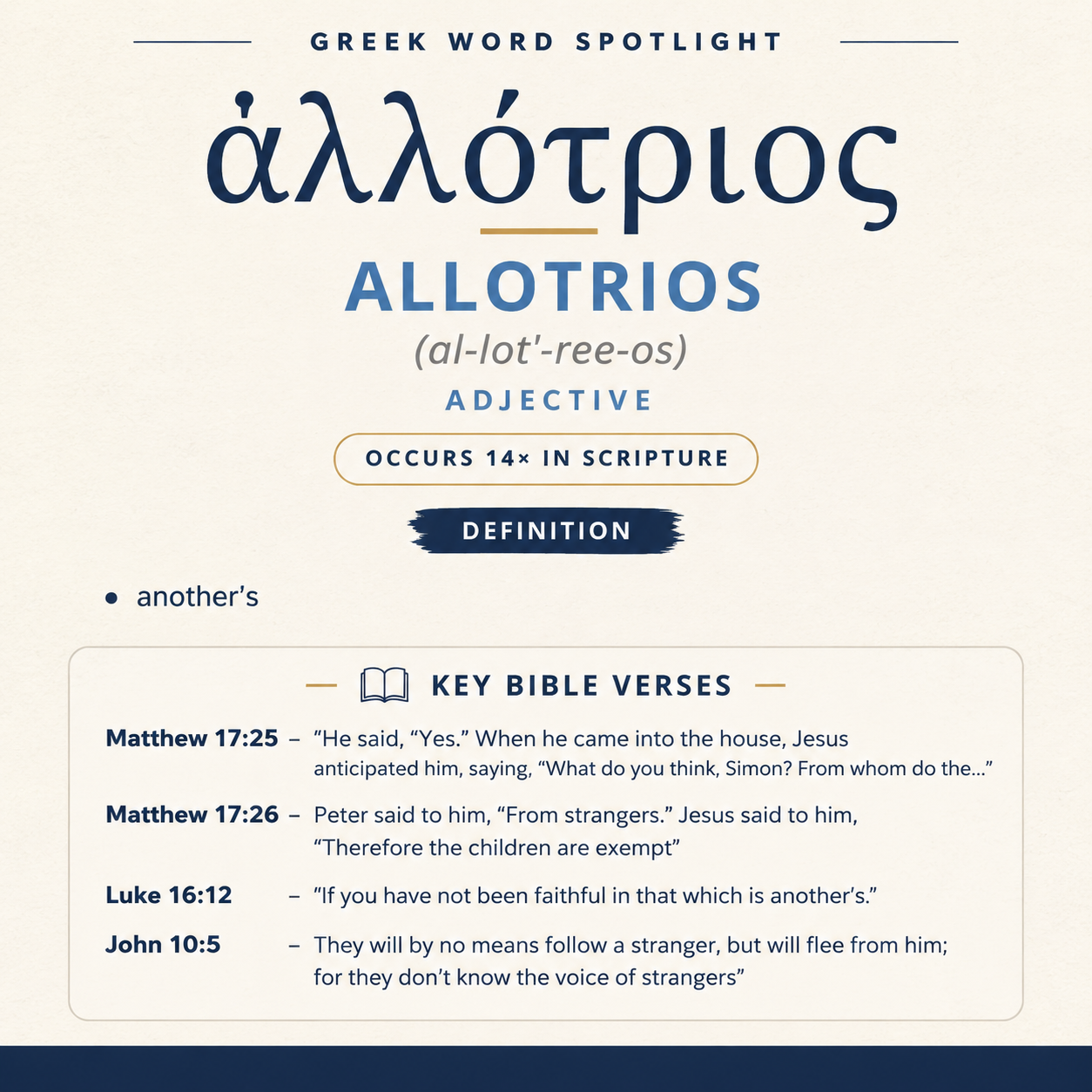
ἀλλότριος (Allotrios) means “another’s” and occurs 14 times in Scripture, including Matthew 17:25–26, Luke 16:12, John 10:5, and Acts 7:6.
Core Meaning
ἀλλότριος is defined as “another’s.” It is used for what belongs to someone else or is foreign.
Learn More →Gospel Contexts
In Matthew 17:26 and John 10:5 it appears in contexts involving “strangers.” Luke 16:12 uses it for “that which is another’s.”
Learn More →Epistle Examples
Romans 14:4 speaks of “another’s servant,” and Romans 15:20 of “another’s foundation.” 2 Corinthians 10:15 refers to “other men’s labors.”
Learn More →ἀλλότριος expresses the idea of belonging to someone else—what is “another’s.” In the passages where it appears, it marks people, property, speech, land, labor, service, sin, and even blood as outside one’s own rightful sphere.
Occurrences
“He said, “Yes.” When he came into the house, Jesus anticipated him, saying, “What do you think, Simon? From whom do the kings of the earth receive toll or tribute? From their children, or from strangers?”” (Matthew 17:25)
Here ἀλλότριος distinguishes two groups in a kingdom: the king’s “children” and “strangers.” The contrast sets up an argument about obligation. “Strangers” are those who do not belong to the king’s household and so are treated as outsiders in matters like “toll or tribute.”
“Peter said to him, “From strangers.” Jesus said to him, “Therefore the children are exempt.” (Matthew 17:26)
Peter supplies the expected answer—tribute comes “from strangers.” The word functions as the category opposite “the children,” so that exemption follows from belonging: those who are not “another’s” (outsiders) are the ones assessed.
“If you have not been faithful in that which is another’s, who will give you that which is your own?” (Luke 16:12)
In this saying, ἀλλότριος marks property or responsibility held in trust. Faithfulness is tested first in handling what belongs to someone else; only then does the question arise of receiving “your own.” The adjective draws a moral boundary between stewardship and possession.
“They will by no means follow a stranger, but will flee from him; for they don’t know the voice of strangers.” (John 10:5)
Here ἀλλότριος identifies the “stranger” by a voice that is not recognized. The response is decisive: not following but fleeing. The word helps define the relationship—this is not one’s own shepherd, not one’s own familiar guide, and therefore not to be trusted.
“God spoke in this way: that his offspring would live as aliens in a strange land, and that they would be enslaved and mistreated for four hundred years.” (Acts 7:6)
In Stephen’s speech, ἀλλότριος describes the land where the offspring would live as “aliens.” Calling it “a strange land” frames their residence as life on ground that belongs to others, a setting that matches the later description of being “enslaved and mistreated.”
“Who are you who judge another’s servant? To his own lord he stands or falls. Yes, he will be made to stand, for God has power to make him stand.” (Romans 14:4)
Here ἀλλότριος guards the limits of judgment: the servant in view is “another’s,” not yours. The verse immediately anchors the servant’s accountability—“To his own lord he stands or falls”—so the adjective marks a relationship of belonging that is not transferable to an outside judge.
“yes, making it my aim to preach the Good News, not where Christ was already named, that I might not build on another’s foundation.” (Romans 15:20)
In Paul’s description of missionary purpose, ἀλλότριος qualifies “foundation.” The image is architectural: he avoids “build[ing]” on groundwork laid by someone else. The word underscores respect for what already belongs to another worker’s prior labor and initiative.
“not boasting beyond proper limits in other men’s labors, but having hope that as your faith grows, we will be abundantly enlarged by you in our sphere of influence,” (2 Corinthians 10:15)
Here ἀλλότριος marks “labors” as belonging to “other men.” The ethical issue is boasting: to boast “beyond proper limits” by claiming credit for what others have done. The adjective draws a boundary around rightful grounds for confidence and speech.
“so as to preach the Good News even to the parts beyond you, not to boast in what someone else has already done.” (2 Corinthians 10:16)
The same concern continues: ἀλλότριος points to work “someone else has already done.” The desire to preach “to the parts beyond you” is paired with refusal to take pride in another person’s completed labor; the word maintains the distinction between one’s own work and another’s accomplishments.
“Lay hands hastily on no one. Don’t be a participant in other people’s sins. Keep yourself pure.” (1 Timothy 5:22)
Here ἀλλότριος qualifies “sins” as belonging to “other people.” The warning is against participation—becoming involved in wrongdoing that is not one’s own. The adjective highlights moral separation: purity is protected by refusing complicity in what belongs to others.
“nor yet that he should offer himself often, as the high priest enters into the holy place year by year with blood not his own,” (Hebrews 9:25)
In this sacrificial comparison, ἀλλότριος modifies “blood”: the high priest enters “with blood not his own.” The word emphasizes substitution and representation by drawing attention to the blood’s ownership—belonging to another—within the repeated annual action described.
“By faith, he lived as an alien in the land of promise, as in a land not his own, dwelling in tents with Isaac and Jacob, the heirs with him of the same promise.” (Hebrews 11:9)
Here ἀλλότριος again marks land as belonging to others: “a land not his own.” The portrayal of tent-dwelling fits the status of an “alien,” and the adjective strengthens the sense that even “the land of promise” is experienced as territory not possessed as one’s own.

Sense and Usage
Across these contexts, ἀλλότριος consistently draws a line between what properly belongs to one party and what lies outside that party’s rightful claim. In Matthew 17:25–26, the distinction is social and legal: “children” versus “strangers” in relation to a king’s revenue, so that belonging affects obligation. In Luke 16:12 the boundary becomes a test of character: faithfulness is evaluated in managing what belongs to someone else before one receives what is “your own.”
In John 10:5, “stranger” is relational and recognizable: the outsider is known by an unfamiliar “voice,” and the appropriate response is avoidance. Acts 7:6 and Hebrews 11:9 extend the idea to geography and residence—living as “aliens” in a “strange land,” or treating even a promised land as “not his own.” In these scenes, ἀλλότριος marks displacement: one’s life is situated on ground that belongs to others, shaping vulnerability and a provisional mode of living (“dwelling in tents”).
Several uses focus on boundaries of authority and credit. Romans 14:4 warns against judging “another’s servant,” grounding accountability in the servant’s “own lord.” Romans 15:20 and 2 Corinthians 10:15–16 apply the same ownership concept to ministry work: foundations and labors can belong to others, and speech about them—especially boasting—must respect that reality. Finally, 1 Timothy 5:22 and Hebrews 9:25 apply the adjective to moral and ritual spheres: “other people’s sins” are not to be shared, and “blood not his own” frames sacrificial action in terms of what belongs to another. In each case, ἀllότριος signals that crossing into what belongs to someone else changes what is fitting—whether in paying, trusting, judging, building, boasting, participating, or offering.
Imagery
The word often carries vivid everyday imagery: a household with “children” and “strangers” (Matthew 17:25–26), a shepherd’s flock that flees an unfamiliar voice (John 10:5), and workers refusing to “build on another’s foundation” (Romans 15:20). When applied to land (Acts 7:6; Hebrews 11:9), it evokes the experience of living on ground that is “another’s,” expressed in the concrete picture of “dwelling in tents.”
Sources: Lexical data from Strong’s Exhaustive Concordance and the Translators Brief Lexicon of Extended Strongs for Greek (STEPBible, CC BY). Occurrence data from the Translators Amalgamated Greek New Testament (STEPBible, CC BY). Scripture quotations from the World English Bible (public domain).




