
Understanding the Meaning of Apalos in Greek
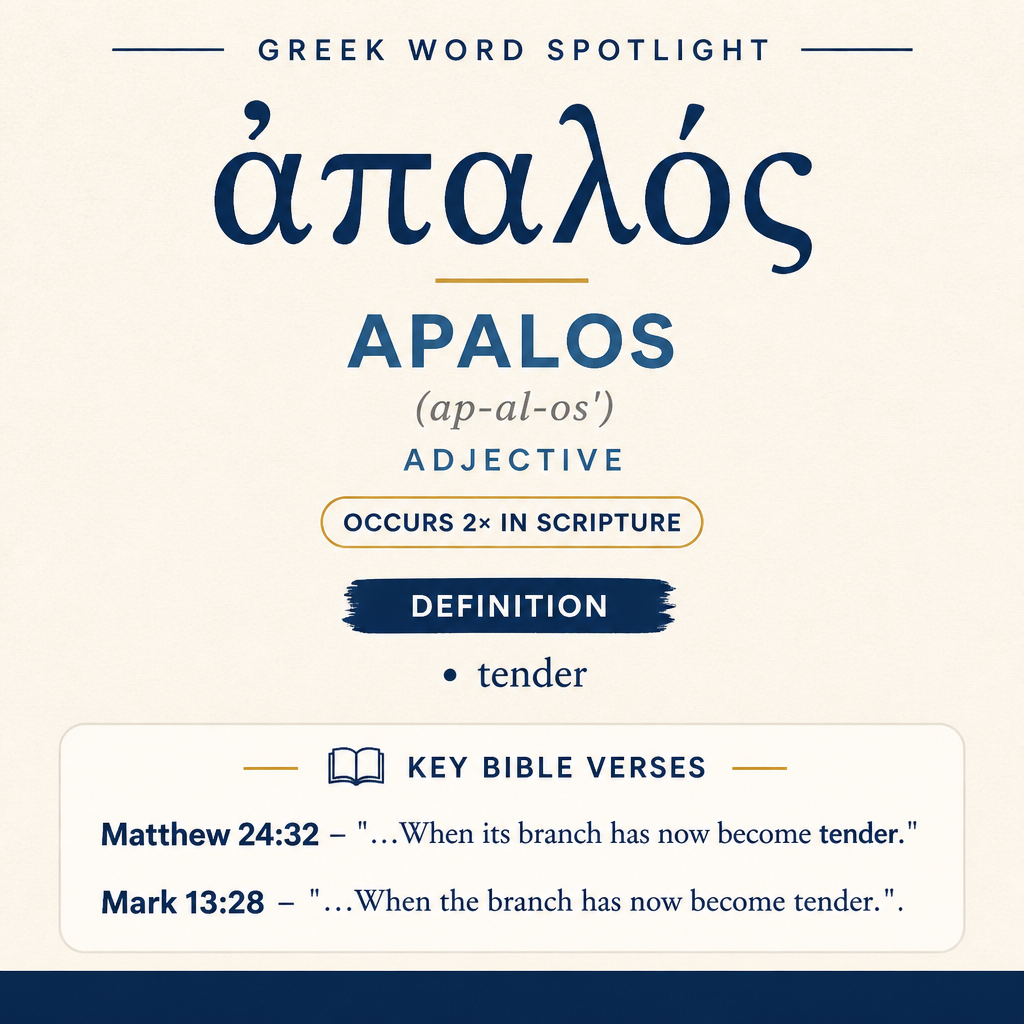
ἁπαλός (Apalos) means “tender” and appears twice in Scripture, in Matthew 24:32 and Mark 13:28.
Context in Verses
Both verses use it of a fig tree branch becoming tender and producing leaves in a parable.
Learn More →ἁπαλός means “tender” and appears in Jesus’ fig-tree illustration in Matthew 24:32 and Mark 13:28. In both places it describes a seasonal change in a branch that serves as an observable sign that another change is near.
Occurrences
“Now from the fig tree learn this parable. When its branch has now become tender, and produces its leaves, you know that the summer is near.” (Matthew 24:32)
Here ἁπαλός belongs to a compact sequence of cues: a branch “has now become tender,” it “produces its leaves,” and from that combined picture “you know that the summer is near.” The adjective marks a particular condition of the branch at a particular moment—“has now become tender”—and so it frames the leafing-out as something that happens in a recognizable stage rather than at random. In the wording of the saying, tenderness is not the final result but part of the transition: the branch reaches a state in which new leaves are produced. That makes “tender” function as an intermediate, visible indicator that connects the present appearance of the tree with the inference drawn (“the summer is near”).
Because the instruction begins, “learn this parable,” the scene asks the listener to treat the fig tree as a worked example. The branch is singled out (“its branch”), and ἁπαλός makes that branch’s condition the key feature to observe. The adjective therefore contributes concreteness: it directs attention to something one can actually notice about a branch as seasons change, and it grounds the conclusion (“you know…”) in a physical observation rather than in speculation.
“Now from the fig tree, learn this parable. When the branch has now become tender, and produces its leaves, you know that the summer is near;” (Mark 13:28)
Mark’s form parallels Matthew’s, with the same movement from observation to recognition. Here the focus is “the branch” (without the possessive “its” in the quote), but ἁπαλός still supplies the defining trait of the branch at the decisive moment: “has now become tender.” The adjective again stands beside the appearance of leaves, and together they establish the basis for knowledge: the onlooker “know[s] that the summer is near.”
Within the sentence’s grammar, “has now become tender” presents tenderness as something arrived at—an attained condition. That nuance matters for the picture: the branch is not described merely as “tender” in the abstract, but as newly tender in a way that corresponds with the onset of leaf production. In Mark’s version, the listener is likewise instructed to “learn this parable” from the fig tree; tenderness serves the parable by marking a reliable, repeatable stage in the tree’s cycle that can be correlated with what follows (“the summer is near”).

Sense and Usage
Across its two Gospel occurrences, ἁπαλός is used in a tightly defined observational context: the branch of a fig tree, at the point of seasonal change, is characterized as “tender.” The adjective does not stand alone; it is coordinated with a second sign—“produces its leaves”—so that tenderness is part of a paired description of what one sees. In both sentences, the point of describing the branch as tender is not botanical description for its own sake, but the logic of inference: when this condition is present, one can recognize that something else is “near.”
The placement of ἁπαλός also gives it a role in time-marking. Both sayings use “now” and “has now become,” presenting tenderness as something that begins to be true at a certain point. That temporal framing means “tender” functions like a threshold description: the branch reaches a condition that corresponds with leafing. The language makes tenderness a sign of transition rather than a permanent trait, fitting the parable’s emphasis on knowing that a change of season is approaching.
In these contexts, ἁπαλός is applied not to the whole tree but specifically to the branch. That specificity narrows the observation to a part of the plant where change becomes evident. A branch that “has now become tender” is implicitly contrasted with how it was before this change; the adjective thus signals the onset of new growth conditions, which is immediately confirmed by the production of leaves. The hearer is invited to connect this seen condition with a conclusion about what is near, and so “tender” serves as a concrete, sensory detail that supports the act of “knowing” in the saying.
Because the same phrase structure appears in both Matthew and Mark, the usage is stable: ἁπαλός belongs to the stock imagery of the fig-tree illustration. It is part of a cause-and-effect pattern within the sentence: when the branch becomes tender and produces leaves, the observer knows summer is near. The adjective is therefore integrated into the parable’s reasoning, supplying one of the observable premises that lead to the stated conclusion.
Fig-Tree Imagery
In both passages, the tenderness of the branch is bound to the appearance of leaves and to the nearness of summer. The adjective paints the branch at the moment when it is poised for visible growth, making the tree’s change something one can watch and learn from: the branch’s tender condition and the leaves together announce that what follows is close at hand.
Sources: Lexical data from Strong’s Exhaustive Concordance and the Translators Brief Lexicon of Extended Strongs for Greek (STEPBible, CC BY). Occurrence data from the Translators Amalgamated Greek New Testament (STEPBible, CC BY). Scripture quotations from the World English Bible (public domain).




